DND Mean in Texting: What Does DND Mean?

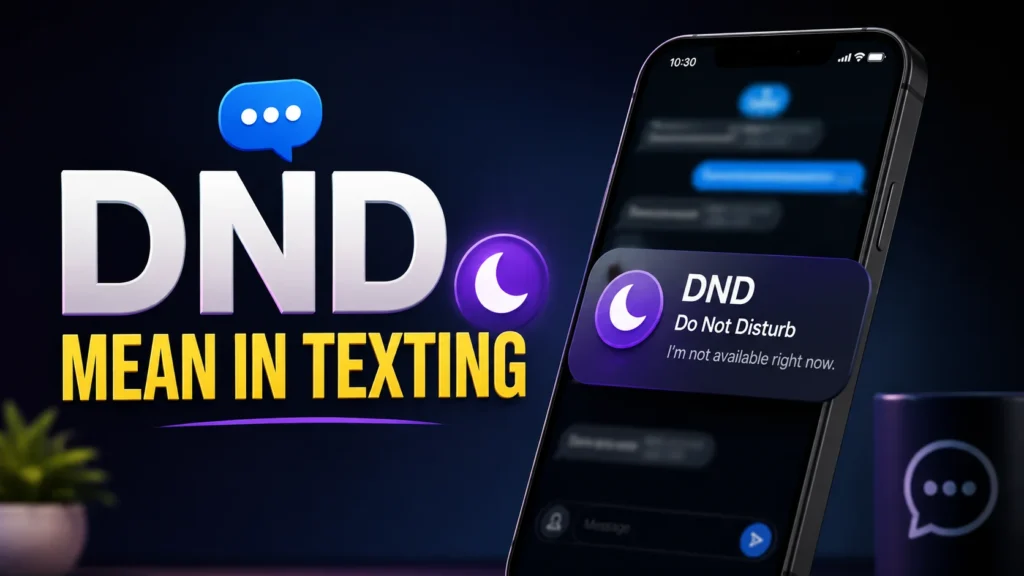
If someone texts you “DND rn” or you notice DND next to a person’s phone status, you may wonder what it means. In texting, DND usually means “Do Not Disturb.”
People use DND to let others know they are unavailable, busy, focusing on something, sleeping, studying, working, or simply taking a break from notifications.
Understanding the DND meaning in texting is useful because the abbreviation can communicate more than just “I’m busy.” Depending on the situation, it can also signal that someone wants privacy or does not want to be interrupted.
DND Mean in Texting – Quick Meaning
DND means “Do Not Disturb” in texting and online communication.
It is commonly used when someone does not want to receive interruptions or respond immediately.
For example:
- “I’m on DND rn.” = “I have Do Not Disturb turned on right now.”
- “DND, I’m studying.” = “Please don’t disturb me because I’m studying.”
- “Going DND for the night.” = “I’m going to stop responding for the night.”
- “Sorry, I was on DND.” = “Sorry, I didn’t see or respond to your messages because Do Not Disturb was enabled.”
The exact tone depends on the relationship and context.
What Does DND Stand For in Texting?
DND stands for “Do Not Disturb.”
The phrase originally describes a request not to interrupt someone. With smartphones and messaging apps, it has become closely associated with notification settings.
When a person says they are “on DND,” they may mean their phone is configured to silence notifications. They may still receive messages, but they might not see alerts immediately.
In casual texting, DND can therefore mean either the literal phone setting or the broader idea of being unavailable.
Origin and Background of DND
The phrase “Do Not Disturb” existed long before smartphones. It was traditionally used on signs, doors, offices, hotel rooms, and other places where someone wanted uninterrupted time.
Digital communication gave the phrase a new role.
As mobile phones became central to everyday communication, operating systems introduced features that allow users to silence calls, alerts, and notifications. “Do Not Disturb” became a familiar digital expression.
Today, DND appears in conversations about studying, sleeping, working, gaming, traveling, relaxing, and taking breaks from social media.
Social media and texting culture have also shortened the phrase into the abbreviation DND because short expressions are faster to type and easy to understand.
Real-Life Conversations
WhatsApp Conversation
Person A: Are you coming online tonight?
Person B: Probably not. DND, I have an exam tomorrow.
Person A: Got it. Good luck!
Here, DND politely communicates that Person B does not want interruptions.
Instagram DM
Person A: Why didn’t you reply to my messages?
Person B: Sorry 😭 I was on DND all afternoon.
Person A: Ohh okay, no worries.
In this example, DND explains why the person did not immediately notice the messages.
Text Message
Person A: Can I call you?
Person B: Not right now, I’m on DND.
Person A: Sure, text me when you’re free.
The abbreviation creates a clear boundary without sounding unnecessarily formal.
TikTok Comment
Person A: Bro why are you ignoring everyone?
Person B: DND mode 😂 I needed a break.
Here, DND is used more casually and humorously.
Emotional and Psychological Meaning of DND
Although DND is technically associated with notifications, its emotional meaning can be broader.
Someone using DND may be trying to protect their attention. Constant messages, calls, and notifications can make it difficult to concentrate or relax.
For some people, saying “I’m on DND” is a simple way to establish a healthy communication boundary.
It can also prevent misunderstandings. Instead of leaving someone wondering why they have not received a response, the person can explain that they are temporarily unavailable.
For example, imagine a student preparing for an important exam. Their friends keep sending messages while they are studying. Turning on DND gives them uninterrupted time without requiring them to respond to every notification.
That small setting can make communication feel less demanding.
Usage in Different Contexts
DND on Social Media
People may use DND when taking a break from Instagram, TikTok, Snapchat, or other platforms.
Examples include:
“Going DND for a few hours.”
“DND tonight, I need some sleep.”
“I’m on DND, don’t spam me 😂.”
The tone is usually casual.
DND With Friends
Among friends, DND can be a straightforward way to say that someone is unavailable.
“I’m studying rn, DND.”
Friends will generally understand that the person wants some uninterrupted time.
DND in Relationships
In romantic relationships, context becomes more important.
If someone regularly says “DND” without explanation, their partner might interpret it as emotional distance. However, if they normally communicate clearly, it may simply mean they need personal time.
A healthier approach is to combine DND with a brief explanation:
“I’m going DND for a couple hours. I’ll text you later.”
This makes the boundary clearer.
DND at Work
DND is common in professional communication, especially when someone is concentrating on a task or attending a meeting.
However, workplace communication should usually be clearer than casual texting.
Instead of simply writing “DND,” you could say:
“I’m unavailable for the next hour and will respond afterward.”
Casual vs. Serious Tone
DND is generally casual.
It works well in texts, group chats, gaming communities, and social media conversations. In formal communication, writing the complete phrase or giving a specific availability window is usually more professional.
When Not to Use DND
In Formal Messages Without Explanation
Simply writing “DND” to a manager, client, teacher, or professional contact may seem abrupt.
A clearer message would be:
“I’m unavailable until 3 PM and will respond afterward.”
When Someone Needs an Urgent Response
DND should not be used as an excuse to ignore an important situation indefinitely.
If you know someone may need you urgently, tell them when you will be available again.
When the Meaning Is Unclear
Not everyone knows internet abbreviations.
If you are talking to someone unfamiliar with texting slang, write “Do Not Disturb” instead.
In Sensitive Conversations
If someone is discussing an emotional or serious issue, simply responding “DND” can sound dismissive.
A more considerate response might be:
“I can’t talk right now, but I’ll check in with you later.”
Common Misunderstandings About DND
DND Does Not Always Mean “I’m Ignoring You”
A person may genuinely have notifications silenced. They may not even know that you contacted them.
DND Does Not Automatically Mean Someone Is Angry
Some people activate DND every night, during work, while studying, or whenever they need concentration.
DND Does Not Always Mean No Messages
DND usually refers to limiting interruptions or notifications. A person can still receive messages while DND is active.
DND Can Be Figurative
Someone may say “I’m on DND” even when they simply mean they are unavailable or taking a break.
DND Compared With Similar Expressions
| Expression | Meaning | Typical Tone |
|---|---|---|
| DND | Do Not Disturb | Casual |
| BRB | Be Right Back | Casual |
| AFK | Away From Keyboard | Gaming/digital |
| Busy | Currently unavailable | Neutral |
| Offline | Not currently active | Neutral |
| Can’t talk | Unable to communicate | Direct |
| Leave me alone | Wants no interaction | Strong |
| TTYL | Talk To You Later | Friendly |
Key Insight
DND is mainly about uninterrupted time, while expressions such as BRB and TTYL focus more directly on when communication will continue.
Variations and Types of DND
1. DND Mode
Refers to having the Do Not Disturb setting activated.
2. On DND
Means the person currently has DND enabled or is intentionally unavailable.
3. Going DND
Means someone is about to become unavailable.
4. DND RN
“RN” means “right now,” so this means the person is currently unavailable.
5. DND Tonight
Usually means the person does not want notifications or interruptions during the evening or night.
6. DND for a While
Indicates a temporary period of being unavailable.
7. DND at Work
Usually means the person wants uninterrupted concentration during work hours.
8. DND While Studying
Signals that the person wants to focus on studying without distractions.
9. DND Mode Activated
A playful way to announce that someone is intentionally disconnecting.
10. Full DND
An informal expression suggesting that someone wants complete uninterrupted time.
How to Respond When Someone Uses DND
Casual Replies
- “Got it!”
- “No worries.”
- “Okay, text me later.”
- “All good.”
Funny Replies
- “DND boss has spoken 😂”
- “Okay, I’ll stop disturbing you 😭”
- “Entering silent mode, understood 😂”
Mature Replies
- “Sure, take your time.”
- “No problem. Reach out when you’re available.”
- “I understand. Hope everything goes well.”
Respectful Replies
- “Of course, I’ll give you some space.”
- “No worries. We can talk later.”
- “Take the time you need.”
The best response usually respects the person’s boundary instead of repeatedly asking why they are unavailable.
Regional and Cultural Usage
Western Culture
In the United States, Canada, the United Kingdom, and other English-speaking regions, DND is widely understood in digital communication.
It is particularly common among younger people who regularly use smartphone notification settings.
Asian Culture
In Asian online communities, DND is also widely recognized, especially among younger users who communicate through messaging apps and social platforms.
The exact level of familiarity can vary depending on age and digital habits.
Middle Eastern Culture
English texting abbreviations are frequently mixed with local languages in online communication. DND may therefore appear alongside Arabic or other languages in informal chats.
Its basic meaning remains “Do Not Disturb.”
Global Internet Usage
Because smartphone interfaces commonly use the phrase “Do Not Disturb,” DND has become increasingly recognizable worldwide.
The abbreviation can cross language boundaries because the setting itself is familiar.
Gen Z vs. Millennials
Gen Z users may use DND casually as part of internet slang:
“DND rn, I’m locked in.”
Millennials may also use it, particularly when referring to the actual phone setting:
“I had my phone on DND during the meeting.”
The difference is often about tone rather than meaning.
Is DND Safe for Kids?
Yes, DND itself is not harmful or inappropriate. It is simply an abbreviation for “Do Not Disturb” and a normal phone feature.
Children and teenagers may use it when studying, sleeping, or taking a break from notifications.
Parents should focus more on the context than the abbreviation itself. If a child frequently uses DND to avoid communication, it may be worth having an open conversation about why.
The word DND alone is not a warning sign.
FAQs About DND Mean in Texting
What does DND mean in texting?
DND usually means “Do Not Disturb.” It indicates that someone does not want interruptions or may not respond immediately.
What does DND mean in a text message?
In a text message, DND can mean that the person has Do Not Disturb enabled or that they are simply unavailable for communication.
What does “I’m on DND” mean?
“I’m on DND” usually means the person has activated Do Not Disturb and may not see or respond to notifications right away.
Does DND mean someone is ignoring you?
Not necessarily. DND usually means the person is unavailable or has notifications silenced. It does not automatically mean they are intentionally ignoring you.
Is DND slang?
DND is better described as a common digital abbreviation than traditional slang. It is widely used in texting and online communication.
What does DND mean on social media?
On social media, DND generally means “Do Not Disturb.” Someone may use it to announce that they are taking a break from messages or notifications.
How should I respond to “DND”?
A simple response such as “No worries, text me when you’re free” is usually appropriate. Respecting the person’s request for uninterrupted time is the safest approach.
Conclusion
The DND meaning in texting is simple: “Do Not Disturb.”
Depending on the conversation, it can refer to an actual phone setting or simply communicate that someone is unavailable and does not want interruptions.
You may see DND in WhatsApp messages, Instagram DMs, TikTok comments, group chats, gaming conversations, and everyday text messages.
The most important thing is context. “DND rn” from a friend may simply mean they are studying, sleeping, working, or taking a break. It does not automatically mean they are angry or deliberately ignoring you.
Once you understand the meaning, responding is easy. Give the person some space, avoid unnecessary follow-up messages, and let them return when they are ready.