WYF Mean in Text: What Does WYF Mean?

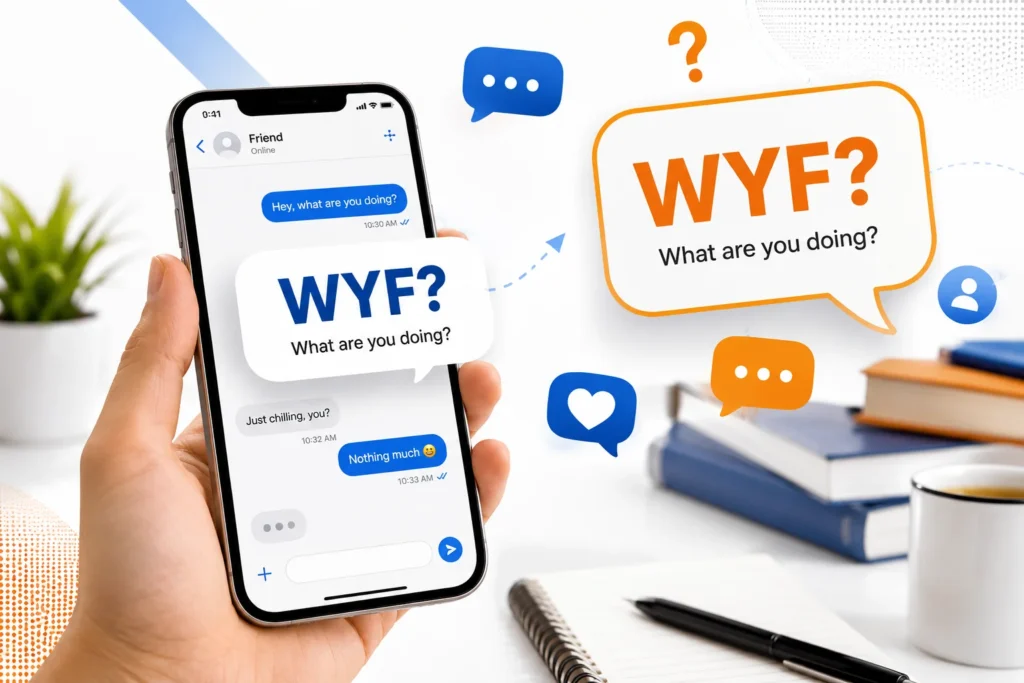
If someone sends you “WYF?” in a text message, Instagram DM, Snapchat chat, or TikTok conversation, you may wonder what the abbreviation means. WYF usually means “Where You From?” It is a casual way of asking someone about their hometown, city, country, or general background.
The phrase is especially common in informal online conversations. Instead of typing the full question, people shorten it to WYF to make their messages quicker and more relaxed.
Understanding WYF mean in text is useful because the abbreviation can appear in many different conversations. A stranger may use it to start a conversation, while a friend may ask it simply out of curiosity.
The exact tone depends on the relationship between the people talking. In most situations, WYF is friendly and conversational rather than formal.
WYF Mean in Text – Quick Meaning
WYF means “Where You From?” in most texting and social media conversations.
It can refer to:
- Your city or town
- Your state or province
- Your country
- Your hometown
- Your cultural or regional background
For example:
“Hey, WYF?”
You might respond:
“I’m from Lahore. WYF?”
Another example is:
“Your accent sounds different. WYF?”
Here, the person is asking where you are from.
Simple Definition of WYF
In everyday digital communication, WYF is an informal abbreviation for “Where You From?” It is primarily used to ask about someone’s location or background.
The phrase is similar to saying “Where are you from?” in standard English, but it feels shorter and more casual.
Origin & Background of WYF
The abbreviation WYF developed from the broader culture of internet slang and text messaging. People began shortening common questions to save typing time and make conversations feel more casual.
Similar abbreviations include WYA for “Where You At?”, WYD for “What You Doing?”, and HBU for “How About You?”
Social media platforms have helped these shortened expressions become part of everyday digital communication. Messaging apps, comments, and direct messages all encourage quick exchanges.
WYF is particularly useful when someone wants to learn where another person is from without making the question sound overly formal.
How Social Media Changed WYF
Platforms such as Instagram, Snapchat, TikTok, and messaging apps have made abbreviations more visible across different age groups and countries.
A person might discover WYF through a comment and then use it in their own conversations without ever learning the full phrase formally.
Its meaning remains simple, but the social context can change. A friendly “WYF?” can be an icebreaker, while the same abbreviation from a stranger may feel more personal.
WYF in Real-Life Conversations
WhatsApp Conversation
Person A: Hey! I don’t think we’ve talked before. WYF?
Person B: I’m from Islamabad. You?
Person A: Karachi! Nice to meet you.
Here, WYF works as a simple conversation starter.
Instagram DM
Person A: Your travel photos are amazing!
Person B: Thank you! 😊
Person A: WYF btw?
Person B: I’m from Pakistan, but I live in Dubai now.
The question helps the conversation move from a compliment toward getting to know each other.
TikTok Comments
Person A: Your accent is so cool.
Person B: Haha thanks!
Person A: WYF?
Person B: Manchester, UK.
On TikTok, WYF can appear as a short comment asking about someone’s background.
Text Message
Person A: I just moved here last month.
Person B: Oh nice! WYF originally?
Person A: I’m originally from Multan.
The word originally makes it clear that the person is asking about the person’s hometown or previous location.
Emotional & Psychological Meaning of WYF
At first glance, WYF looks like a simple abbreviation. In conversation, it can carry a little more social meaning.
People often ask “Where you from?” because location can create an immediate connection. Discovering that someone comes from the same city, country, or region can give people something familiar to discuss.
It can also be an icebreaker. When two people do not know much about each other, asking where someone is from is an easy way to continue the conversation.
Why People Use WYF
People may use WYF because they want to:
- Start a conversation
- Learn someone’s background
- Find common ground
- Show casual curiosity
- Continue a new online friendship
- Understand someone’s accent or location
Imagine joining a new online community and chatting with someone who seems interesting. Instead of asking a long formal question, they might simply type “WYF?” The short wording makes the interaction feel relaxed.
WYF in Different Contexts
WYF on Social Media
On social media, WYF is commonly used in comments, captions, and direct messages.
Someone might see your profile, notice your accent, or recognize a familiar location in your photos and ask “WYF?”
The tone is generally casual.
WYF Between Friends
Friends may use WYF when talking to someone they recently met or when discussing different places.
For example:
“WYF originally? I thought you were from London.”
The question may lead to a longer conversation about childhood, travel, family, or culture.
WYF in Romantic Conversations
In dating or flirting contexts, WYF can be an early getting-to-know-you question.
Someone may ask:
“Hey, WYF?”
It does not automatically mean romantic interest. Context matters, especially when the conversation starts on a dating or social platform.
WYF at Work
WYF is usually too informal for professional communication.
In an email, interview, business proposal, or formal workplace message, use “Where are you from?” or a more specific question instead.
For example:
“What city are you based in?”
That sounds clearer and more professional.
Casual vs. Serious Tone
WYF almost always belongs to casual communication.
It can sound friendly, curious, or conversational. If the subject involves sensitive personal information, however, the abbreviation may feel intrusive.
When NOT to Use WYF
Although WYF is common online, it is not suitable for every situation.
Avoid using it in formal emails, academic writing, professional reports, or official communication.
You should also be careful when asking strangers about personal background. Some people may prefer not to share their location or nationality online.
Cultural Sensitivity
The question “Where are you from?” can have different meanings depending on context.
If someone has already answered with their current city, repeatedly asking where they are “really” from can make the conversation uncomfortable.
A respectful approach is to accept the answer they provide.
Privacy Concerns
When communicating with strangers online, remember that location information can be personal.
There is a major difference between saying:
“I’m from Canada.”
and sharing:
“I live at 123 Example Street.”
Using WYF does not mean someone is required to reveal private location details.
Common Misunderstandings About WYF
WYF Does Not Usually Mean “Where Are You?”
One common mistake is confusing WYF with WYA.
WYA generally means “Where You At?”, which usually asks about someone’s current location.
WYF usually asks about someone’s origin or background.
WYF Is Not Always Flirting
If someone sends “WYF?”, it does not automatically mean they are interested romantically.
It may simply be a conversation starter.
The surrounding messages are more important than the abbreviation itself.
WYF Can Have Different Meanings
Acronyms can sometimes have multiple meanings in different communities. In ordinary texting and social media slang, however, “Where You From?” is the common interpretation.
If the surrounding conversation seems unusual, consider the context before assuming the meaning.
WYF Comparison Table
| Expression | Meaning | Typical Use |
|---|---|---|
| WYF | Where You From? | Asking about someone’s origin |
| WYA | Where You At? | Asking someone’s current location |
| WYD | What You Doing? | Asking what someone is doing |
| HBU | How About You? | Returning a question |
| HMU | Hit Me Up | Asking someone to contact you |
| IDK | I Don’t Know | Expressing uncertainty |
| WBU | What About You? | Asking for the other person’s answer |
Key Insight
The easiest way to remember the difference is simple: WYF asks about where someone is from, while WYA usually asks where someone is right now.
Variations and Related Forms of WYF
1. WYF?
This is the shortest form and usually means “Where You From?”
Example: “You seem familiar. WYF?”
2. WYF From?
This version is sometimes used informally, although it is grammatically repetitive.
Example: “Hey, WYF from?”
3. Where You From?
This is the full casual phrase behind the abbreviation.
Example: “Where you from? Your accent is interesting.”
4. Where Are You From?
This is the grammatically standard version.
Example: “Where are you from?”
5. WYF Originally?
This asks about someone’s original hometown or place of origin.
Example: “I live in Toronto now. WYF originally?”
6. WYF BTW?
Adding BTW, meaning “by the way,” makes the question sound like a casual side question.
Example: “Your profile is cool. WYF btw?”
7. WYF Bro?
This adds a friendly, informal tone.
Example: “WYF bro? I haven’t seen you around here before.”
8. WYF Girl?
This is another highly casual variation that may appear between young people or online acquaintances.
Example: “Your style is amazing. WYF girl?”
9. WYF Originally From?
This version emphasizes someone’s original location.
Example: “You live in New York now, but WYF originally from?”
10. WYF Country?
This specifically asks which country someone is from.
Example: “WYF country? I can’t recognize the accent.”
How to Respond When Someone Uses WYF
Your response depends on how comfortable you are with the person.
Casual Replies
- “I’m from Pakistan. You?”
- “Lahore! WYF?”
- “Originally from Karachi.”
- “I’m from the UK. What about you?”
Funny Replies
- “Earth 😂”
- “Somewhere on Google Maps.”
- “Classified information 😂”
- “Why, are you planning a visit?”
Funny answers work best when the conversation already has a playful tone.
Mature Replies
- “I’m originally from Islamabad, although I live in Dubai now.”
- “I’m from Canada. Where are you from?”
- “I grew up in Lahore.”
These answers provide enough context without oversharing.
Respectful Replies
If you do not want to reveal your location, you can simply say:
“I prefer not to share that online.”
You do not owe a stranger detailed personal information.
Regional & Cultural Usage of WYF
Western Culture
In many Western online communities, WYF is generally understood as a casual question about someone’s hometown, state, or country.
It is often used between people who have recently connected online.
Asian Culture
Across Asian online communities, the phrase can also be used as an informal icebreaker.
People may respond with a city, country, province, or region depending on what they believe the other person is asking.
Middle Eastern Culture
In Middle Eastern online conversations, people may use similar wording to ask about nationality, hometown, or family background.
The appropriate response depends heavily on the relationship and cultural context.
Global Internet Usage
Internet slang crosses borders quickly. Someone in one country may use WYF with a person from another country without thinking about the cultural differences behind the question.
That makes context especially important.
Gen Z vs. Millennials
Gen Z users are generally more accustomed to abbreviations across social platforms, comments, and DMs.
Millennials may understand WYF easily but may use the full phrase more frequently, particularly in professional or mixed-age conversations.
The difference is not absolute. Personal communication style matters more than age alone.
Is WYF Safe for Kids?
WYF is not inherently harmful. It is simply an informal abbreviation for asking where someone is from.
The important issue is context.
Children and teenagers should understand that they do not need to share their exact address, school location, phone number, or other private information with strangers online.
A safe answer can be general, such as a country or broad region, rather than a precise location.
Parents and educators can use abbreviations like WYF as an opportunity to teach young users about online privacy and responsible communication.
FAQs About WYF Mean in Text
What does WYF mean in text?
WYF usually means “Where You From?” It is an informal texting abbreviation used to ask about someone’s hometown, city, country, or background.
What does WYF mean on Instagram?
On Instagram, WYF usually means “Where You From?” Someone may use it in a comment or DM as a casual conversation starter.
What does WYF mean on Snapchat?
On Snapchat, WYF generally means “Where You From?” It is commonly used when someone wants to know another person’s location or background.
Is WYF a slang word?
Yes. WYF is an informal internet abbreviation rather than a standard English expression. It is mainly used in texting and social media conversations.
What is the difference between WYF and WYA?
WYF means “Where You From?”, while WYA means “Where You At?” WYF usually asks about origin or background, whereas WYA usually asks about someone’s current location.
Is WYF rude?
Usually, WYF is not rude. It is a casual question, although asking strangers about their background or location can feel personal in some situations.
How should I reply to WYF?
You can answer with a general location, such as “I’m from Pakistan” or “I’m from London.” If you are uncomfortable sharing, you can politely decline.
Conclusion
Understanding WYF mean in text is simple once you know the context. In most texting, Instagram, Snapchat, and social media conversations, WYF means “Where You From?”
It is usually a friendly way to start a conversation and learn about someone’s background.
The most important thing is to pay attention to the situation. With friends or online acquaintances, WYF can sound relaxed and natural. In professional communication, the full phrase is usually a better choice.
Remember the simple distinction: WYF asks where someone is from, while WYA generally asks where someone is now.
Once you understand that difference, you can recognize and use WYF confidently without getting confused by modern texting slang.