PU Meaning in Text: What Does PU Mean in Texting?

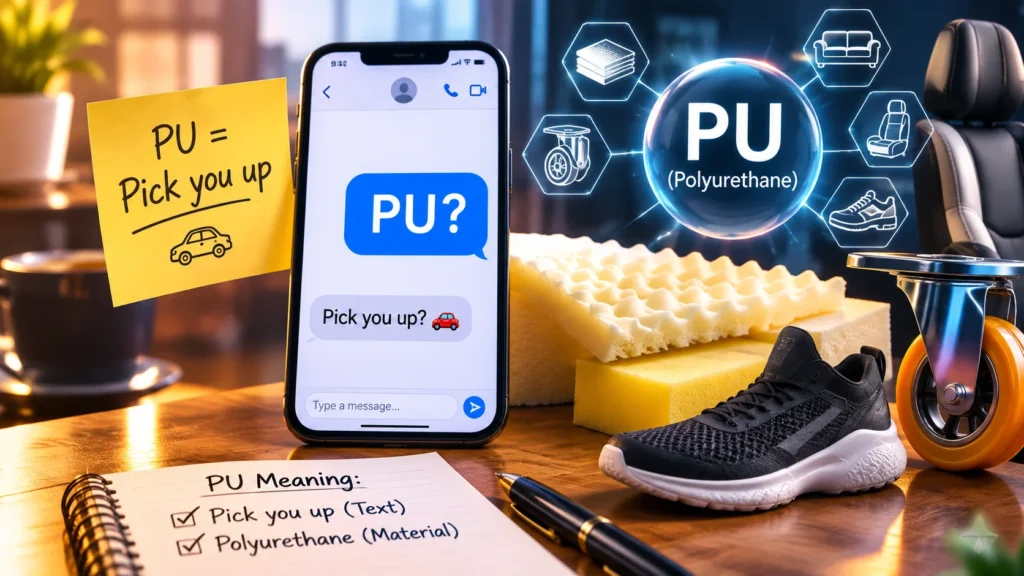
If you searched for PU meaning in text, you may have come across this short abbreviation in a text message, WhatsApp chat, Instagram DM, Snapchat conversation, or social media comment.
The tricky part is that PU does not have one fixed meaning in every conversation. Its interpretation depends on the words around it, the relationship between the people chatting, and the platform where it appears.
In everyday texting, PU can mean “pick up,” especially when someone is talking about answering a phone, collecting an item, or picking up another person. In other situations, PU can have completely different meanings.
Knowing the context is therefore essential. Instead of treating PU as a single definition, think of it as a flexible abbreviation whose meaning changes with the conversation.
This guide explains PU meaning in text, its common uses, examples, slang interpretations, variations, misunderstandings, and the best ways to respond when someone sends it.
PU Meaning in Text – Quick Answer
The most common meaning of PU in text is “pick up.”
It can refer to:
- Pick up the phone — answer a call.
- Pick me up — come and collect someone.
- Pick up an item — collect something from a location.
- Pick up something later — collect something at a later time.
For example:
“Can you PU me at 7?”
Here, PU means “pick up.”
Another example is:
“Why didn’t you PU?”
In this context, the sender probably means “Why didn’t you pick up?”, usually referring to a phone call.
What Does PU Mean in Texting?
When someone uses PU in texting, the surrounding words usually reveal the intended meaning.
If the conversation involves a phone call, PU may mean “pick up the phone.”
If the conversation involves transportation, it may mean “pick me up.”
If the discussion involves shopping, deliveries, or belongings, it may mean “pick up” an item.
For example:
“Can you PU the parcel?”
This means:
“Can you pick up the parcel?”
The abbreviation saves time without changing the basic meaning.
PU Meaning in Chat
In casual chat, PU is useful because people often shorten familiar phrases.
Friends who communicate frequently may use abbreviations without explaining them.
Consider this conversation:
Person A: “I’m waiting outside.”
Person B: “Okay, I’ll PU you.”
The meaning is naturally understood as “I’ll pick you up.”
In another conversation:
Person A: “I called you three times.”
Person B: “Sorry, I was busy.”
Person A: “You could’ve PU.”
Here, PU means “picked up” or “pick up,” depending on the exact sentence.
PU Meaning on Social Media
The PU meaning on social media can be less predictable.
Instagram, TikTok, Snapchat, Facebook, and other platforms contain different communities with their own slang and abbreviations.
A person might use PU as a shortened phrase, while another user may use the same letters with a completely different meaning.
This is why social media slang should always be interpreted through context.
Look at:
- The entire sentence
- The previous messages
- Emojis
- The topic of discussion
- The relationship between the users
- The platform or community
These clues can help you determine what PU means in a particular post or conversation.
PU Meaning in WhatsApp
WhatsApp conversations are usually informal, so abbreviations such as PU can appear naturally.
For example:
Person A: “Are you coming?”
Person B: “Yeah. Can you PU me?”
Person A: “Sure, what time?”
Here, PU me clearly means “pick me up.”
Another example:
Person A: “I called you.”
Person B: “Sorry! I didn’t PU because I was driving.”
The intended meaning is “pick up the call.”
The exact grammar may be informal, but the meaning is easy to understand from context.
Real-Life Conversations Using PU
WhatsApp Example
Person A: “Can you PU me after class?”
Person B: “Sure. I’ll be there around 4.”
Person A: “Perfect, thanks!”
In this conversation, PU means “pick up.”
Instagram DM Example
Person A: “Hey, did you see my call?”
Person B: “No 😭 I was away from my phone.”
Person A: “I needed you to PU!”
Person B: “Sorry 😂 Call me again.”
Here, PU refers to picking up a phone call.
Text Message Example
Person A: “Can you PU the groceries?”
Person B: “Yeah, I’ll get them on my way home.”
The abbreviation means “pick up.”
Casual Chat Example
Person A: “I’ll PU you at 8.”
Person B: “Okay, see you then!”
In this context, PU means “pick you up.”
Emotional and Psychological Meaning of PU
The abbreviation PU itself does not usually express a specific emotion.
Its emotional tone comes from the surrounding conversation.
For example, “PU!” may sound impatient when someone is repeatedly calling another person.
“Can you PU me?” usually sounds practical and casual.
“I’ll PU you ❤️” can feel caring because the complete message communicates consideration and support.
This demonstrates an important feature of digital communication: short abbreviations often borrow their emotional meaning from context.
People do not communicate through words alone. Timing, punctuation, emojis, previous messages, and relationships all influence how a short abbreviation feels.
Why Do People Use PU Instead of Pick Up?
People use PU because texting is designed around speed and convenience.
Short abbreviations allow users to communicate quickly without typing every word.
This is particularly common among friends, couples, classmates, and people who message frequently.
There is also a social element. Digital communication has developed its own informal vocabulary, including expressions such as:
- LOL
- BTW
- IDK
- BRB
- FYI
- TTYL
- PU
Not every abbreviation is equally common, but the principle is the same: familiar phrases can be shortened when the context is obvious.
PU in Different Contexts
PU in Friendships
Friends may use PU when arranging transportation.
“Can you PU me after dinner?”
The meaning is straightforward: “Can you pick me up?”
PU in Relationships
Couples may also use PU when making plans.
“I’ll PU you at 8 ❤️”
The phrase can feel warm and personal even though the abbreviation itself is neutral.
PU in Family Conversations
Parents, siblings, and relatives may use PU for everyday arrangements.
“Can you PU your brother from school?”
Again, the meaning is “pick up.”
PU at Work
The abbreviation is less appropriate in formal professional communication.
Instead of writing:
“Please PU the documents.”
It is clearer to write:
“Please pick up the documents.”
Professional writing should prioritize clarity over unnecessary abbreviations.
When Should You Use PU?
You can use PU when the conversation is casual and the other person is likely to understand the abbreviation.
Good situations include:
- Friends texting each other
- Family group chats
- Casual WhatsApp messages
- Informal social media conversations
- Quick transportation arrangements
- Messages about collecting items
The abbreviation works best when there is little chance of misunderstanding.
When Should You Avoid PU?
Avoid PU when clarity is especially important.
This includes:
- Formal emails
- Academic assignments
- Legal documents
- Business contracts
- Official instructions
- Customer-service communication
- Messages to unfamiliar people
For example, instead of saying:
“PU the order.”
A professional message would be:
“Please pick up the order.”
The second version is immediately understandable.
Common Misunderstandings About PU
PU Does Not Always Mean Pick Up
This is the most important point.
Although “pick up” is a common interpretation, PU can have other meanings in different environments.
Context Determines Meaning
A message such as:
“Can you PU me?”
strongly suggests transportation.
A message such as:
“Why didn’t you PU?”
may refer to answering a phone.
Abbreviations Can Be Community-Specific
A particular online group may use PU differently from another group.
Never assume that every abbreviation has one universal internet definition.
Professional Readers May Not Understand It
A casual abbreviation that makes perfect sense to friends may confuse a manager, teacher, customer, or client.
PU vs. Similar Texting Expressions
| Expression | Meaning | Common Use |
|---|---|---|
| PU | Pick up | Casual texting |
| P/U | Pick up | Informal messages |
| Pick up | Collect or answer | General communication |
| PU me | Pick me up | Transportation |
| PU the phone | Pick up the phone | Phone calls |
| BRB | Be right back | Chatting |
| BTW | By the way | Casual messages |
| IDK | I don’t know | Texting |
| FYI | For your information | Work and casual communication |
Key Insight
PU is highly context-dependent. When the conversation involves transportation, calls, or collecting something, “pick up” is usually the most natural interpretation.
Variations of PU in Text
PU Me
Usually means “pick me up.”
Example: “Can you PU me at 6?”
PU the Phone
Usually means “pick up the phone.”
Example: “PU the phone, I need to talk.”
PU the Package
Usually means “pick up the package.”
Example: “Can you PU the package today?”
PU the Kids
Usually means “pick up the kids.”
Example: “I’ll PU the kids after work.”
PU Later
Usually means “pick up later.”
Example: “I’ll PU the order later.”
PU From School
Usually means collecting someone from school.
Example: “Can you PU me from school?”
PU From Work
Usually means collecting someone from their workplace.
Example: “Can you PU me from work tonight?”
PU a Call
Refers to answering a phone call.
Example: “Why didn’t you PU my call?”
P/U
This is another written form of “pick up.”
Example: “P/U available after 5 PM.”
Pick Up
The complete phrase is the clearest alternative to PU.
Example: “Can you pick me up at 8?”
How to Respond When Someone Uses PU
Your response should depend on what the person is asking.
Casual Response
“Sure, I can PU you.”
Friendly Response
“Yep, I’ll be there!”
Funny Response
“Okay 😂 I’m coming!”
If You Are Unsure
“What do you mean by PU?”
This is the safest response when the abbreviation is unclear.
Professional Response
If someone uses PU in a workplace conversation, respond with the complete phrase:
“Sure, I can pick it up this afternoon.”
This keeps the communication clear and professional.
Regional and Cultural Usage
Western English Usage
In many English-speaking online communities, PU may be understood as a casual abbreviation for “pick up.”
The meaning is particularly obvious when transportation or phone calls are involved.
Asian Internet Communication
English abbreviations are widely incorporated into digital conversations across Asian countries.
The exact popularity of PU can vary by age, platform, and local communication habits.
Middle Eastern Digital Communication
Many users mix English abbreviations with their native language while chatting online.
As a result, PU may appear alongside Arabic or other languages, with context determining its meaning.
Global Internet Culture
Internet language is increasingly global, but slang remains highly flexible.
An abbreviation can become popular in one community without being widely recognized elsewhere.
Gen Z vs. Millennials: How PU May Be Understood
Generational differences can influence how people interpret texting abbreviations.
Gen Z users often communicate through highly compressed language, memes, emojis, and platform-specific expressions.
Millennials may be familiar with many traditional texting abbreviations but may not recognize newer or community-specific slang immediately.
Neither interpretation is automatically correct. The conversation itself provides the strongest clue.
Is PU Safe for Kids?
PU is generally harmless when used to mean “pick up.”
Parents and educators should still teach children that online abbreviations can have multiple meanings.
The letters may be harmless in one conversation and confusing in another.
Children should also understand that unfamiliar slang should not automatically be repeated simply because it appears online. Context and communication skills matter more than memorizing every abbreviation.
How to Know What PU Means
If someone sends you PU and you are unsure what they mean, use a simple process.
First, read the complete sentence.
Next, look at the previous messages.
Then, identify the topic.
If they are talking about a car, school, work, shopping, or transportation, “pick up” becomes more likely.
If they are talking about a phone call, PU may refer to answering the phone.
If the context still does not make sense, simply ask for clarification.
FAQs About PU Meaning in Text
What does PU mean in text?
PU commonly means “pick up” in casual text messages. It can refer to picking up a person, item, or phone call.
What does PU mean in texting slang?
In texting slang, PU can be a shortened form of “pick up.” The exact interpretation depends on the context.
What does PU mean when someone says “PU me”?
“PU me” usually means “pick me up.” It is commonly used when arranging transportation.
What does PU mean on WhatsApp?
On WhatsApp, PU may mean “pick up,” especially when friends or family are discussing calls, transportation, or collecting something.
What does PU mean on Instagram?
PU on Instagram can have different interpretations. When it appears in a DM, comment, or caption, the surrounding conversation should be considered before deciding what it means.
Is PU a slang word?
PU is generally better described as an abbreviation than a traditional slang word. Its informal use is especially common in casual digital communication.
Should I use PU in formal writing?
It is better to avoid PU in formal writing. Use the complete phrase, such as “pick up,” to make your meaning immediately clear.
Final Thoughts
Understanding PU meaning in text is less about memorizing a single definition and more about recognizing context.
In everyday texting, PU most commonly relates to “pick up.” It can mean picking up a person, collecting an item, or answering a phone call.
The surrounding words are what make the intended meaning clear.
If you are messaging friends or family, PU can be a convenient and natural abbreviation. In professional or formal communication, spelling out “pick up” is usually the better choice.
The next time you see PU in a text, do not immediately assume its meaning. Read the conversation around it, consider the situation, and then interpret the abbreviation. That small habit can prevent misunderstandings and make digital communication much easier.