POV Mean in Text: Ultimate Meaning & Examples

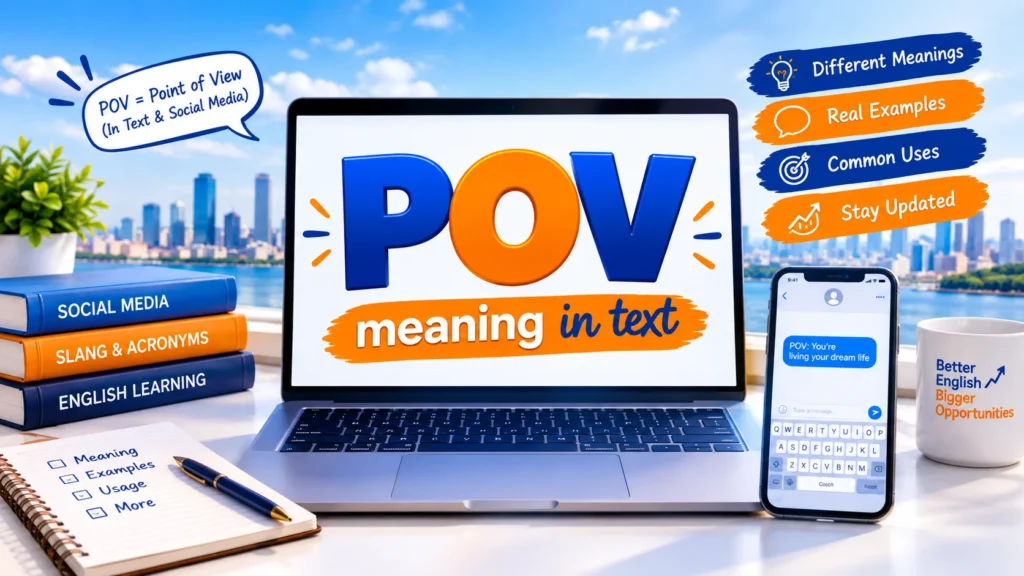
If you have seen POV in a text, TikTok caption, Instagram Reel, or meme, you may wonder what the three letters actually mean. POV mean in text is usually “Point of View,” and people use it to describe a situation from a particular person’s perspective or to invite you to imagine yourself in that situation.
The meaning is simple, but the way POV is used online can be slightly different from its traditional meaning. On social media, it often introduces a relatable scenario, joke, reaction, or imaginary situation.
What Does POV Mean in Text?
POV stands for “Point of View.” In ordinary texting, someone may use it to show that they are describing something from a specific perspective.
For example:
- “POV: You finally get home after a long day.”
- “POV, you see your old teacher at the mall.”
In both examples, the writer is asking you to imagine yourself experiencing the situation. This is why POV became especially common in memes, short videos, captions, and casual online conversations.
I’ve noticed that people rarely stop to explain POV when they use it with friends. If someone sends a meme that begins with “POV: Monday morning,” the three letters are enough to establish the joke before the rest of the message even starts.
How POV Is Used on Social Media
The popularity of POV grew alongside internet culture, particularly through memes and short-form video platforms. On TikTok, Instagram, YouTube Shorts, and similar platforms, creators often place “POV:” at the beginning of a caption or video to establish a scene that viewers are supposed to imagine themselves experiencing.
A creator might write:
“POV: Your mom calls you when you’re already outside.”
The video then acts out that situation. The viewer understands that the content is presenting a familiar scenario from a particular perspective.
Sometimes online creators use POV more loosely than its literal definition. Instead of putting the camera exactly where the viewer’s eyes would be, they may simply use the word to introduce a relatable situation.
POV Mean in Text: Different Contexts
The exact way POV mean in text works depends on where you see it. In a private message, it can introduce a hypothetical situation, while in a meme it often sets up the punchline.
| Context | How POV Is Used | Example |
|---|---|---|
| Texting | Describes a situation from a perspective | “POV: You forgot your homework.” |
| TikTok | Introduces a video scenario | “POV: Your friend says they’re five minutes away.” |
| Sets up a Reel, Story, or meme | “POV: It’s finally Friday.” | |
| Snapchat | Adds context to a snap | “POV: You’re trying not to laugh.” |
| Memes | Creates a relatable setup | “POV: The teacher says there’s a surprise test.” |
| Online comments | Refers to someone’s perspective | “POV from the back row 😂” |
The same abbreviation can therefore move between serious, funny, sarcastic, and completely casual situations without changing its basic meaning.
Real Texting Examples With POV
Imagine a friend sends you a funny video after you both complained about waking up early for work.
Maya: POV: You said you’d wake up at 6 😭
Alex: And it’s somehow 8:47
Maya: exactlyyy 😂
Here, POV introduces the situation rather than functioning as a formal abbreviation that needs explanation.
Another example might happen in a group chat when friends are discussing an awkward encounter.
Sam: POV you run into your crush looking like this 💀
Nina: delete this immediately
Sam: too late lol
The abbreviation helps frame the joke as if the reader is personally experiencing the scene.
A third example could be much simpler:
Chris: POV: you finally finish your exams
Dan: freedom 😭
Chris: literally
This use is common because POV quickly communicates the imagined situation without requiring a long explanation.
What Emotion or Intent Does POV Add?
POV itself does not automatically communicate one particular emotion. The feeling comes from the situation attached to it.
A funny scenario can make POV humorous, while a nostalgic caption can make it sentimental. For example, “POV: You hear the song you played every summer as a kid” has a completely different emotional effect from “POV: Your boss asks who broke the printer.”
Online, POV is often used to create relatability. The writer wants the reader to recognize the situation and think, “That has happened to me.”
It can also make a joke feel more immediate because the audience is placed inside the scenario rather than simply being told about it.
Common Misunderstandings About POV
One common mistake is assuming that POV must always mean the literal camera perspective. In modern social media language, that’s not necessarily the case.
For example, a TikTok may say “POV: Your best friend finally answers after three days,” even though the video isn’t technically filmed from the viewer’s exact perspective. The creator is using POV to establish the imagined scenario.
Another misunderstanding is thinking that POV only belongs to TikTok. Although short-form video culture helped make the expression extremely common, Point of View is much older and is also used in writing, photography, film, gaming, and everyday conversation.
You may also see lowercase versions such as “pov” rather than “POV.” The capitalization usually doesn’t change the meaning in casual texting.
POV vs. Similar Internet Expressions
Several expressions can perform a similar job, but they are not interchangeable in every situation.
- POV: Places the reader inside a particular perspective or scenario.
- Imagine: Directly asks someone to picture something.
- When: Often introduces a relatable situation or reaction.
- Me: Commonly presents someone’s personal reaction.
- IRL: Means “in real life” and contrasts online situations with offline ones.
For example, “POV: Your friend cancels at the last minute” frames the situation as something the viewer is experiencing. “Me when my friend cancels” instead focuses more directly on the speaker’s reaction.
How Should You Respond When Someone Uses POV?
Usually, you don’t need to respond to the abbreviation itself. Respond to the situation or joke that comes after it.
If someone sends you a funny POV meme, a reaction such as “LOL,” “that’s literally me,” or a relevant joke can keep the conversation natural. If the POV describes something that actually happened to both of you, you can respond directly to that shared experience.
For example:
Friend: POV: We said we’d only stay for one hour
You: And somehow it’s midnight 😭
The response works because it continues the scenario instead of treating POV like a formal question.
Read More: Reel Mean on Instagram: Easy Guide & Examples
Frequently Asked Questions
Does POV mean “Point of View” in texting?
Yes. In most texting and social-media contexts, POV stands for Point of View and introduces a situation from a particular perspective.
What does POV mean on TikTok?
On TikTok, POV usually introduces a scenario that viewers are encouraged to imagine themselves experiencing. It is frequently used for comedy, relatable situations, storytelling, and role-play.
Is POV slang?
POV is better described as an abbreviation than traditional slang. However, its widespread use in memes, texts, captions, and short videos has made it a familiar part of internet language.
Can POV be used in a serious message?
Yes. POV can be used seriously when discussing someone’s perspective or viewpoint, although the abbreviation is especially common in casual online communication.
Final Takeaway
Understanding POV mean in text is mostly about recognizing the perspective behind the message. It stands for Point of View, and in modern texting and social media, it commonly introduces a scenario that asks you to imagine yourself in that moment.
Whether it appears in a TikTok caption, Instagram Reel, group chat, meme, or private message, the surrounding context tells you whether the POV is meant to be funny, relatable, awkward, nostalgic, or simply descriptive.