Cap Mean in Slang: The Ultimate Meaning Guide

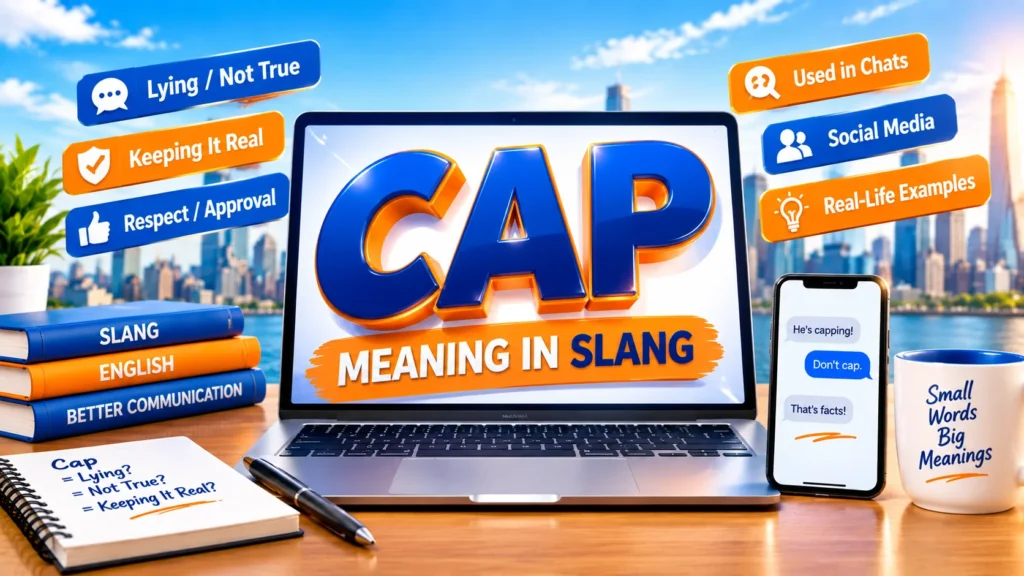
If someone texts you “that’s cap” or simply says “no cap,” they usually are not talking about a hat. In modern slang, cap is connected to lying, exaggerating, or saying something that is not true, while “no cap” means the speaker is being serious or honest.
What Does Cap Mean in Slang?
Cap mean in slang is usually “a lie,” “something untrue,” or “an exaggeration.” When someone says “You’re capping,” they mean they think you are not telling the truth.
For example:
- “You got that job without an interview? That’s cap.”
- “No cap, this is the best pizza I’ve had.”
The exact tone depends on the conversation. Among friends, calling something “cap” can be playful teasing rather than a serious accusation of lying.
How “Cap” Is Used in Everyday Texting
You will often see the word used as a short reaction because it quickly challenges something someone has said. A person might send “cap” by itself when they strongly doubt a claim.
Here are a few common forms:
| Slang Expression | Meaning | Example |
|---|---|---|
| Cap | A lie or false statement | “Bro, that’s cap.” |
| Capping | Lying or exaggerating | “Are you capping right now?” |
| No cap | Seriously; honestly | “No cap, I was shocked.” |
| Stop capping | Stop lying or exaggerating | “Stop capping, you didn’t do that.” |
| That’s cap | That isn’t true | “You finished it in five minutes? That’s cap.” |
In casual messages, “cap” is especially useful because it can communicate doubt without requiring a long explanation.
The Difference Between “Cap” and “No Cap”
These two expressions are closely connected but have opposite functions.
“Cap” suggests that someone is lying, exaggerating, or making an unbelievable claim. “No cap” tells the other person that what follows is meant sincerely.
For instance, imagine a friend says, “I ran 20 miles before breakfast.” You might respond, “Cap 😂” if you think they are exaggerating.
On the other hand, someone might say, “No cap, that concert was incredible,” to emphasize that they genuinely mean what they are saying.
A Quick Texting Example
Mia: “I won the game with one hand.”
Jay: “Cap 😭”
Mia: “I swear. Ask Daniel.”
Jay: “Okay okay, no cap then.”
Here, “cap” works as a quick way of expressing disbelief, while “no cap” changes the meaning toward honesty.
Where Did the Slang Come From?
The modern slang use of “cap” is strongly associated with African American English and later spread widely through music, social media, memes, and online conversations. Rap and hip-hop helped bring expressions such as “no cap” into mainstream internet culture, where they became common on platforms such as TikTok, Instagram, Snapchat, and X.
The history is a little more complicated than simply saying that “cap” was invented by social media. Cap has older slang history, while its modern meaning of lying or exaggerating became particularly prominent in contemporary African American speech and popular culture.
Today, the expression can appear far beyond its original communities, although people may use it with different levels of familiarity or authenticity.
Real Texting Examples of “Cap”
The easiest way to understand this slang is to see how it sounds in an actual conversation.
Example 1: Doubting a friend
Chris: “I slept for 14 hours straight.”
Nate: “Cap.”
Chris: “Nah fr 😭 my phone died too.”
Here, Nate is basically saying, “I don’t believe you.”
Example 2: Calling out an exaggeration
Sara: “He said he bought the whole store.”
Lena: “That’s cap 💀”
Sara: “Exactly. He bought like two shirts.”
In this conversation, “cap” points out that the original statement was exaggerated.
Example 3: Emphasizing honesty
Alex: “No cap, that was the hardest exam I’ve ever taken.”
Sam: “Same. Question 4 finished me.”
Here, “no cap” reinforces that Alex is speaking seriously.
What Emotion Does “Cap” Express?
The word can express disbelief, skepticism, teasing, or playful confrontation. Its emotional force usually comes from the situation rather than the word itself.
If a close friend says something obviously exaggerated, replying “cap 😂” can be lighthearted. In a more serious conversation, however, saying “you’re capping” can sound like a direct accusation that the person is lying.
I’ve noticed that the emoji often changes the feel of the message. “Cap 💀” usually sounds more playful than “That’s cap.” The first can feel like joking disbelief, while the second may sound more direct.
Common Mistakes When Using “Cap”
One of the easiest mistakes is assuming that cap always means “lie” in exactly the same way. Sometimes it refers to exaggeration, a doubtful claim, or something the speaker simply doesn’t believe.
Another mistake is confusing “cap” with “no cap.” They work in opposite directions:
- Cap = I don’t believe that / that’s not true.
- No cap = I’m being serious / I’m telling the truth.
- Capping = You’re lying or exaggerating.
- Stop capping = Stop lying or exaggerating.
It can also sound awkward when used in formal situations. “That’s cap” belongs naturally in casual chats, comments, gaming conversations, and social media—not a professional email or formal business discussion.
Cap vs. Other Modern Slang
Several expressions overlap with “cap,” but they are not always interchangeable.
“Lying” is the straightforward standard-English word, while “cap” is more casual and slang-heavy.
“Fronting” can describe pretending, exaggerating, or presenting yourself differently from reality, depending on context.
“BS” can also be used when someone thinks a statement is nonsense or untrue, but it is more direct and can sound harsher.
“For real” and “no cap” can both emphasize sincerity, although “no cap” has a stronger connection to the idea of not lying or exaggerating.
Is “Cap” Still Used in Slang?
Yes. Cap remains recognizable in online slang and casual conversation, particularly in texting, memes, gaming chats, TikTok comments, and other social-media spaces. Its popularity can vary by age group and online community, so not every speaker uses it regularly.
You may also see creative variations such as “cappin,” “capping,” “no cap,” or “stop the cap.” The spelling and punctuation can change, but the basic idea remains connected to truthfulness and exaggeration.
Read More:
Frequently Asked Questions
| Question | Answer |
|---|---|
| What does cap mean in slang? | It usually means a lie, false statement, or exaggeration. |
| What does no cap mean? | It means “seriously,” “honestly,” or “I’m not lying.” |
| What does you’re capping mean? | It means the speaker thinks you are lying or exaggerating. |
| Is cap appropriate for formal writing? | No. It is informal slang and is best suited to casual conversation and social media. |
Read More: Bet Mean in Text: What Does “Bet” Mean?
Final Thoughts on Cap in Slang
Understanding cap mean in slang becomes much easier when you remember the simple contrast: cap suggests something isn’t true, while no cap emphasizes that something is true or sincerely meant.
Whether someone writes “cap,” “you’re capping,” or “no cap,” the surrounding conversation determines how serious or playful the expression feels. In casual texting, it can be a surprisingly efficient way to call out exaggeration, express disbelief, or emphasize that you’re being completely honest.