
WYA Mean in Text: Meaning, Examples & Social Media Guide

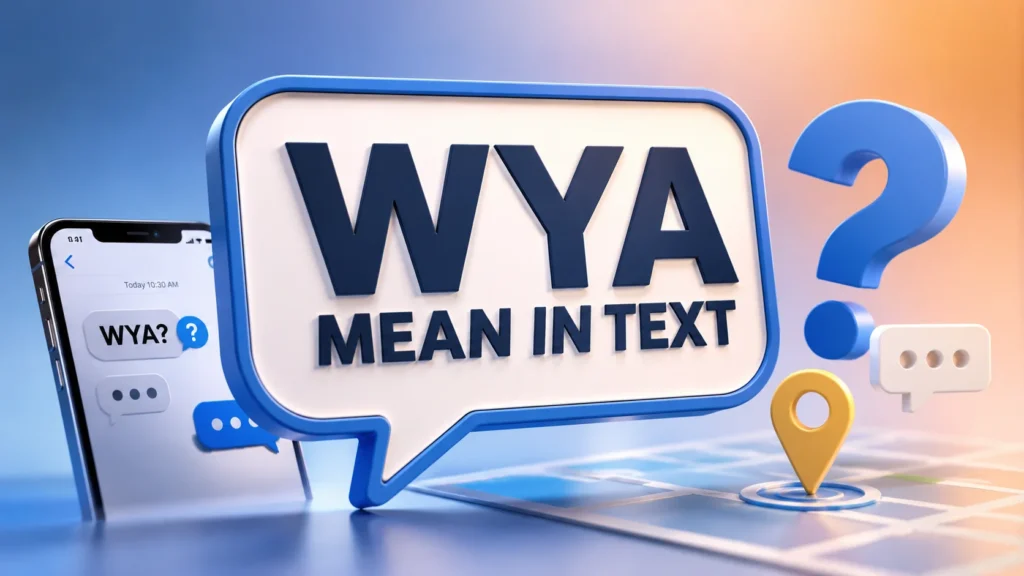
If you’ve ever received a message saying “WYA?” and wondered what it meant, you’re not alone. Texting slang changes quickly, and new abbreviations become part of everyday conversations on social media, messaging apps, and online communities.
The abbreviation WYA is one of the most commonly used internet slang terms, especially among teenagers, young adults, and frequent social media users. While it looks simple, its meaning can change slightly depending on the relationship between the people talking and the situation.
In this guide, you’ll learn exactly what WYA means in text, where it came from, how people use it on platforms like WhatsApp, Instagram, Snapchat, TikTok, and regular text messages, and when you should—or shouldn’t—use it yourself.
By the end, you’ll feel confident recognizing and responding to WYA in any conversation.
WYA Mean in Text – Quick Meaning
What Does WYA Mean?
WYA stands for:
“Where You At?”
It’s an informal way of asking someone where they are or what they’re doing right now.
Instead of typing the full sentence, people shorten it to three letters to make texting quicker and more casual.
Quick Definition
- Full form: Where You At?
- Meaning: Asking someone’s current location or availability.
- Tone: Casual, friendly, informal.
- Common platforms: WhatsApp, Instagram, Snapchat, TikTok, Facebook Messenger, SMS.
Short Examples
“WYA? Everyone’s already here.”
“Hey! WYA? We’ve been waiting for you.”
“WYA lol? I thought you were coming.”
These examples show that WYA is usually friendly rather than demanding.
Origin & Background
Where Did WYA Come From?
WYA developed naturally from spoken English.
In everyday conversation, many English speakers say “Where you at?” instead of the more formal “Where are you?” The shortened phrase became even shorter once texting culture exploded.
As mobile phones and instant messaging became popular in the early 2000s, users began replacing common phrases with abbreviations to save time.
That’s how:
- BRB became “Be Right Back”
- LOL became “Laugh Out Loud”
- IDK became “I Don’t Know”
- WYA became “Where You At?”
Cultural Influence
Youth culture played a huge role in making WYA popular.
Friends meeting after school, classmates planning outings, gamers coordinating online sessions, and families checking on one another all started using WYA because it felt relaxed and conversational.
Social Media Impact
Social media helped spread the abbreviation worldwide.
Today you’ll regularly see WYA on:
- Instagram DMs
- Snapchat
- TikTok comments
- Facebook Messenger
- iMessage
- Discord
How the Meaning Has Evolved
Originally, WYA simply asked for someone’s location.
Today, it can also mean:
- Are you coming?
- Are you available?
- What’s taking so long?
- Why haven’t you replied?
- Are you joining us?
The emotional tone depends entirely on the conversation.
Real-Life Conversations
WhatsApp Conversation
Person A:
Hey! WYA?
Person B:
Almost there. Five more minutes.
Person A:
Perfect, we’re saving you a seat.
Instagram DM
Person A:
WYA? Haven’t seen you online today.
Person B:
I’ve been busy studying for exams.
Person A:
Good luck! Message me later.
TikTok Comments
Person A:
WYA bestie 😂
Person B:
Still recovering from yesterday’s workout.
Person A:
Same! My legs still hurt.
Text Message
Person A:
Movie starts in 20 minutes. WYA?
Person B:
Parking now. I’ll be inside soon.
Person A:
Awesome, see you in a minute.
Emotional & Psychological Meaning
More Than Just a Location Question
Although WYA literally asks where someone is, it often communicates something much deeper.
Depending on the relationship, it can express:
- Excitement
- Curiosity
- Concern
- Impatience
- Affection
- Missing someone
People rarely ask WYA simply to collect information.
Instead, they’re usually hoping to continue spending time together.
Why People Use It
Modern communication values speed.
Rather than writing:
“Where are you right now? Are you still coming?”
people naturally type:
“WYA?”
The shorter message feels conversational without sounding overly formal.
What It Reveals About Modern Communication
Today’s conversations are fast-paced.
Short abbreviations like WYA help people stay connected while typing less.
They also create a feeling of closeness because friends often share an informal texting style.
A Real-Life Scenario
Imagine your close friend promised to meet you at a café after work.
Twenty minutes pass, and they haven’t arrived.
Instead of sending a long message, you simply text:
“WYA?”
That tiny message communicates curiosity, mild concern, and excitement—all at once. It feels natural because both of you already understand the context.
Usage in Different Contexts
Social Media
On Instagram, Snapchat, and TikTok, WYA often means:
- Where are you?
- Why aren’t you here?
- Join the conversation.
- Come hang out.
It’s especially common in stories, comments, and direct messages.
Example:
“WYA? We’re all online.”
Friends & Relationships
Friends use WYA constantly.
Examples include:
- Meeting after class
- Planning dinner
- Gaming together
- Checking on each other
In relationships, WYA can sound affectionate.
Example:
“WYA? I miss you already.”
Depending on the situation, it can also express playful impatience.
Example:
“WYA? I’ve been waiting forever 😂”
Work & Professional Settings
WYA is generally not appropriate in professional communication.
Instead of writing:
“WYA?”
Consider saying:
- Where are you currently?
- Are you available?
- Have you arrived?
- Can you join the meeting?
Professional messages benefit from complete sentences and a respectful tone.
Casual vs Serious Tone
One interesting thing about WYA is how easily its tone changes.
A simple “WYA?” between close friends feels relaxed and friendly.
However, if someone has been missing for several hours, the exact same message may express genuine concern.
Understanding the context is always more important than focusing on the abbreviation itself.
When NOT to Use It
Although WYA is widely accepted in casual conversations, it isn’t suitable for every situation. Understanding when to avoid it helps you communicate more clearly and professionally.
Professional Communication
In workplaces, emails, or formal meetings, WYA can appear too casual or even unprofessional.
Instead of saying:
“WYA?”
Try:
- “Where are you currently?”
- “Have you arrived?”
- “Are you available to join the meeting?”
- “Please let me know your current status.”
Using complete sentences shows respect and professionalism.
Speaking to Someone You Don’t Know Well
If you’re messaging a teacher, client, manager, or someone you’ve just met, WYA may sound overly familiar.
A more polite message is usually the better choice.
During Serious Situations
When discussing emergencies, health issues, or important family matters, abbreviations can seem insensitive.
Clear communication is always more appropriate in serious conversations.
Cultural Differences
Not everyone is familiar with texting slang.
Older adults or people learning English may misunderstand WYA, so consider your audience before using it.
Common Misunderstandings
Some People Think It’s Rude
Because WYA is so short, it can occasionally sound demanding.
Compare these:
- “WYA?”
- “Hey! WYA? Hope everything’s okay.”
The second message feels much warmer.
It Doesn’t Always Mean Physical Location
Many people assume WYA only asks where someone is.
In reality, it can also mean:
- Are you free?
- Why haven’t you replied?
- Are you joining us?
- What’s going on?
The surrounding conversation determines the meaning.
Tone Depends on Context
A friend texting “WYA 😂” feels playful.
A parent texting “WYA?” late at night usually expresses concern.
The same abbreviation can communicate very different emotions.
Comparison Table
| Expression | Meaning | Typical Tone | Common Use |
|---|---|---|---|
| WYA | Where are you? | Casual | Checking location or availability |
| WYD | What are you doing? | Friendly | Asking about someone’s activity |
| WRU | Where are you? | Casual | Alternative abbreviation |
| HMU | Hit me up | Friendly | Contact me later |
| ETA? | Estimated time of arrival | Neutral | Asking when someone will arrive |
| OMW | On my way | Helpful | Replying to WYA |
| BRB | Be right back | Casual | Temporary absence |
| AFK | Away from keyboard | Gaming/Online | Temporarily unavailable |
Key Insight
Although WYA, WYD, and WRU often appear together, they ask different questions. WYA focuses on someone’s location or availability, while WYD asks about their current activity. Knowing the difference helps conversations flow naturally.
Variations / Types
1. WYA?
The standard abbreviation asking where someone is.
2. WYA Bro?
A casual version commonly used between close male friends.
3. WYA Bestie?
A playful way to check on a close friend.
4. WYA RN
“Where you at right now?” Used when someone needs an immediate update.
5. WYA LOL
Adds humor so the question feels lighthearted.
6. WYA 😂
Using a laughing emoji makes the message playful rather than serious.
7. WYA 👀
Often suggests curiosity or anticipation.
8. WYA ASAP
Used when someone needs a quick response.
9. WYA Fam
Popular among close friend groups and online communities.
10. WYA Tonight?
Specifically asks about someone’s plans for the evening.
How to Respond When Someone Uses It
Casual Replies
- “At home.”
- “Almost there.”
- “Just left work.”
- “On my way.”
Funny Replies
- “Currently surviving Monday. 😂”
- “Mentally on vacation.”
- “Lost but optimistic.”
- “You’ll find me near the snacks.”
Mature Replies
- “I’m running about ten minutes late.”
- “I’m still at the office but leaving soon.”
- “Sorry for the delay. I’ll update you shortly.”
Respectful Replies
- “Thanks for checking in. I’m on my way.”
- “I’m safe and should arrive soon.”
- “I appreciate your patience.”
Regional & Cultural Usage
Western Culture
In countries like the United States, Canada, and the United Kingdom, WYA is part of everyday digital communication. It’s commonly used among friends, classmates, and family members.
Asian Culture
Many English-speaking social media users in Asia understand WYA, especially younger generations. However, local messaging habits often mix English abbreviations with native languages.
Middle Eastern Culture
Among younger users who communicate in English, WYA appears frequently in chats and social media. Formal conversations, however, generally avoid slang abbreviations.
Global Internet Usage
Because social media connects people worldwide, WYA has become an internationally recognized abbreviation among English-speaking internet users.
Gen Z vs. Millennials
Gen Z
- Uses WYA naturally.
- Often pairs it with emojis and memes.
- Frequently uses it on Snapchat, TikTok, and Instagram.
Millennials
- Understand WYA well.
- Use it mainly in text messages and messaging apps.
- Tend to switch to full sentences in professional conversations.
Is It Safe for Kids?
Yes. WYA is generally considered safe and harmless.
It simply means “Where You At?” and doesn’t contain offensive language or inappropriate content.
That said, parents should still encourage children to be mindful about sharing their real-time location with people they don’t know. Teaching digital safety and privacy is more important than the abbreviation itself.
Read More: FT Mean in Text: Meaning, Examples & How to Use It
FAQs
What does WYA mean in text?
WYA stands for “Where You At?” It’s an informal way to ask someone where they are or whether they’re available.
Is WYA considered rude?
No. It’s usually friendly and casual. However, it can sound abrupt if used without context or with someone you don’t know well.
Is WYA the same as WRU?
They have the same basic meaning. WRU means “Where Are You?” while WYA comes from the more conversational phrase “Where You At?”
Can WYA mean something other than location?
Yes. Depending on the conversation, it may also ask whether someone is available, joining an event, or responding to messages.
Is WYA used on Snapchat and TikTok?
Absolutely. It’s widely used on Snapchat, TikTok, Instagram, WhatsApp, Facebook Messenger, Discord, and standard text messaging.
Should I use WYA at work?
Generally, no. In professional settings, it’s better to use complete, polite sentences.
How should I reply to WYA?
Simply answer with your location, availability, or estimated arrival time. If appropriate, you can also add a friendly or humorous response.
Conclusion
Now that you know what WYA means in text, you’ll recognize it almost instantly in conversations across messaging apps and social media. While its literal meaning is “Where You At?”, the phrase often conveys much more than a request for someone’s location. It can express excitement, curiosity, concern, or a simple desire to connect.
Like many internet abbreviations, WYA works best in casual conversations with friends, family, or people you’re comfortable with. In professional or formal settings, using complete sentences is usually the better choice.
The next time someone texts you “WYA?”, you’ll understand not only what they’re asking but also the tone behind the message—making your conversations feel more natural, confident, and engaging.

[…] Posts View All Posts Previous WYA Mean in Text: Meaning, Examples & Social Media Guide Next OTP Mean in Text: 3 Meanings You Need to […]