
ASH Mean in Text: Meaning, Slang Uses & Examples

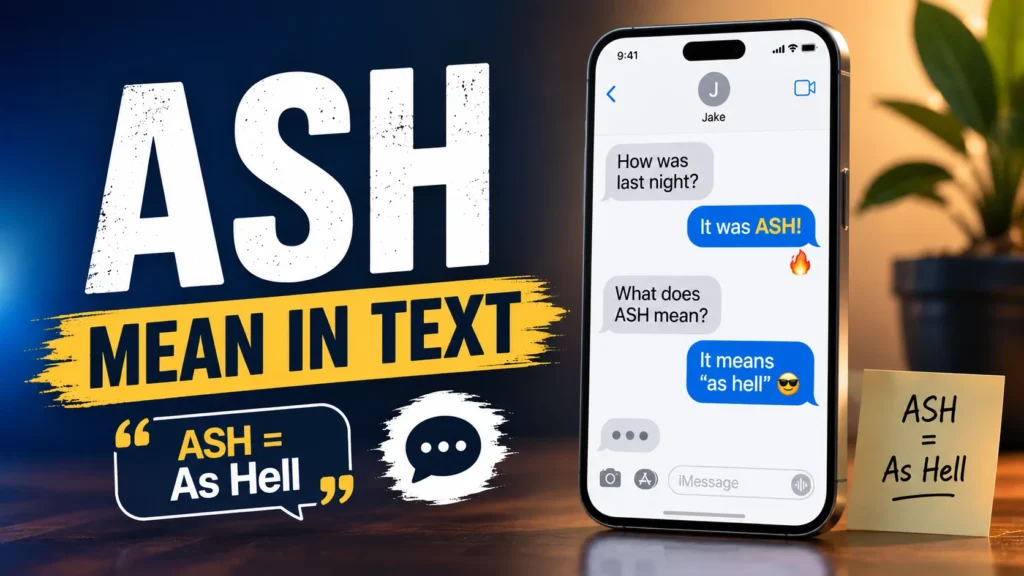
If someone texts “I’m tired ash”, comments “that’s funny ash,” or writes “you look good ash,” you might wonder what those three letters actually mean.
In modern texting, ASH usually means “as hell.” It works as an informal intensifier, adding extra emphasis to a word or feeling. In simple terms, “tired ash” means extremely tired, while “funny ash” means very funny.
The expression is most common in casual digital communication. You may encounter it in text messages, TikTok comments, Instagram conversations, Snapchat messages, gaming chats, and other informal online spaces.
There is an important detail, though: ASH does not always mean “as hell.”
If someone writes “Hey Ash,” they may simply be addressing a person named Ash. “Ash” can also refer literally to the powdery residue left after something burns.
That is why the surrounding sentence matters.
This guide explains ASH mean in text, how the slang works, what it communicates emotionally, where you can use it, when you should avoid it, and how to respond naturally.
ASH Mean in Text – Quick Meaning
In casual texting slang, ASH most commonly means “as hell.”
It is used to make a description stronger.
Simple definition
ASH = as hell
In this usage, it behaves like an intensifier similar to:
- Very
- Extremely
- Really
- Seriously
- Super
For example:
“I’m tired ash.”
This means:
“I’m extremely tired.”
Another example:
“That food is good ash.”
This means:
“That food is extremely good.”
The phrase is informal and often appears after an adjective or description. Current online slang references commonly describe “ash” this way, particularly in casual social-media and messaging contexts.
More examples of ASH in text
“It’s cold ash outside.”
Meaning: It is extremely cold outside.
“She’s funny ash.”
Meaning: She is very funny.
“I’m hungry ash.”
Meaning: I’m extremely hungry.
“That test was hard ash.”
Meaning: That test was extremely difficult.
“You’re moving slow ash.”
Meaning: You are moving extremely slowly.
The important idea is emphasis.
ASH does not usually introduce a completely new idea. Instead, it increases the intensity of the word before it.
What Does ASH Stand For in Texting?
When ash is being used as modern slang, it is generally understood as a shortened or stylized form of “as hell.”
It is better to think of it as an informal internet expression rather than a traditional acronym.
For example:
“I’m sleepy ash.”
The speaker is not talking about fire, smoke, or a person’s name. They are emphasizing how sleepy they feel.
A natural translation would be:
“I’m really sleepy.”
The same structure can appear with positive, negative, humorous, or emotional descriptions.
ASH as an intensifier
The role of ASH is similar to adding “extremely” to a sentence.
Compare:
Normal:
“I’m tired.”
Stronger:
“I’m extremely tired.”
Internet slang:
“I’m tired ash.”
The last version is casual and expressive.
It is designed for conversational settings rather than formal English.
ASH Meaning Depends on Context
One of the biggest mistakes people make with internet slang is assuming that every occurrence has the same meaning.
The word ash has several possible interpretations.
1. ASH = “as hell”
This is the most relevant meaning when discussing texting slang.
Example:
“That movie was scary ash.”
Meaning: The movie was extremely scary.
2. Ash as a person’s name
Ash is also a common short name or nickname.
Example:
“Ash, can you call me later?”
Here, ASH does not mean “as hell.”
It is simply someone’s name.
3. Ash as a literal word
Ash can refer to the fine residue left after something burns.
Example:
“There was ash all over the fireplace.”
This is ordinary English, not internet slang.
4. ASH as an abbreviation
In specialized settings, ASH may stand for different organizations, concepts, names, or technical terms.
The correct interpretation depends on the subject and surrounding information.
How can you tell which meaning applies?
Look at the sentence structure.
If ash appears after an adjective, such as:
- tired ash
- funny ash
- cold ash
- hungry ash
- cute ash
the slang meaning “as hell” is likely.
If someone writes:
“Hey Ash, where are you?”
it is probably a name.
If the conversation involves a fireplace, fire, or burning material, the literal meaning may be intended.
Context solves most of the confusion.
Origin and Background of ASH Slang
Internet language changes quickly.
People constantly shorten phrases, alter spellings, and create new ways to communicate emotion in fewer characters.
The slang use of ash fits into that broader pattern.
It is associated with informal digital communication where people often modify expressions to make them shorter, punchier, or easier to type.
Why shorten “as hell”?
In casual messaging, people frequently compress familiar expressions.
The goal is not necessarily grammatical correctness. The goal is speed, tone, humor, and identity.
A person might write:
“I’m exhausted ash.”
instead of:
“I’m extremely exhausted.”
The slang version sounds more conversational and emotionally exaggerated.
Social media influence
Social platforms have made informal expressions travel much faster.
A phrase used in one online community can spread across TikTok, Instagram, Snapchat, gaming communities, and private group chats.
This is one reason younger users can recognize slang that older speakers may never have encountered.
Online language is also highly contextual. A phrase can become popular without being appropriate for every audience.
Language keeps evolving
Slang is not fixed.
Its spelling, popularity, and meaning can shift over time. Some expressions disappear quickly, while others become familiar parts of casual speech.
ASH should therefore be understood as informal internet language, not as a replacement for standard English.
ASH in Real-Life Conversations
The easiest way to understand slang is to see it in realistic situations.
Here are several examples showing how ASH can naturally appear in digital conversations.
WhatsApp conversation: Feeling exhausted
Person A:
How was your day?
Person B:
Long ash 😭
Person A:
Work?
Person B:
Yeah. Meetings all day.
Here, “long ash” means extremely long.
The expression adds emotional intensity without requiring a long explanation.
Instagram DM: Complimenting a friend
Person A:
Did you see my new pictures?
Person B:
Yeah, you look good ash 🔥
Person A:
Stoppp 😂
Person B:
I’m serious!
Here, ASH strengthens the compliment.
The message means the person looks very good.
TikTok comment: Reacting to something funny
Person A:
Bro this video is funny ash 😭
Person B:
The ending got me 😂
The slang communicates enthusiasm.
The commenter is not simply saying the video is funny. They are emphasizing that it is extremely funny.
Text message: Talking about food
Person A:
Did you try that new restaurant?
Person B:
Yeah. The fries are good ash.
Person A:
Okay I’m going tomorrow 😂
Here, “good ash” means really good.
The phrase makes the recommendation feel more energetic and conversational.
Emotional and Psychological Meaning of ASH
Slang is not just about shortening words.
It also communicates personality, emotion, closeness, and social identity.
When someone writes “I’m tired ash,” they are usually expressing more than simple tiredness.
They may be communicating:
- Frustration
- Exhaustion
- Humor
- Exaggeration
- Informality
- Emotional intensity
The exact feeling depends on context.
ASH creates emphasis
Compare these messages:
“I’m tired.”
“I’m really tired.”
“I’m tired ash.”
The third version often sounds more dramatic and conversational.
It can make a message feel less formal and more like spoken conversation.
ASH can create humor
Slang often works because it exaggerates everyday experiences.
Someone saying:
“I’m hungry ash.”
may not literally be experiencing an emergency-level hunger.
They are probably exaggerating for humor.
That exaggeration is part of the conversational style.
ASH can signal familiarity
People are more likely to use casual slang with friends, online communities, or people they feel comfortable around.
The expression can therefore make a conversation feel relaxed.
Still, using slang does not automatically mean the relationship is close. Context and communication style matter.
A personal-style scenario
Imagine a friend messages you after a difficult exam:
“That exam was hard ash.”
You probably understand immediately that they are frustrated and mentally exhausted.
You do not need a formal explanation.
The slang compresses the emotional message into a few words.
That is one of the strengths of modern digital language: a short phrase can carry a surprisingly large amount of tone.
How ASH Is Used in Different Contexts
The meaning usually remains similar, but the appropriateness changes depending on where you use it.
ASH on social media
Social media is one of the most natural environments for this slang.
You might see:
- “Cute ash”
- “Funny ash”
- “Cold ash”
- “Wild ash”
- “Tired ash”
TikTok comments and casual Instagram conversations are especially suited to informal expressions.
ASH between friends
Friends may use ASH freely.
Example:
“You’re late ash 😂”
The message means:
“You’re extremely late.”
Depending on the relationship, it could sound teasing rather than genuinely angry.
ASH in relationships
Romantic partners may use slang when their communication style is relaxed.
Example:
“I miss you ash.”
The expression adds emotional intensity.
However, whether it sounds affectionate, funny, or awkward depends on the couple’s normal communication style.
ASH in gaming chats
Gaming conversations are often fast-paced and informal.
A player might write:
“That boss is hard ash.”
The meaning is straightforward:
“That boss is extremely difficult.”
ASH at work
This is where caution becomes important.
Avoid using slang like ASH in:
- Formal emails
- Job applications
- Business reports
- Client communications
- Academic assignments
- Professional presentations
Instead of:
“The deadline is tight ash.”
write:
“The deadline is extremely tight.”
The second version is clearer and professionally appropriate.
Casual vs. serious communication
ASH belongs mainly to casual communication.
If the topic is emotionally serious, slang can sometimes make your message sound less sensitive than intended.
When discussing grief, conflict, professional problems, or serious relationship issues, choose words that accurately match the seriousness of the situation.
When NOT to Use ASH
Knowing slang also means knowing when to avoid it.
1. Formal writing
Do not use ASH in professional or academic writing.
For example, avoid:
“The assignment was difficult ash.”
Use:
“The assignment was extremely difficult.”
2. Professional emails
A manager, client, teacher, or interviewer may not understand the slang.
Even if they understand it, the wording may seem overly casual.
3. Sensitive conversations
If someone is discussing something painful, exaggerated slang may unintentionally minimize their feelings.
A more thoughtful response is usually better.
4. With people unfamiliar with internet slang
Not everyone follows current online language.
If the other person asks what you mean, explain it rather than assuming they understand.
5. Cross-cultural conversations
English slang can be confusing for international speakers.
A phrase that feels obvious to one person may be completely unfamiliar to another.
Plain English is usually safer when clarity matters more than style.
Common Misunderstandings About ASH
Misunderstanding 1: ASH always means “as hell”
Not necessarily.
Context matters.
“Ash” may be a name, a literal word, or an abbreviation for something unrelated.
Misunderstanding 2: ASH is always offensive
The slang comes from an informal expression containing “hell,” so some people may consider it unsuitable in conservative or formal environments.
However, the abbreviation itself is commonly used casually as an intensifier.
Whether it is acceptable depends on the audience.
Misunderstanding 3: ASH means “very” in every situation
ASH often works similarly to “very” or “extremely,” but it is not interchangeable with them in every sentence.
Its strength comes partly from its slang tone.
Misunderstanding 4: ASH is always an acronym
Not exactly.
In the slang usage, it is better understood as a shortened internet form of “as hell” rather than a conventional acronym.
Misunderstanding 5: Every person using ASH has the same intention
Tone matters.
“Cute ash 😂” may be playful.
“Late ash” could be teasing.
“Painful ash” could express genuine frustration.
The surrounding conversation reveals the intended emotion.
ASH vs. Similar Slang Expressions
| Expression | General meaning | Tone | Example |
|---|---|---|---|
| ASH | As hell / extremely | Very casual | “Tired ash” |
| AF | As f*** / extremely | Very casual, stronger | “Tired AF” |
| ASL | As hell in some slang contexts | Casual | “Funny asl” |
| FR | For real | Casual | “That was funny fr” |
| OMG | Oh my God | Casual | “OMG, that was crazy” |
| SO | Very / extremely | Casual to neutral | “So tired” |
| VERY | Strong degree | Neutral | “Very tired” |
| EXTREMELY | Very high degree | Formal/neutral | “Extremely tired” |
| SUPER | Very / extremely | Casual | “Super tired” |
| REALLY | Very / genuinely | Casual to neutral | “Really tired” |
Key Insight
ASH is primarily about intensity plus informality.
The word “extremely” can communicate the same basic degree, but ASH adds a distinctly casual internet tone.
Variations and Common Patterns of ASH
ASH is flexible because it usually follows the word being emphasized.
Here are common patterns you may encounter.
1. Tired ash
Meaning: Extremely tired.
Example:
“I’m tired ash after work.”
The speaker is emphasizing exhaustion.
2. Funny ash
Meaning: Extremely funny.
Example:
“That video was funny ash.”
The person found the video very entertaining.
3. Hungry ash
Meaning: Extremely hungry.
Example:
“I’m hungry ash right now.”
The speaker is emphasizing strong hunger.
4. Cold ash
Meaning: Extremely cold.
Example:
“It’s cold ash today.”
The weather feels unusually cold.
5. Hot ash
Meaning: Extremely hot.
Example:
“It’s hot ash in here.”
The speaker is emphasizing the heat.
6. Cute ash
Meaning: Extremely cute.
Example:
“That puppy is cute ash.”
The speaker thinks the puppy is very cute.
7. Good ash
Meaning: Extremely good.
Example:
“This pizza is good ash.”
The person strongly approves of the food.
8. Bad ash
Meaning: Extremely bad.
Example:
“That service was bad ash.”
The speaker strongly dislikes the experience.
9. Slow ash
Meaning: Extremely slow.
Example:
“My internet is slow ash today.”
The speaker is frustrated by the slow connection.
10. Hard ash
Meaning: Extremely difficult.
Example:
“That level is hard ash.”
The speaker thinks the level is very challenging.
How to Respond When Someone Uses ASH
Your response should match the relationship and tone.
You do not need to explain the slang every time.
Casual replies
If a friend says:
“I’m tired ash.”
You could reply:
“Same 😭”
Or:
“Honestly, me too.”
Another option:
“Go get some sleep 😂”
Funny replies
If someone writes:
“I’m hungry ash.”
You could say:
“Then stop texting and go eat 😂”
Or:
“Your stomach is writing the messages now 😭”
Humor works well when the relationship is comfortable.
Mature replies
If someone says:
“That meeting was stressful ash.”
A mature response could be:
“Yeah, it sounded like a rough one.”
This acknowledges their emotion without copying the slang.
Respectful replies
If you are unsure about the person’s communication style, keep your answer simple:
“I understand. That sounds exhausting.”
You do not have to mirror someone else’s slang to show that you understand them.
Regional and Cultural Usage of ASH
Internet slang crosses borders quickly, but its familiarity is not universal.
Western English-speaking culture
In casual online communication, ASH can be understood as an informal intensifier.
Its use is especially natural in relaxed conversations among people who are familiar with internet slang.
Asian communication
English is widely used online across many Asian communities, but slang familiarity varies significantly.
Someone may understand standard English perfectly while still being unfamiliar with a newer internet abbreviation.
That is why context remains important.
Middle Eastern communication
The same principle applies.
English-language social media can expose users to international slang, but not everyone will interpret ASH in exactly the same way.
When communicating across generations or cultures, straightforward English can prevent unnecessary confusion.
Global internet usage
Online communities mix language styles constantly.
A person may use standard English in one conversation and highly informal slang in another.
The platform, community, age group, and relationship all influence language choices.
Gen Z vs. Millennials
Younger internet users may encounter and understand rapidly changing slang more frequently.
Millennials may recognize some expressions but not every newer variation.
Neither group has a single communication style.
Individual online habits matter more than age alone.
Is ASH Safe for Kids?
The slang use of ASH is generally not considered dangerous by itself, but the phrase it represents is informal and contains the word “hell.”
For younger users, the more important issue is context.
Parents and educators can explain that slang is different from formal English.
Children should understand that a phrase appropriate for a private conversation with friends may not be suitable for schoolwork or communication with teachers.
A simple rule is useful:
Casual slang belongs in casual settings.
Learning the difference between informal and formal language is more valuable than simply memorizing whether one abbreviation is “safe.”
Is ASH a Bad Word?
ASH itself is not normally treated as a standalone swear word.
In the slang sense, however, it represents “as hell,” which some audiences may consider mildly inappropriate or too informal.
That makes audience awareness important.
For example, texting:
“That movie was scary ash 😂”
to a friend may be completely natural.
Writing:
“The results were surprising ash.”
in an academic paper would be inappropriate.
The issue is not just whether the phrase is offensive.
It is also about register.
Formal English requires different vocabulary from casual internet conversation.
Is ASH the Same as AF?
ASH and AF can serve a similar grammatical purpose.
Both can intensify an adjective.
For example:
“I’m tired ash.”
and:
“I’m tired AF.”
Both communicate extreme tiredness.
The major difference is that AF directly abbreviates a stronger profanity, while ASH is often used as a less explicit alternative.
Both remain highly informal.
Neither belongs in formal professional writing.
ASH vs. ASL: Are They the Same?
This is a common source of confusion.
In some internet slang, ASL can be used to mean “as hell,” while ASL has several other established meanings, including American Sign Language and the older internet abbreviation “age, sex, location.”
ASH is therefore not automatically interchangeable with ASL.
The sentence and community matter.
If someone writes:
“I’m tired ash.”
the intended meaning is relatively straightforward.
If someone writes:
“I’m tired asl.”
the same intensifier meaning may be intended, but the abbreviation can have other interpretations.
Context is essential.
How to Understand ASH Without Guessing
If you see ASH in a message and are unsure, follow these steps.
Step 1: Look at the words around it
Ask whether ASH follows an adjective.
“Tired ash” strongly suggests slang.
Step 2: Consider the platform
TikTok, Instagram, Snapchat, gaming chats, and casual texting are more likely to contain informal slang.
Step 3: Consider the relationship
Friends are more likely to use slang than a formal workplace contact.
Step 4: Check capitalization
“ASH” and “ash” can look different, but capitalization alone does not determine the meaning.
Step 5: Consider alternative meanings
Could it be someone’s name?
Could it refer to burned material?
Could it be a specialized abbreviation?
If yes, do not automatically assume slang.
Step 6: Ask if necessary
A simple:
“What do you mean by ash?”
can prevent an embarrassing misunderstanding.
Why People Use ASH Instead of “Very”
Language is about more than literal meaning.
Compare:
“That was very funny.”
with:
“That was funny ash 😭”
The first sounds neutral.
The second feels more spontaneous, dramatic, and conversational.
That difference is exactly why slang survives.
People want language that reflects the way they feel, not just language that is grammatically correct.
ASH can make a sentence feel:
- More expressive
- More relaxed
- More humorous
- More dramatic
- More conversational
- More connected to online culture
It is not necessarily “better” English.
It is simply a different register of English.
Common Sentence Examples Using ASH
Here are additional examples to help you recognize the pattern naturally.
“I’m sleepy ash.”
Meaning: I’m extremely sleepy.
“That concert was loud ash.”
Meaning: The concert was extremely loud.
“You’re funny ash.”
Meaning: You are extremely funny.
“This homework is confusing ash.”
Meaning: This homework is extremely confusing.
“The traffic is bad ash.”
Meaning: The traffic is extremely bad.
“That outfit is cute ash.”
Meaning: That outfit is extremely cute.
“I’m stressed ash today.”
Meaning: I’m extremely stressed today.
“This coffee is strong ash.”
Meaning: This coffee is extremely strong.
“The weather changed fast ash.”
Meaning: The weather changed extremely quickly.
“That game was intense ash.”
Meaning: That game was extremely intense.
FAQs About ASH Mean in Text
What does ASH mean in text?
In casual texting slang, ASH usually means “as hell.” It is used as an intensifier to emphasize an adjective or feeling. For example, “tired ash” means “extremely tired.”
What does ASH mean on TikTok?
On TikTok and similar social platforms, ASH can mean “as hell” when it appears after an adjective. A comment such as “funny ash” means that something is extremely funny.
Is ASH a slang word?
Yes. When ASH is used to mean “as hell,” it is informal internet slang. It is mainly suitable for casual conversations rather than formal writing.
Is ASH the same as “very”?
Not exactly, but it can perform a similar function. ASH intensifies a description, so “tired ash” can mean “very tired” or “extremely tired.”
Is ASH appropriate in professional messages?
Generally, no. ASH is informal slang. In professional communication, use standard expressions such as “very,” “extremely,” or “particularly” instead.
Can ASH mean something other than “as hell”?
Yes. “Ash” can be a person’s name, the residue left after burning, or an abbreviation with a specialized meaning. Always use context to determine the intended interpretation.
Is ASH offensive?
ASH itself is not usually treated as a swear word, but the slang expression represents “as hell,” which may be considered inappropriate in some formal or conservative settings. Audience and context determine whether it is suitable.
Conclusion: Understanding ASH Mean in Text
The simplest answer to “ASH mean in text” is:
ASH usually means “as hell” in casual internet slang.
It acts as an intensifier, making the word or feeling before it sound stronger.
So:
“tired ash” = extremely tired
“funny ash” = extremely funny
“hungry ash” = extremely hungry
“cute ash” = extremely cute
The expression is most appropriate for informal communication with friends, social-media conversations, comments, and casual online communities.
It should generally be avoided in professional emails, academic writing, formal documents, and situations where polished language is expected.
Most importantly, do not assume every “ash” means the same thing.
If someone writes “Hey Ash,” they may be talking to a person named Ash. If the conversation involves a fireplace, ash may simply mean the residue left after burning.
Context is the key.
Modern texting moves quickly, and slang can sometimes feel like a secret language. Once you recognize how ASH works, however, the pattern becomes easy to understand.
When used appropriately, it is simply another way people add emphasis, personality, humor, and emotional energy to everyday digital communication.






[…] Read More: ASH Mean in Text: Meaning, Slang Uses & Examples […]