BTO Mean in Text: Essential Guide to Its Meaning

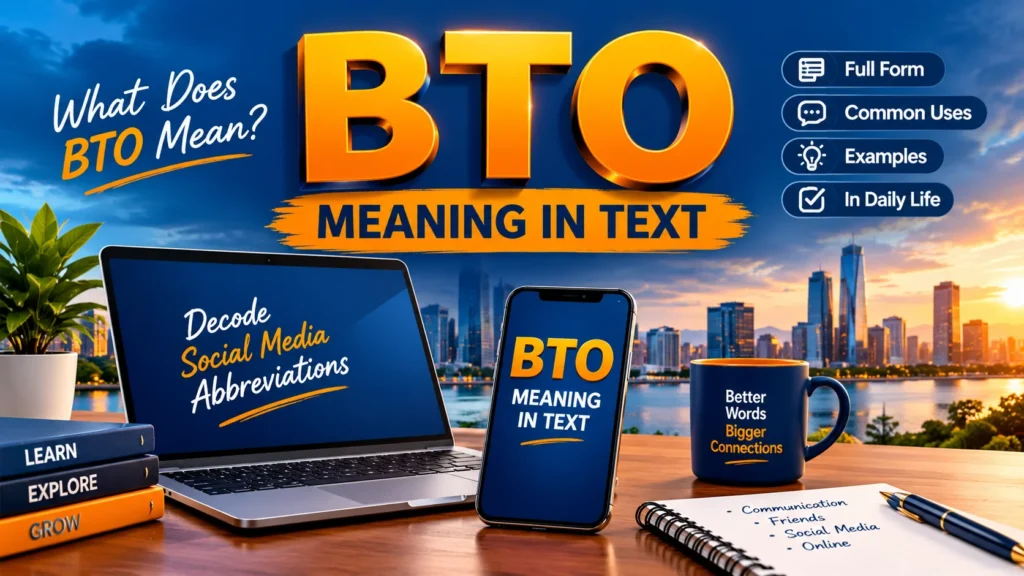
If you have seen BTO in a text, DM, comment, or online conversation, you may be wondering what it means. The most common BTO mean in text usage is “Built to Order,” especially when people are talking about products, cars, computers, furniture, or other items made after an order is placed.
However, BTO can have different meanings depending on the conversation. In casual texting, social media, gaming, business, and online communities, the intended meaning can change, so the surrounding words matter.
What Does BTO Mean in Text?
BTO usually means “Built to Order.” It describes something that is produced or prepared specifically after a customer places an order instead of being made and kept as ready-to-buy stock.
For example:
- “This laptop is BTO, so it’ll take a few weeks.”
- “I ordered the BTO version with extra storage.”
I’ve mostly seen this abbreviation in conversations where someone is discussing customized products or something that has to be manufactured before delivery. It is less common as everyday slang than abbreviations such as LOL, BTW, or IDK.
BTO Mean in Text: Common Uses
The exact meaning depends heavily on where you encounter it. Here are some of the more useful interpretations:
| BTO Meaning | Where It Is Used | Example |
|---|---|---|
| Built to Order | Shopping, technology, manufacturing | “The PC is BTO.” |
| Back to Office | Workplace conversations | “I’m BTO tomorrow.” |
| Business Turnaround Opportunity | Business discussions | “The company sees BTO as an opportunity.” |
| Buy to Own | Sales or finance contexts | “This is a BTO agreement.” |
| Back to One | Casual or entertainment contexts | “Okay, BTO and try again.” |
Among these, Built to Order is one of the clearest meanings when BTO appears alongside words such as custom, shipping, configuration, production, or delivery.
How BTO Changes Across Different Conversations
In a shopping or technology conversation, BTO usually relates to customization. Someone might say, “My BTO Mac is finally shipping,” meaning the device was configured or produced specifically for their order.
At work, you may encounter BTO as an abbreviation for Back to Office, particularly in informal workplace messages. For example, “I’m BTO Monday” could mean someone is returning to the office.
That is why simply seeing the three letters isn’t enough to determine the intended definition. The words around BTO usually provide the clue.
Real Texting Examples With BTO
Here are a few realistic situations showing how the abbreviation can appear.
Example 1 — Online shopping
Maya: “Did your new PC arrive?”
Chris: “Not yet 😭 It’s BTO.”
Maya: “Ohh so they’re building it first?”
Here, BTO means Built to Order because the conversation is about a computer being prepared specifically for the customer.
Example 2 — Workplace chat
Sam: “Are you joining the meeting tomorrow?”
Alex: “Yep, I’m BTO that day.”
Sam: “Cool, see you there.”
In this context, BTO may mean Back to Office, rather than Built to Order.
Example 3 — Product discussion
Jake: “Why is yours taking longer?”
Liam: “Mine was BTO with the upgraded storage.”
Jake: “Makes sense now.”
The mention of an upgraded configuration makes Built to Order the natural interpretation.
Common Mistakes When Understanding BTO
One of the easiest mistakes is assuming that BTO has one universal definition. Unlike very established texting abbreviations, this one is strongly dependent on the subject being discussed.
Another mistake is treating every use of BTO as slang. In many cases, it is actually an industry or workplace abbreviation that has simply been shortened for convenience in messages.
Before replying, look at the surrounding conversation. If the discussion involves products, customization, or manufacturing, Built to Order is a strong possibility; if it involves office attendance, Back to Office may make more sense.
How Should You Reply to BTO?
If someone uses BTO and you’re unsure what they mean, there’s nothing wrong with asking directly.
You can reply:
- “What does BTO mean here?”
- “Do you mean built to order?”
- “BTO as in back to office?”
If the meaning is already obvious from the conversation, you can simply respond to the message normally. For example, if someone says their BTO computer is delayed, you could ask when they expect it to arrive.
BTO vs Similar Abbreviations
BTO can be confused with other short abbreviations because its meaning changes with context. B2O, BTO, and similar combinations may appear in business or workplace communication, but they are not necessarily interchangeable.
If BTO appears in a product listing, customer message, or technology discussion, Built to Order is usually the interpretation worth checking first. In a workplace conversation, however, the surrounding sentence may point toward a completely different expansion.
Read More: GD Mean in Text: Common Meanings Explained
Frequently Asked Questions
What does BTO mean in text?
BTO most commonly means “Built to Order” when discussing products, technology, manufacturing, or customized items. In workplace conversations, it can also have other meanings.
What does BTO mean in a text message?
In a text message, BTO can mean different things depending on context. Built to Order is common in product-related conversations, while Back to Office may appear in workplace chats.
Is BTO a slang word?
Not usually. BTO is better described as an abbreviation that can be used in texting, business, technology, and workplace communication.
How Do I Know Which BTO Meaning Someone Intends?
To understand what BTO mean in text, check the context of the conversation. Words like custom, order, shipping, and configuration usually point to Built to Order, while words related to work, meetings, or returning to the workplace may suggest Back to Office.
Final Takeaway
When you see BTO mean in text, don’t assume there is only one possible definition. Built to Order is a common interpretation, particularly when someone is discussing customized products or items produced after purchase, but workplace and business contexts can give BTO a different meaning.
The safest approach is to read the surrounding message before deciding what the abbreviation means. A few words of context can usually make the intended meaning clear.