
GMT Mean in Text: What Does GMT Mean in Texting?

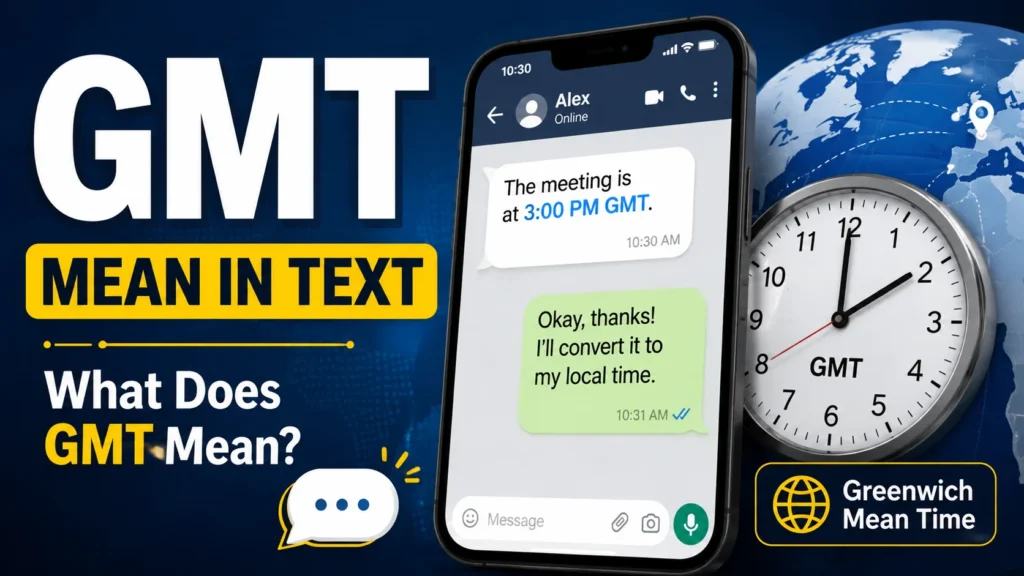
If you have seen “GMT” in a text message, comment, or social media conversation, you may have wondered what the sender actually meant.
The confusion is understandable. GMT is widely known as an abbreviation for Greenwich Mean Time, the time standard historically associated with Greenwich in London. Cambridge Dictionary also defines GMT as an abbreviation for Greenwich Mean Time.
In texting and online slang, however, GMT can also mean “Got Me Tight.” In this usage, it describes someone or something that has made a person frustrated, irritated, angry, or emotionally tense. Slang references list “Got Me Tight” as a texting and online-chat meaning.
That difference is important.
If someone writes, “The way he ignored me GMT,” they are probably not discussing time zones. They are expressing annoyance.
If someone writes, “The event starts at 7 PM GMT,” they are almost certainly talking about Greenwich Mean Time.
The surrounding words, platform, and conversation topic usually reveal which meaning is intended.
GMT Mean in Text – Quick Meaning
In informal texting, GMT can mean “Got Me Tight.”
It expresses frustration or irritation about a person, situation, comment, or event.
GMT = Got Me Tight
The phrase is similar in emotional meaning to saying:
- “That really annoyed me.”
- “That made me mad.”
- “That got on my nerves.”
- “That has me frustrated.”
- “That situation is stressing me out.”
Examples of GMT in Text
Example 1:
“He left me on read for three days. GMT.”
Meaning: That really annoyed me.
Example 2:
“My internet stopped working during the final minute. GMT.”
Meaning: That made me extremely frustrated.
Example 3:
“She promised she would come and canceled again. GMT.”
Meaning: Her behavior has really irritated me.
The expression is informal, so it is much more natural in casual conversations than in formal writing.
GMT Can Have More Than One Meaning
One of the biggest mistakes people make when searching “GMT mean in text” is assuming that the abbreviation always has one fixed definition.
It does not.
The meaning depends heavily on context.
GMT as “Got Me Tight”
In slang-heavy conversations, GMT can mean “Got Me Tight,” an expression of frustration or anger. Slang references specifically associate this meaning with online chat and text messaging.
GMT as “Greenwich Mean Time”
The standard and far more established meaning of GMT is Greenwich Mean Time. It refers to the time at Greenwich in London and has historically served as an important reference for world timekeeping.
For example:
“The livestream begins at 8 PM GMT.”
Here, GMT clearly refers to a time zone or time reference.
GMT as “Grinding My Teeth”
Some abbreviation directories also list “Grinding My Teeth” as an internet/chat interpretation of GMT.
This meaning can also communicate irritation, but it should not automatically be assumed whenever GMT appears.
The safest approach is simple: read the entire sentence before deciding what GMT means.
Origin & Background of GMT in Texting
The history of GMT is interesting because the abbreviation existed long before modern texting slang.
Greenwich Mean Time developed around the timekeeping tradition connected to the Royal Observatory at Greenwich in London. Over time, GMT became a familiar reference point for describing time differences around the world.
Digital communication later gave familiar abbreviations new possibilities.
Online communities frequently shorten phrases because quick messages are easier to type and understand among people who share the same slang. “Got Me Tight” fits that pattern because it compresses an emotional reaction into three letters.
How GMT Became a Digital Expression
Texting culture encourages brevity.
Instead of writing:
“That situation has really made me angry.”
Someone may use a short slang expression to communicate the same emotional reaction more quickly.
The meaning is particularly dependent on community and context. Unlike established dictionary abbreviations, slang meanings can vary between social groups.
That is why you should be careful about treating every internet definition of GMT as universally accepted.
Social Media and the Evolution of Meaning
Social platforms have made abbreviations travel faster than ever.
A phrase that begins in a particular community can eventually appear in group chats, comments, memes, gaming conversations, and private messages.
The result is a communication environment where the same three letters can mean something completely different depending on who wrote them.
When NOT to Use GMT
Avoid It in Formal Communication
Do not rely on GMT slang in:
- Job applications
- Academic assignments
- Business emails
- Official complaints
- Customer-service messages
- Legal communication
- Professional reports
Slang can make your meaning unclear.
Avoid It When the Audience May Not Know Slang
If you are speaking with someone unfamiliar with internet abbreviations, writing the full idea is safer.
Instead of:
“GMT.”
Try:
“That really annoyed me.”
Clear communication is more important than sounding trendy.
Be Careful With Cultural Differences
Slang is not universal.
An expression that feels obvious to one online community may be completely unfamiliar to another. GMT is especially confusing because it already has a well-established meaning connected to time.
If the context involves scheduling, international communication, or travel, assume the time-zone meaning may be intended unless the conversation clearly suggests otherwise.
Common Misunderstandings About GMT
Misunderstanding 1: GMT Always Means Greenwich Mean Time
Not necessarily.
GMT is strongly associated with Greenwich Mean Time, but online slang sources also document “Got Me Tight” as a texting meaning.
Misunderstanding 2: GMT Always Means “Got Me Tight”
That is also incorrect.
If someone writes:
“The meeting is at 4 PM GMT.”
They are talking about time.
Context matters.
Misunderstanding 3: GMT Is Always Angry
“Got Me Tight” usually signals irritation, but the intensity can vary.
Someone may use it genuinely or exaggerate for humor.
Misunderstanding 4: Every Internet Definition Is Universal
Slang evolves quickly.
A definition found on one slang website may be uncommon in another community. That is why sentence-level context should always take priority over an isolated abbreviation list.
GMT vs. Similar Expressions
| Expression | Meaning | Typical Tone | Common Context |
|---|---|---|---|
| GMT | Got Me Tight | Frustrated | Casual texting |
| SMH | Shaking My Head | Disappointed/annoyed | Social media and chat |
| ISTG | I Swear to God | Strong emphasis | Casual texting |
| OMG | Oh My God | Surprise/emotion | General chat |
| Ugh | Frustration or annoyance | Emotional | Casual messages |
| Mad | Angry or upset | Direct | Everyday conversation |
| Annoyed | Irritated | Neutral/direct | Casual or formal |
| Grinding My Teeth | Expressing frustration | Strongly annoyed | Informal chat |
| Greenwich Mean Time | Time reference | Neutral | Scheduling/time zones |
Key Insight
The most important thing to remember is that GMT is context-dependent. In slang conversations, “Got Me Tight” can express frustration, while in scheduling and international communication, GMT commonly means Greenwich Mean Time.
Is GMT Safe for Kids?
The abbreviation itself is not inherently harmful.
If GMT means Greenwich Mean Time, it is simply a time-related abbreviation.
If GMT means “Got Me Tight,” it is an informal expression of frustration rather than an inherently offensive phrase.
Parents, teachers, and younger users should still pay attention to context.
Internet slang can have different meanings across communities. Children may encounter unfamiliar abbreviations in gaming chats, social media comments, or private messages.
The best approach is to encourage children to ask about unfamiliar terms rather than assuming what they mean.
Read More: SNM Meaning in Text: What Does SNM Mean in Chat?
FAQs About GMT Mean in Text
What does GMT mean in text?
In informal slang, GMT can mean “Got Me Tight,” expressing frustration or irritation. In many other contexts, GMT means Greenwich Mean Time. Context determines the intended meaning.
Is GMT slang for “Got Me Tight”?
Yes. Some online slang references use GMT as an abbreviation for “Got Me Tight,” meaning that something has made someone annoyed, angry, or frustrated.
What does GMT mean on Instagram?
On Instagram, GMT may mean “Got Me Tight” when it appears in a conversation about something frustrating. If it appears alongside a specific time, such as “8 PM GMT,” it almost certainly refers to Greenwich Mean Time.
What does GMT mean on TikTok?
On TikTok, the meaning depends on context. In a reaction to an irritating or disappointing situation, it can mean “Got Me Tight.” In event schedules or international livestream announcements, it can mean Greenwich Mean Time.
Is GMT the same as UTC?
GMT and UTC are closely related but are not technically identical concepts. GMT is a time zone/time standard associated with mean solar time at Greenwich, while UTC is the modern international time standard used as the basis for precise timekeeping.
For ordinary online scheduling, people sometimes use the terms interchangeably, but technical contexts distinguish them.
Can GMT mean “Grinding My Teeth”?
Yes. Some abbreviation references list “Grinding My Teeth” as another internet/chat interpretation of GMT.
Still, you should not automatically assume this meaning. Look at the sentence and conversation first.
How can I tell which GMT meaning someone intends?
Look for context.
If GMT appears next to a clock time, date, meeting, livestream, or international event, it probably means Greenwich Mean Time.
If it appears after a complaint or frustrating story, “Got Me Tight” may be intended.
Conclusion
So, what does GMT mean in text?
In informal slang, GMT can mean “Got Me Tight,” a phrase used to express frustration, irritation, or anger.
But GMT has another much more established meaning: Greenwich Mean Time.
That is why context is essential.
A message such as “That comment GMT” may communicate annoyance. A message such as “The webinar begins at 7 PM GMT” is clearly discussing time.
The smartest way to understand internet abbreviations is not to memorize one definition and apply it everywhere. Pay attention to the sentence, the conversation, the platform, and the relationship between the people communicating.
Once you understand that distinction, GMT becomes much easier to interpret — and you can respond without worrying about accidentally misunderstanding what someone meant.


[…] Read More: GMT Mean in Text: What Does GMT Mean in Texting? […]