ISTG Mean in Text: Meaning, Uses & Examples

If you have ever received a message that says “ISTG”, you may have wondered what those four letters actually mean. Is it serious? Is the person annoyed? Are they joking? Or are they simply emphasizing what they are saying?
ISTG mean in text is a common search query because texting has developed its own language. People often shorten phrases to communicate quickly, especially on platforms such as Instagram, TikTok, Snapchat, WhatsApp, and in everyday text messages.
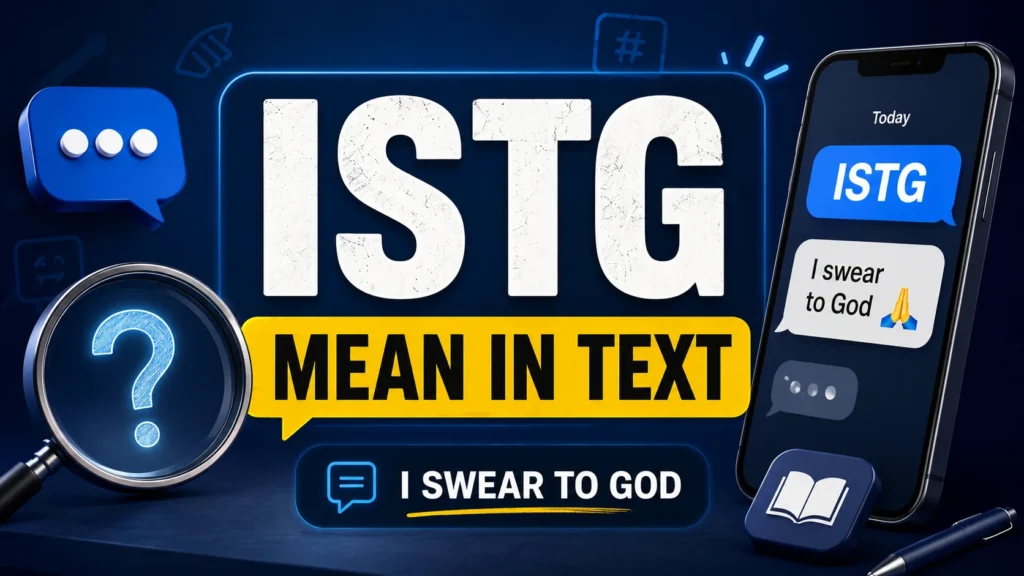
ISTG usually stands for “I swear to God.” It is generally used to emphasize a statement, express frustration, show strong emotion, or insist that something is true.
For example:
“ISTG, I thought you already knew.”
Here, the speaker is emphasizing that they genuinely believed the other person knew.
The meaning can change slightly depending on the conversation. It may sound sincere, dramatic, playful, irritated, or even humorous.
Understanding the surrounding context is therefore more important than simply memorizing the abbreviation.
ISTG Mean in Text: Quick Meaning
ISTG means “I swear to God” in texting and online conversations.
People commonly use it when they want to add emotional emphasis to what they are saying.
What Does ISTG Stand For?
ISTG = I Swear To God
It is an informal texting abbreviation rather than a formal English expression.
Common uses include:
- Emphasizing that something is true
- Showing frustration
- Expressing disbelief
- Making a strong promise
- Showing excitement
- Adding dramatic emphasis
- Reacting strongly to something
Examples of ISTG in Text
“ISTG, that was the funniest thing ever.”
This shows strong enthusiasm.
“ISTG, if you do that again, I’m leaving.”
This sounds frustrated or serious.
“ISTG I didn’t take your charger.”
Here, the person is strongly insisting that they are telling the truth.
The exact emotion depends heavily on the words surrounding ISTG.
Origin and Background of ISTG Meaning
The phrase “I swear to God” is much older than texting culture. People have historically used expressions involving swearing or making solemn declarations when they wanted to emphasize honesty or seriousness.
The abbreviation ISTG emerged naturally from the broader culture of digital communication.
As texting became faster and more conversational, people began shortening frequently used expressions. Similar abbreviations include OMG, IDK, TBH, IMO, and BTW.
How ISTG Became Popular Online
Social media helped abbreviations become part of everyday informal communication.
Instagram captions, TikTok comments, Snapchat messages, group chats, and memes all encourage short, expressive language.
ISTG fits this environment particularly well because it communicates a strong emotional reaction using only four letters.
Its modern usage is often less solemn than the complete phrase.
Someone might write:
“ISTG this cat knows exactly what she’s doing.”
The speaker probably is not making a formal oath. They are simply adding humor and emphasis.
How the Meaning Has Evolved
In contemporary online conversations, ISTG can be serious, playful, exaggerated, or sarcastic.
That flexibility is one reason it remains useful.
The abbreviation often communicates emotion more than literal religious meaning. Context determines whether the writer is genuinely swearing, exaggerating for humor, or simply emphasizing a point.
ISTG Meaning in Real-Life Conversations
Seeing ISTG in realistic conversations makes its meaning much easier to understand.
WhatsApp Conversation
Person A: Did you seriously forget the tickets?
Person B: ISTG, I put them in my bag this morning.
Person A: Check the side pocket.
Person B: Oh wow. 😭
Here, ISTG emphasizes that Person B genuinely believed the tickets were already in the bag.
Instagram DM
Person A: You have to watch that movie.
Person B: Is it actually that good?
Person A: ISTG, you’ll love it.
In this example, ISTG expresses strong confidence and excitement.
TikTok Comments
Person A: Why does this happen to me every Monday?
Person B: ISTG Mondays have something against us 😂
This use is playful. The commenter is exaggerating for humor rather than making a literal oath.
Text Message
Person A: You said you weren’t going to tell anyone.
Person B: ISTG I didn’t tell anybody.
Here, ISTG has a more serious tone. The person is strongly defending their honesty.
Emotional and Psychological Meaning of ISTG
The phrase behind ISTG carries emotional weight.
When people use it, they often want their words to feel stronger than an ordinary statement.
ISTG Can Signal Frustration
Consider:
“ISTG, you never listen to me.”
The abbreviation makes the frustration more noticeable.
Without ISTG, the sentence might feel more neutral:
“You never listen to me.”
The added abbreviation gives the message emotional intensity.
ISTG Can Show Sincerity
It can also be used to reassure someone.
“ISTG I had no idea about the surprise.”
The speaker wants the other person to believe them.
ISTG Can Create Humor
Online communication often relies on exaggeration.
“ISTG my phone only dies when I need it most.”
The person is probably not literally swearing. They are making an ordinary frustration sound dramatic and funny.
Why People Use It
Digital messages do not provide facial expressions, gestures, or vocal tone.
A short expression such as ISTG can help add emotional information.
In that sense, ISTG works almost like a tone marker. It tells the reader, “Pay attention to how strongly I feel about this.”
ISTG Meaning Usage in Different Contexts
The meaning of ISTG depends on the relationship between the people communicating.
Social Media
ISTG is very common in informal social media interactions.
It may appear in:
- TikTok comments
- Instagram captions
- Instagram DMs
- Snapchat messages
- Facebook comments
- X posts
- Meme conversations
Online, it is often humorous or exaggerated.
Friends and Relationships
Friends frequently use ISTG when reacting emotionally.
“ISTG you always make me laugh.”
A romantic partner might use it similarly:
“ISTG, you looked amazing tonight.”
The tone depends on the surrounding message.
Work and Professional Settings
ISTG is generally not recommended in formal professional communication.
Avoid using it in:
- Job applications
- Business emails
- Academic writing
- Formal reports
- Client communication
- Professional presentations
Instead of:
“ISTG, I sent the report yesterday.”
A professional alternative would be:
“I’m certain I sent the report yesterday.”
The second version is clearer and more appropriate for workplace communication.
Casual vs. Serious Tone
ISTG can appear in both casual and serious conversations.
The difference comes from context.
“ISTG this pizza is incredible 😂”
is casual and playful.
“ISTG I didn’t say that.”
may indicate defensiveness or conflict.
When NOT to Use ISTG Meaning
Although ISTG is widely understood online, it is not suitable for every situation.
Formal Communication
Avoid it in professional or academic writing.
The phrase is informal and can make an otherwise serious message sound casual.
Religious Sensitivity
Because ISTG expands to “I swear to God,” some people may consider it religiously inappropriate or uncomfortable.
This is particularly important when communicating with people whose religious or cultural values you do not know well.
You can simply say:
“I promise.”
or
“I’m telling you the truth.”
Serious Conflicts
ISTG can intensify an argument.
For example:
“ISTG, you always do this.”
may sound more aggressive than intended.
If you are trying to calm a difficult conversation, straightforward language may be better.
Common Misunderstandings About ISTG Meaning
ISTG Does Not Always Mean Anger
A common mistake is assuming that ISTG automatically indicates frustration.
It can express excitement, humor, sincerity, disbelief, or irritation.
It Is Not Always a Literal Oath
In modern texting, ISTG is frequently used as an intensifier.
Someone writing:
“ISTG this song is perfect.”
is probably emphasizing enthusiasm rather than making a formal religious statement.
Capitalization Does Not Change the Meaning
You may see:
- ISTG
- istg
- Istg
They generally mean the same thing.
Lowercase forms are particularly common in casual texting.
Context Controls the Tone
Compare:
“ISTG you’re the best 😂”
with:
“ISTG don’t do that again.”
The first is affectionate or excited.
The second sounds like a warning.
ISTG Meaning vs. Similar Texting Expressions
| Expression | Meaning | Typical Tone |
|---|---|---|
| ISTG | I swear to God | Strong emphasis |
| OMG | Oh my God | Surprise or excitement |
| FR | For real | Agreement or sincerity |
| TBH | To be honest | Honesty or openness |
| NGL | Not gonna lie | Candid opinion |
| I swear | Strong emphasis or promise | Serious or emotional |
| IDK | I don’t know | Uncertainty |
| IKR | I know, right? | Agreement |
| SMH | Shaking my head | Disappointment or disbelief |
| LOL | Laughing out loud | Humor or lightness |
Key Insight
ISTG is primarily an emphasis expression. It can make a message sound more intense, sincere, emotional, or dramatic, but the exact feeling comes from context.
Variations and Types of ISTG Usage
ISTG does not have completely separate dictionary definitions, but its conversational functions can vary considerably.
1. ISTG for Honesty
Used when someone wants to convince another person that they are telling the truth.
Example: “ISTG, I didn’t touch your phone.”
2. ISTG for Frustration
Used when someone feels annoyed.
Example: “ISTG, this internet is driving me crazy.”
3. ISTG for Excitement
Used to intensify enthusiasm.
Example: “ISTG, that concert was incredible.”
4. ISTG for Humor
Used dramatically to make a joke funnier.
Example: “ISTG my dog thinks he’s the landlord.”
5. ISTG for Disbelief
Used when someone cannot believe something.
Example: “ISTG, did he actually say that?”
6. ISTG for Warning
Used before a statement that sounds serious.
Example: “ISTG, don’t touch my fries.”
7. ISTG for Affection
Used to emphasize a positive feeling toward someone.
Example: “ISTG, you’re one of my favorite people.”
8. ISTG for Exasperation
Used after repeated problems or annoying experiences.
Example: “ISTG, I’ve explained this five times.”
9. ISTG for Dramatic Emphasis
Used to make an ordinary statement sound exaggerated.
Example: “ISTG, I’ve been waiting forever.”
10. ISTG as a Reaction
Sometimes ISTG stands alone as an emotional response.
Example:
Person A: He forgot his own birthday.
Person B: ISTG 😭
Here, the abbreviation communicates disbelief or amusement.
How to Respond to Someone Online with ISTG Meaning
There is no single correct response. Your reply should match the emotion behind the message.
Casual Replies
- “I believe you 😂”
- “Okay, okay!”
- “Fair enough.”
- “I hear you.”
- “For real?”
Funny Replies
- “Your oath has been accepted 😂”
- “Okay, courtroom drama.”
- “I’ll allow it 😭”
- “That’s a serious statement.”
Mature Replies
If the person is being serious, respond directly:
- “I understand what you’re saying.”
- “Okay, I believe you.”
- “Thanks for clarifying.”
- “I appreciate you explaining.”
Respectful Replies
When the conversation involves a sensitive issue:
“I understand. Thanks for being honest with me.”
A calm response can prevent a casual abbreviation from turning into an unnecessary argument.
Regional and Cultural Usage of ISTG
The abbreviation is widely recognizable across English-speaking internet communities, but its tone can differ between cultures.
Western Culture
In American and other Western online spaces, ISTG is commonly used as an informal intensifier.
It can be humorous, dramatic, frustrated, or sincere.
Asian Culture
English-language social media users across Asia may use ISTG in the same digital contexts as other international users.
However, the phrase may be interpreted more cautiously by people who are less familiar with Western internet slang.
Middle Eastern Culture
English-language online communities may use ISTG, particularly among younger social media users.
Religious sensitivity can matter more strongly depending on the individual and context because the full phrase references God.
Global Internet Usage
TikTok, Instagram, gaming communities, messaging platforms, and online fandoms have helped slang travel across national boundaries.
As a result, ISTG is increasingly understood beyond its original English-speaking audience.
Gen Z vs. Millennials
Younger users may use ISTG casually, often alongside emojis, memes, and exaggerated reactions.
Millennials may also recognize it easily, particularly through texting and social media.
The difference is usually style rather than meaning.
Is ISTG Meaning Safe for Kids?
ISTG is not generally an explicit or sexually inappropriate abbreviation.
However, parents and educators should teach children that the phrase means “I swear to God” and can be considered disrespectful or inappropriate in some religious or family settings.
The bigger issue is context.
A child using ISTG jokingly with friends is different from using it aggressively toward a teacher, parent, or other adult.
Teaching children to understand tone and audience is more useful than simply labeling every slang term as good or bad.
FAQs About ISTG Mean in Text
What does ISTG mean in text?
ISTG means “I swear to God.” It is used in texting and social media to emphasize honesty, frustration, excitement, disbelief, or another strong emotion.
What does ISTG mean on Instagram?
On Instagram, ISTG usually means “I swear to God.” Users often use it in DMs, comments, captions, and replies to add emphasis or express a strong reaction.
Is ISTG a bad word?
ISTG is not usually considered a traditional swear word, but its expanded form may be considered inappropriate in some religious or formal settings.
What does ISTG mean from a girl?
ISTG has the same basic meaning regardless of gender. A girl may use it to express honesty, frustration, excitement, humor, or strong emphasis.
What does ISTG mean from a guy?
It generally means “I swear to God.” The emotional meaning depends on the surrounding conversation rather than the sender’s gender.
Is ISTG serious?
Sometimes it is serious, but not always. Online users frequently use ISTG humorously or dramatically, so context is essential.
What should I reply to ISTG?
You can respond according to the tone. Casual replies such as “I believe you 😂” work for friendly conversations, while “I understand” or “Thanks for clarifying” is better for serious discussions.
Conclusion
Understanding ISTG mean in text is really about understanding more than four letters.
ISTG stands for “I swear to God,” but its practical meaning changes according to the conversation. It can communicate sincerity, frustration, excitement, disbelief, affection, humor, or dramatic emphasis.
That flexibility explains why ISTG works so well in modern digital communication.
The safest way to interpret it is to look at the entire message rather than focusing only on the abbreviation. A laughing emoji can make ISTG playful. A disagreement can make it serious. A friendly compliment can make it affectionate.
Use ISTG naturally with people who understand informal texting language. For professional, academic, or culturally sensitive situations, clearer alternatives such as “I promise,” “I’m certain,” or “I’m being honest” are usually better.
Once you understand the tone behind it, ISTG becomes much easier to recognize and use confidently.