YW Mean in Text: Meaning, Uses, Examples & More

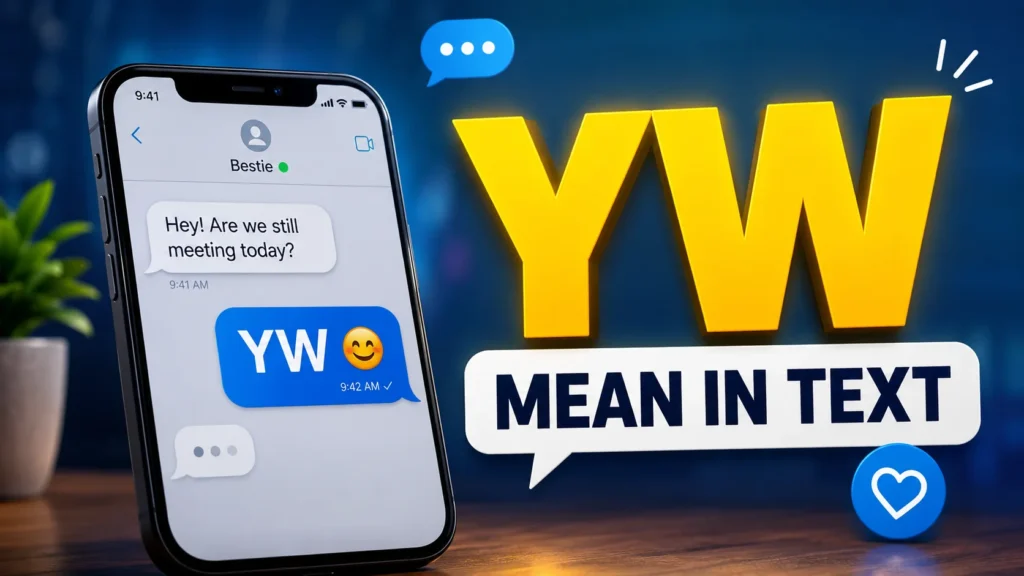
If you have received a message that simply says “YW” after thanking someone, you may have wondered what those two letters mean. In most texting and social media conversations, YW means “you’re welcome.”
It is a short, convenient way to respond when someone says “thanks,” “thank you,” “TY,” or “TYSM.” Instead of typing the complete phrase, people often use the abbreviation YW to keep the conversation quick and casual.
For example:
Person A: “Thanks for helping me with that assignment!”
Person B: “YW!”
The meaning is straightforward: “You’re welcome!”
However, digital communication is rarely just about dictionary definitions. The same abbreviation can feel warm, neutral, playful, or even slightly dismissive depending on the relationship, punctuation, capitalization, emojis, and situation.
That is why understanding YW meaning in text requires more than knowing what the letters stand for.
You also need to understand how YW is used, where it appears, what tone it communicates, when it is appropriate, and when a complete phrase would be better.
This guide explores all of those details so you can recognize and use YW confidently in texting, WhatsApp, Instagram DMs, Snapchat, TikTok, group chats, and everyday online communication.
YW Mean in Text: Quick Meaning
YW means “you’re welcome” in most text messages and online chats.
It is generally used as a response to gratitude.
Someone might write:
“Thanks!”
And the natural response could be:
“YW!”
Likewise:
“TYSM for sending me that!”
“YW 😊”
The abbreviation is particularly common in casual digital communication.
What Does YW Stand For?
YW stands for “you’re welcome.”
It is created from the first letters of the two words:
- Y = You’re
- W = Welcome
The apostrophe in “you’re” is not represented separately because texting abbreviations usually focus on recognizable initials rather than exact spelling.
YW Definition in Simple English
In simple terms, YW is a polite response meaning that the person does not need to thank you for what you did.
It can communicate:
- You’re welcome.
- No problem.
- Glad I could help.
- It was my pleasure.
- Don’t worry about it.
The exact emotional meaning depends on context.
Example of YW in a Text
Friend: “Thanks for picking me up!”
You: “YW!”
Here, YW is simply a casual version of “You’re welcome.”
Is YW Slang or an Abbreviation?
YW is best described as a texting abbreviation or internet abbreviation.
It is not offensive slang.
It belongs to the same broad family of digital shortcuts as:
- TY — Thank you
- TYSM — Thank you so much
- NP — No problem
- IDK — I don’t know
- BTW — By the way
- WYA — Where you at?
- LOL — Laughing out loud
The purpose is usually speed and convenience rather than creating a completely new meaning.
Why Do People Use YW Instead of “You’re Welcome”?
The simple answer is convenience.
Digital communication has changed how people think about writing.
When someone is sending a quick message, typing two letters can feel more natural than writing a complete phrase.
Compare:
“You’re welcome!”
with:
“YW!”
Both communicate the same basic idea.
The second version takes less effort and fits naturally into fast-paced conversations.
Texting Is More Conversational Than Traditional Writing
Modern messaging often resembles spoken conversation.
People send short messages one after another instead of composing carefully structured paragraphs.
For example:
“Thanks!”
“YW”
“You saved me 😂”
“Haha no worries”
This style feels more like a quick verbal exchange.
The abbreviation works because both participants already understand the context.
Digital Communication Rewards Efficiency
People frequently text while doing something else.
They may be:
- Walking
- Studying
- Working
- Traveling
- Shopping
- Watching a video
- Talking to friends
- Participating in a group chat
A short abbreviation can therefore be practical.
YW communicates the necessary information without extending the conversation unnecessarily.
Abbreviations Can Also Create Familiarity
Texting language can make conversations feel relaxed.
If two friends constantly use abbreviations with each other, writing “YW” can feel more natural than “You’re welcome.”
The abbreviation becomes part of their shared communication style.
That does not mean it is always informal or inappropriate. It simply means the surrounding relationship determines whether it feels natural.
Origin and Background of YW Meaning
The phrase “you’re welcome” is much older than texting.
People have traditionally used it as a polite response after someone expresses gratitude.
The abbreviation YW developed much later as digital communication became widespread.
The Growth of Texting Abbreviations
Early mobile communication encouraged shorter messages.
Users became accustomed to abbreviations because typing on older mobile keyboards could be slow and inconvenient.
Expressions that appeared frequently in everyday conversations were especially likely to become shortened.
“Thank you” became TY.
“Thank you so much” became TYSM.
“You’re welcome” became YW.
The practice continued even as smartphones made typing easier.
Social Media Strengthened the Trend
Social platforms made abbreviated communication even more common.
Users communicate through:
- Instagram DMs
- Snapchat
- TikTok
- Facebook Messenger
- Discord
- Online gaming chats
- Group messages
These environments favor quick, informal communication.
YW fits naturally into that environment because the meaning is usually obvious from the preceding message.
The Meaning Has Not Changed Much
Unlike some internet expressions that develop completely new meanings, YW has remained relatively stable.
Its central meaning is still:
“You’re welcome.”
What has changed is the way people use it.
It can now appear with:
- Lowercase letters
- Emojis
- Multiple punctuation marks
- Other abbreviations
- Memes
- Playful language
- Sarcasm or teasing
The core definition remains the same, but its emotional tone can shift.
YW Meaning in Text Messages
In ordinary text messages, YW is usually a direct response to thanks.
Example 1
Person A: “Thanks for bringing my charger.”
Person B: “YW!”
The meaning is simple.
Example 2
Person A: “TYSM for helping me study.”
Person B: “yw 😊”
This sounds relaxed and friendly.
Example 3
Person A: “Thanks for waiting!”
Person B: “YW, no worries.”
Here, YW is combined with another phrase to make the response warmer.
Example 4
Person A: “I really appreciate you helping me today.”
Person B: “You’re welcome. Anytime.”
In this situation, the complete phrase may feel more appropriate than YW because the emotional context is more meaningful.
YW Meaning on Social Media
The meaning of YW generally remains “you’re welcome” on social media.
However, the platform can influence how it feels.
YW on Instagram
Instagram users may use YW in:
- DMs
- Comments
- Story replies
- Group conversations
Example:
“Thanks for sharing my post!”
“YW!”
A friend might also write:
“yw bestie ❤️”
The added wording changes the emotional tone.
YW on Snapchat
Snapchat conversations are usually informal, so YW can feel completely natural.
Example:
“Thanks for sending that snap 😂”
“YW 😂”
The abbreviation fits Snapchat’s quick conversational style.
YW on TikTok
YW may appear in TikTok comments or direct messages.
Example:
“Where did you find that sound?”
“On the creator’s profile.”
“TYSM!”
“YW!”
The exchange is short because the platform encourages fast interactions.
YW on WhatsApp
WhatsApp conversations vary widely from casual family chats to professional communication.
Among friends:
“Thanks for sending the location.”
“YW!”
In a professional group:
“Thank you for sharing the document.”
“You’re welcome.”
The second option may be more appropriate because the environment is formal.
Real-Life Conversations Showing YW Meaning
WhatsApp Conversation
Person A: Thanks for sending me the restaurant location.
Person B: YW!
Person A: I would have never found it 😂
Person B: Haha, no problem.
This sounds casual, friendly, and natural.
Instagram DM Conversation
Person A: Your recommendation was actually perfect.
Person B: Haha, glad you liked it.
Person A: TYSM!!
Person B: YW 😊
The emoji adds warmth.
TikTok Comment Conversation
Person A: What song is this?
Person B: It’s called “Midnight Drive.”
Person A: TYSM!
Person B: YW!
Here, the abbreviation is practical and concise.
Text Message Between Close Friends
Person A: Thanks for covering for me earlier.
Person B: YW 😂
Person A: I owe you one.
Person B: Absolutely you do.
The humor surrounding the abbreviation determines its tone.
Emotional and Psychological Meaning of YW
It is tempting to think of YW as purely functional.
Yet even tiny text messages can communicate social attitudes.
When someone writes YW, they may be expressing:
- Politeness
- Friendliness
- Acceptance of gratitude
- Confidence
- Helpfulness
- Casual warmth
- Social familiarity
YW Can Reduce Social Distance
A complete response such as:
“You’re very welcome.”
may sound slightly more formal.
A message like:
“YW!”
often feels more relaxed.
That makes it useful between people who already share a casual relationship.
YW Can Also End a Conversation
Sometimes the purpose of YW is simply to close an exchange.
For example:
“Thanks for sending that.”
“YW!”
There may be nothing else to say.
The conversation can end naturally without either person feeling obligated to continue.
This is one reason short digital responses are so useful.
Why “YW” Can Occasionally Feel Cold
Context is everything.
Suppose someone sends:
“Thank you for staying with me last night. I really needed someone.”
And receives:
“yw”
The response is technically correct, but it may feel emotionally thin.
Compare that with:
“You’re welcome. I’m really glad I could be there for you.”
The second response acknowledges the emotional importance of the moment.
This shows that correct meaning and appropriate tone are not always the same thing.
How Capitalization Changes YW
The abbreviation can be written in several ways.
YW
This is the standard capitalized form.
It is clear and recognizable.
yw
Lowercase YW often feels more casual.
Example:
“ty!”
“yw”
This style is common among people who prefer relaxed texting.
Yw
This mixed form can occur naturally because of automatic capitalization or personal typing habits.
The meaning is generally unchanged.
YW!
The exclamation mark makes it more energetic.
It may sound cheerful or enthusiastic.
YW 😊
The emoji makes the response softer and friendlier.
YW.
A period can make the message appear more final or serious.
Some readers may interpret it as neutral. Others might perceive it as slightly abrupt, especially if the relationship is sensitive.
YW Meaning in Different Relationship Contexts
Between Friends
YW is extremely natural among friends.
“Thanks for helping me move!”
“YW bro!”
The language can be informal because the relationship allows it.
Between Family Members
YW may be used casually within families.
“Thanks for picking me up.”
“YW!”
No formal language is usually necessary.
In Romantic Relationships
Partners may use YW frequently for small favors.
“Thanks for bringing me coffee ❤️”
“YW ❤️”
The emotional meaning comes from the relationship, not simply the abbreviation.
Between New Acquaintances
YW can still work, but a slightly fuller response may feel safer.
“You’re welcome!”
This avoids any uncertainty about whether the abbreviation is understood.
In Professional Relationships
Use judgment.
If your workplace chat is informal:
“Thanks for sending that.”
“YW!”
may be perfectly acceptable.
If you are communicating with a client or senior professional, use:
“You’re welcome.”
The safest approach is to match the communication style already established.
YW Meaning in Professional and Academic Communication
YW is not inherently unprofessional.
The issue is context.
Informal Workplace Chat
A team that regularly uses casual language may comfortably use:
“YW!”
Formal Email
A more polished response would be:
“You’re very welcome. I’m glad I could help.”
Academic Setting
When replying to a professor, supervisor, or academic administrator, a complete phrase may be more respectful.
Instead of:
“YW”
consider:
“You’re welcome.”
The goal is not to eliminate abbreviations from professional communication.
It is to understand that audience and purpose should guide language choices.
When NOT to Use YW
There are situations where a complete response is better.
1. Formal Business Correspondence
If the message represents you or your organization professionally, avoid unnecessary abbreviations.
2. Important Client Communication
Clients may expect polished communication.
“You’re welcome” is clearer and more professional than “YW.”
3. Serious Emotional Conversations
If someone has expressed meaningful gratitude, a thoughtful response is usually better.
4. Communication With Someone Who May Not Understand It
English learners or people unfamiliar with online abbreviations may not immediately understand YW.
5. Official or Academic Writing
Formal writing generally requires standard English rather than texting shortcuts.
Common Misunderstandings About YW
Is YW Always “You’re Welcome”?
In ordinary texting, that is the most common interpretation.
Context should still be considered if the conversation does not involve gratitude.
Is YW Rude?
No.
YW itself is not rude.
The way it is delivered can influence how it feels.
Does “yw” Mean Something Different From “YW”?
Usually not.
Capitalization generally changes the visual style rather than the definition.
Is YW a Bad Word?
No.
YW is not inherently vulgar, offensive, or inappropriate.
Does YW Mean “You Wish”?
Usually no.
In most texting contexts, YW means “you’re welcome.”
“ You wish” can sometimes appear in playful conversations, but it is not the standard interpretation of YW.
When someone writes YW immediately after you say “thanks,” “you’re welcome” is overwhelmingly the natural reading.
YW Compared With Similar Texting Expressions
| Expression | Meaning | Tone | Typical Use |
|---|---|---|---|
| YW | You’re welcome | Casual | Texts and chats |
| You’re welcome | You’re welcome | Neutral | General communication |
| TY | Thank you | Casual | Texts and DMs |
| TYSM | Thank you so much | Warm | Casual texting |
| NP | No problem | Casual | Friends and colleagues |
| No worries | It was not a problem | Friendly | Everyday conversation |
| Anytime | Happy to help again | Warm | Friends and family |
| Of course | Glad to help | Friendly | Casual and professional |
| My pleasure | Happy to help | Polite | Formal or courteous situations |
| No problem at all | The favor was easy | Reassuring | Friendly conversations |
Key Insight
YW, NP, “no worries,” “anytime,” and “my pleasure” can all respond to gratitude, but they do not create exactly the same emotional impression. YW is the simplest direct abbreviation of “you’re welcome,” while the alternatives allow you to express different levels of warmth, reassurance, and formality.
Variations and Forms of YW
1. YW
Meaning: You’re welcome.
This is the basic standard form.
2. yw
Meaning: You’re welcome.
Lowercase styling makes it look more relaxed.
3. Yw
Meaning: You’re welcome.
A mixed-capitalization version that may result from normal typing.
4. YW!
Meaning: You’re welcome!
The exclamation point gives it more energy.
5. YW 😊
Meaning: You’re welcome.
The emoji makes the response warmer.
6. YW, Anytime
This communicates that the person would be happy to help again.
7. YW, No Problem
This emphasizes that the favor was not a burden.
8. YW! Glad I Could Help
This sounds more expressive and reassuring.
9. YW ❤️
This can communicate affection when used between close people.
10. YW 😂
The laughing emoji can create a playful or joking tone.
How to Respond When Someone Says YW
Because YW is usually a response to your thanks, you do not always need to answer.
Still, if the conversation continues, you have several options.
Casual Responses
- “Thanks again!”
- “Appreciate it!”
- “You’re the best!”
- “Got you!”
- “Thanks!”
Funny Responses
- “I owe you one 😂”
- “Your good deed has been officially recorded.”
- “Legend!”
- “I’ll repay you someday 😂”
- “Noted. You’re getting promoted to MVP.”
Mature Responses
- “I really appreciate your help.”
- “That means a lot.”
- “Thanks for being there.”
- “I genuinely appreciate it.”
Respectful Responses
- “Thank you again.”
- “I appreciate your kindness.”
- “That was very helpful.”
- “I’m grateful for your support.”
Regional and Cultural Usage of YW
YW has become part of global internet communication.
Still, the way people use English abbreviations varies across cultures.
Western Usage
In the United States, Canada, the United Kingdom, Australia, and other English-speaking environments, YW is widely understandable in casual digital communication.
It is especially natural among younger internet users.
Asian Usage
English texting abbreviations are frequently mixed with local languages in many Asian online communities.
A person may use YW alongside another language, emojis, transliterated words, or other abbreviations.
The meaning remains generally recognizable when the conversation is in English.
Middle Eastern Usage
Many multilingual internet users in the Middle East communicate partly in English online.
YW can therefore appear in casual English messages and social-media conversations.
In formal settings, complete expressions of politeness may be preferred.
Global Internet Culture
The internet has created a kind of shared informal vocabulary.
A user does not necessarily need to live in an English-speaking country to understand YW.
Online communities spread abbreviations rapidly across borders.
Generational Differences in YW Usage
Different generations may interpret digital language differently.
Gen Z
Gen Z users may favor lowercase texting:
“yw”
They may also combine abbreviations with emojis, memes, irony, and conversational shorthand.
Millennials
Millennials commonly understand YW and may use it naturally, especially in informal messages.
Some may prefer capitalized:
“YW!”
depending on their individual texting style.
Older Adults
Older users may recognize YW but prefer:
“You’re welcome.”
That does not mean they cannot understand texting abbreviations.
It simply reflects different communication habits.
The Important Lesson
There is no single “correct” texting style.
The best choice depends on the audience.
Is YW Safe for Kids?
Yes. YW is generally a harmless abbreviation meaning “you’re welcome.”
It does not inherently contain sexual, violent, or offensive meaning.
Still, children should understand that internet abbreviations can be context-dependent.
A useful digital-literacy lesson is to avoid assuming that every abbreviation has only one possible interpretation.
Parents can also teach children that online language should change depending on the audience.
For example:
Friend: “Thanks for helping me!”
Child: “YW!”
That is perfectly ordinary.
But in a formal school message, the child might write:
“You’re welcome.”
Understanding when to use informal language is just as important as understanding what it means.
YW vs. You’re Welcome: Which One Should You Use?
There is no universal winner.
Choose based on the situation.
Use YW When:
- You are texting friends.
- You are chatting casually.
- You are responding on social media.
- The other person uses abbreviations.
- The conversation is informal.
- You want to keep the response brief.
Use “You’re Welcome” When:
- You are writing a formal email.
- You are communicating with a client.
- You are addressing a teacher or supervisor.
- The situation is serious.
- You are unsure whether the recipient knows the abbreviation.
- You want the tone to be especially clear and respectful.
Use a Warmer Alternative When:
- Someone expresses deep gratitude.
- The person is emotionally vulnerable.
- You want to show genuine care.
- The favor was meaningful.
Examples include:
“I’m really glad I could help.”
“Anytime. I’m here for you.”
“You’re very welcome.”
The Role of Emojis With YW
Emojis can dramatically change the emotional impression of a short abbreviation.
YW 😊
Friendly and warm.
YW ❤️
Affectionate or caring.
YW 😂
Playful.
YW 👍
Simple and positive.
YW 😭
Could be humorous or emotionally exaggerated depending on the conversation.
This illustrates a major feature of digital communication: people use visual cues to replace some of the emotional information normally communicated through facial expressions and voice.
Why Context Matters More Than the Abbreviation
Suppose three people receive the same message:
“Thanks for helping me!”
One receives:
“YW!”
Another receives:
“yw 😊”
Another receives:
“You’re very welcome. I’m glad I could help.”
The literal meaning is similar.
The emotional impression is not.
The first sounds energetic and casual.
The second sounds relaxed and warm.
The third sounds thoughtful and formal.
This is why learning texting language should never be limited to memorizing definitions.
Understanding tone, relationship, timing, and context is equally important.
YW and Modern Digital Etiquette
Good texting etiquette involves more than knowing abbreviations.
It involves choosing language that respects the person receiving the message.
Match Their Communication Style
If someone writes complete sentences and rarely uses abbreviations, constantly responding with shorthand may feel overly casual.
If they frequently use abbreviations, YW may fit naturally.
Consider the Emotional Situation
A casual abbreviation is perfect for a casual favor.
A meaningful moment deserves a meaningful response.
Avoid Overthinking Every Message
Not every short reply is secretly negative.
If someone writes:
“yw”
they may simply be typing quickly.
Do not automatically interpret lowercase letters or short messages as anger, disinterest, or rejection.
Look at the Whole Conversation
Tone is created across multiple messages.
If the person has been friendly throughout the conversation, a simple “yw” probably carries the same friendly intention.
What Does YW Mean From a Girl?
If a girl sends “YW” after you thank her, it normally means exactly what it means from anyone else:
“You’re welcome.”
It does not automatically indicate flirting, romantic interest, or emotional distance.
The surrounding conversation matters.
For example:
You: “Thanks for helping me with that!”
Her: “YW 😊”
This is friendly.
It could be warm, but the abbreviation alone cannot prove romantic interest.
What Does YW Mean From a Guy?
The same principle applies.
If a guy responds:
“YW bro”
he is most likely simply saying:
“You’re welcome.”
The word “bro” makes the tone especially casual.
Does YW Mean the Conversation Is Over?
Not necessarily.
Sometimes YW naturally closes the conversation.
Other times it is simply an acknowledgment before the conversation continues.
For example:
“Thanks for the recommendation!”
“YW!”
Conversation ends.
But:
“Thanks for helping me!”
“YW! Did you finish the project?”
Here, YW is simply part of a longer interaction.
Do not treat the abbreviation as an automatic signal that someone wants to stop talking.
Is YW a Positive Response?
Generally, yes.
It usually signals that the person has accepted your gratitude.
It may also communicate that they were happy to help.
However, the emotional strength varies.
Compare:
“yw”
with:
“You’re welcome! Anytime ❤️”
Both are positive.
The second is simply more expressive.
Frequently Asked Questions About YW Mean in Text
What does YW mean in text?
YW usually means “you’re welcome” in text messages. It is commonly used after someone says “thanks,” “thank you,” “TY,” or “TYSM.”
What does YW mean in chat?
YW means “you’re welcome” in most chat conversations. It is a short abbreviation used to acknowledge someone’s gratitude.
What does YW mean on Snapchat?
On Snapchat, YW generally means “you’re welcome.” Because Snapchat conversations are usually casual and fast-paced, the abbreviation fits naturally into everyday messaging.
What does YW mean on Instagram?
YW usually means “you’re welcome” on Instagram. It can appear in DMs, comments, story replies, and casual conversations after someone says thanks.
What does YW mean on TikTok?
On TikTok, YW generally means “you’re welcome.” It may appear when someone thanks another user for information, a recommendation, a video, or another helpful response.
Is YW rude in texting?
No, YW is not inherently rude. It is a common casual abbreviation. However, a complete response such as “You’re welcome” may be better in formal or emotionally serious situations.
What should I reply after someone says YW?
You may not need to reply. If you want to continue the conversation, try “Thanks again,” “I appreciate it,” “You’re the best,” or another natural response.
Final Thoughts on YW Mean in Text
Understanding YW mean in text is simple once you recognize the context.
In the overwhelming majority of ordinary texting situations, YW means “you’re welcome.”
It is a concise response to expressions of gratitude and is widely suitable for casual digital conversations.
You may encounter it as:
YW
yw
Yw
YW!
YW 😊
The basic meaning stays the same, but the tone can change.
Capitalization, punctuation, emojis, relationship, and the emotional situation all influence how the message feels.
YW works especially well in:
- Text messages
- Instagram DMs
- Snapchat
- TikTok
- Group chats
- Gaming conversations
- Casual workplace chats
- Conversations between friends and family
For formal communication, “You’re welcome” is usually the safer option.
For emotional conversations, a warmer response such as “I’m glad I could help” can communicate more genuine care.
The bigger lesson is that digital communication is not only about shortening words. It is about knowing how much language the moment requires.
Sometimes:
“YW!”
is exactly right.
Other times:
“You’re very welcome. I’m glad I could help.”
is the better choice.
When you understand the difference, you are not merely learning another texting abbreviation. You are learning how modern English adapts to relationships, platforms, emotions, and everyday digital life.