
ASL Mean in Text: What Does ASL Really Mean?

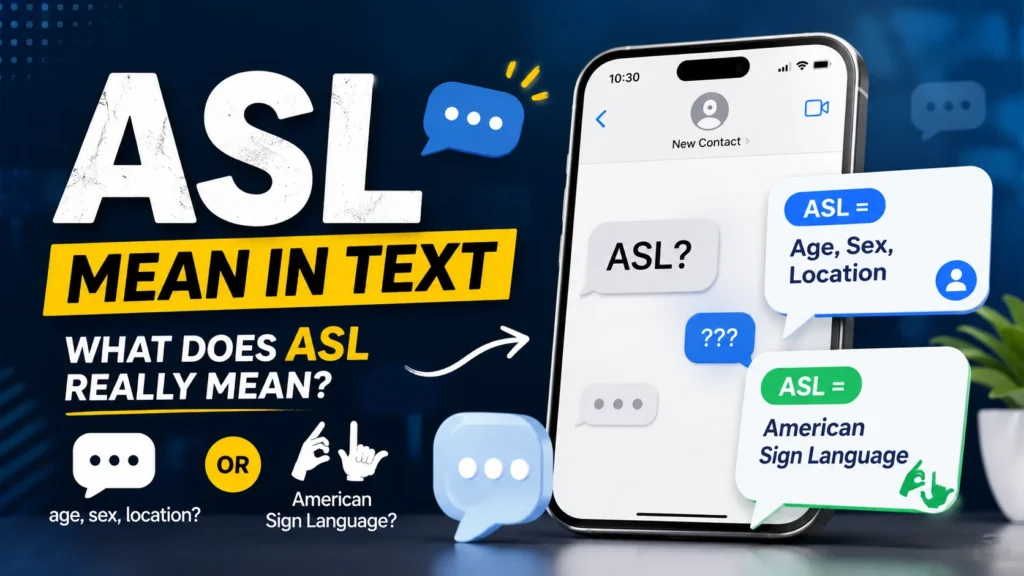
If you have received a message containing “ASL”, you may have wondered what the person actually means. In texting and online conversations, ASL can have more than one meaning, so the surrounding conversation matters.
The most common traditional meaning of ASL in text is “age, sex, location.” It was especially popular in early internet chatrooms and messaging platforms when people wanted to learn basic information about someone quickly.
For example:
- “Hey, ASL?”
- “ASL please?”
- “Can I get your ASL?”
In these examples, the person is generally asking for your age, sex, and location.
Today, however, ASL can also mean American Sign Language, particularly when the conversation involves communication, accessibility, deaf culture, or language.
That difference is important because the same three letters can point to completely different ideas.
ASL Mean in Text – Quick Meaning
The Most Common Texting Meaning
In older internet slang, ASL stands for:
- A = Age
- S = Sex
- L = Location
Someone asking “ASL?” is essentially asking:
“How old are you, what is your sex, and where are you from?”
This abbreviation became common in online chatrooms because it allowed people to ask three personal questions using only three letters.
ASL as American Sign Language
ASL also commonly means American Sign Language, a complete visual language used primarily by Deaf and hard-of-hearing communities in the United States and parts of Canada.
For example:
“I’m learning ASL.”
Here, ASL almost certainly means American Sign Language, not “age, sex, location.”
Why Context Matters
Modern communication is full of abbreviations. The meaning of ASL depends heavily on the topic, platform, and surrounding words.
If someone simply writes “ASL?” in a casual chat, the older slang meaning may be intended.
If someone says “Do you know ASL?”, they are much more likely to be talking about American Sign Language.
Origin & Background of ASL
Where “ASL?” Came From
The texting meaning of ASL became popular during the early days of internet chatrooms and instant messaging.
Before modern social platforms made profiles, photographs, biographies, and location information easily available, strangers had fewer ways to learn basic information about one another.
A short question such as “ASL?” became a convenient way to start a conversation.
The abbreviation was particularly associated with anonymous online chat environments.
How Its Meaning Changed
Internet language changes as technology changes.
As social media profiles became more detailed, people no longer needed to ask strangers for their age, sex, and location as frequently. The slang meaning of ASL therefore became less prominent among younger internet users.
The meaning American Sign Language remained widely established because it refers to an actual language and cultural community.
Social Media Influence
On platforms such as Instagram, TikTok, Snapchat, and messaging apps, ASL may occasionally appear in slang, but its interpretation depends strongly on context.
Someone discussing sign language will almost certainly be using ASL to mean American Sign Language.
Someone sending only “ASL?” to a stranger may be using the older chatroom abbreviation.
Real-Life Conversations Using ASL
WhatsApp Conversation
Person A: Hey, we haven’t talked before. ASL?
Person B: 22, female, Lahore. You?
Person A: 24, male, Toronto.
Here, ASL clearly means age, sex, location.
Instagram DM
Person A: I saw your post about learning sign language.
Person B: Yeah, I’m taking an ASL course.
Person A: That’s awesome. How long have you been learning?
In this conversation, ASL means American Sign Language.
TikTok Comments
Person A: Your ASL signing is really good!
Person B: Thank you! I’ve been practicing for two years.
The topic makes the intended meaning obvious.
Text Message
Person A: Someone just asked me “ASL?” in a random chat.
Person B: They probably mean age, sex, location.
Person A: That’s what I thought too.
Here, ASL is clearly being used as an old internet abbreviation.
Emotional & Psychological Meaning of ASL
Why People Ask “ASL?”
When ASL means age, sex, location, the question is often an attempt to establish basic personal information quickly.
In anonymous conversations, people naturally want some context about the person on the other side of the screen.
The abbreviation makes the request feel short and informal.
That does not automatically make the question appropriate, though. Asking someone for personal information can feel intrusive, especially when the conversation is between strangers.
What It Reveals About Online Communication
ASL is a good example of how internet language developed around speed and convenience.
People wanted to communicate quickly, so longer questions were compressed into abbreviations.
Modern slang continues this tradition through expressions such as “WYA,” “HMU,” “IDK,” and “TBH.”
A Simple Real-Life Scenario
Imagine joining an old-style online chatroom and receiving a message that simply says, “ASL?”
The person is not necessarily trying to be rude. They may simply be using the communication style common to that environment.
Understanding the era and context behind the abbreviation helps prevent unnecessary misunderstandings.
Usage in Different Contexts
Social Media
On social media, ASL may refer to American Sign Language, especially in videos, captions, educational posts, and accessibility discussions.
For example:
“This creator teaches ASL vocabulary.”
In an older-style casual chat, however, “ASL?” may still mean age, sex, location.
Friends and Relationships
Among friends, ASL is less likely to be used for “age, sex, location” because friends usually already know these details.
If someone uses ASL while discussing sign language, the American Sign Language meaning is more likely.
Work and Professional Settings
Avoid using “ASL?” in professional communication if you mean age, sex, and location.
It can sound outdated, overly personal, or unclear.
Instead, ask directly for the information you genuinely need.
For example:
“Where are you based?”
That is much clearer and more appropriate.
Casual vs. Serious Tone
“ASL?” has an informal internet-chat feel.
“American Sign Language,” on the other hand, is a formal name for a language and should be written clearly when the context requires precision.
When NOT to Use ASL
Avoid Asking Strangers for Personal Details
If you are using ASL to mean age, sex, location, be careful when speaking with strangers.
Age and location can be personal information. Sharing or requesting such details may create privacy concerns.
Avoid Ambiguous Workplace Messages
Sending “ASL?” to a coworker can create unnecessary confusion.
Professional communication benefits from direct language.
Consider Cultural and Community Context
When discussing Deaf communities or sign language, ASL refers to American Sign Language.
It should not be treated as simply another piece of internet slang in that context.
Recognizing this distinction shows respect for the language and the people who use it.
Common Misunderstandings About ASL
Mistake 1: Assuming ASL Always Means “Age, Sex, Location”
This is one of the most common misunderstandings.
Today, ASL frequently refers to American Sign Language, particularly in educational and accessibility-related conversations.
Mistake 2: Assuming ASL Always Means American Sign Language
The opposite mistake is also possible.
If someone sends only “ASL?” in an old-fashioned online chat, they may be asking for age, sex, and location.
Mistake 3: Ignoring the Conversation
Never interpret an abbreviation in isolation when the surrounding conversation provides clues.
Look at the words before and after it.
Mistake 4: Treating It as a Completely Safe Question
The phrase may be casual, but the information being requested can still be personal.
You are never required to disclose your age, sex, or location to an online stranger.
ASL vs. Similar Internet Expressions
| Expression | Meaning | Typical Context |
|---|---|---|
| ASL | Age, sex, location | Older online chat |
| ASL | American Sign Language | Language and accessibility |
| WYA | Where you at? | Texting and social media |
| WYD | What are you doing? | Casual texting |
| HMU | Hit me up | Social conversations |
| IRL | In real life | Online discussions |
| DM | Direct message | Social media |
| IMO | In my opinion | Texting and comments |
Key Insight
The important lesson is that ASL has two major meanings, and context determines which one makes sense. When the topic is online introductions, it may mean “age, sex, location.” When the topic involves signing or Deaf communication, it usually means “American Sign Language.”
Variations and Types of ASL Usage
1. ASL?
Meaning: Age, sex, location.
A short question commonly associated with older online chat culture.
2. ASL Please
Meaning: Asking someone to provide their age, sex, and location.
Adding “please” makes the request slightly more conversational.
3. What’s Your ASL?
Meaning: What are your age, sex, and location?
This is a longer version of the same internet abbreviation.
4. ASL Chat
Meaning: Online conversations where people may use the traditional ASL abbreviation.
The phrase is associated with older anonymous chat environments.
5. ASL Class
Meaning: A class for learning American Sign Language.
Here, ASL has nothing to do with age, sex, or location.
6. Learn ASL
Meaning: Learn American Sign Language.
This phrase is commonly seen in educational contexts.
7. ASL Interpreter
Meaning: A professional who interprets between ASL and another language.
The context makes the meaning clear.
8. ASL Signs
Meaning: Signs used within American Sign Language.
This usage is related to visual language and communication.
9. ASL Vocabulary
Meaning: Words or concepts expressed through American Sign Language.
This phrase commonly appears in educational content.
10. ASL Community
Meaning: A reference to people connected with American Sign Language and Deaf culture.
This usage is cultural and linguistic rather than internet slang.
How to Respond When Someone Uses ASL
Casual Replies
If someone asks “ASL?” and you are comfortable answering:
“23, male, Islamabad. You?”
You can also keep it simple:
“I’m 23 and based in Pakistan. What about you?”
Funny Replies
If you do not want to answer directly:
“Nice try 😂”
Or:
“That’s classified information.”
Humor can work when the conversation is clearly friendly.
Mature Replies
If you prefer privacy:
“I’d rather not share personal details with someone I just met.”
This communicates your boundary without being aggressive.
Respectful Replies
If you are unsure what the person means:
“Do you mean age, sex, location, or American Sign Language?”
That response is especially useful because it removes ambiguity immediately.
Regional & Cultural Usage of ASL
Western Culture
In the United States and Canada, ASL is widely recognized as American Sign Language.
The older “age, sex, location” meaning may still be understood by people familiar with early internet culture.
Asian Culture
In Asian online communities, English internet abbreviations can spread through gaming, social media, and international chat platforms.
The meaning may vary according to the person’s age and online experience.
Middle Eastern Culture
English abbreviations are also common among many internet users in Middle Eastern digital spaces.
Because ASL can involve personal information, cultural expectations around privacy should be considered before sharing details.
Global Internet Usage
Internet slang travels quickly across borders.
A person may recognize ASL without necessarily using it in the same way another person does.
That is why context remains more reliable than assumptions.
Gen Z vs. Millennials
Younger users may be more familiar with ASL as American Sign Language, especially through educational and social content.
Older internet users may recognize “ASL?” as a classic chatroom abbreviation.
Generational experience can therefore influence interpretation.
Is ASL Safe for Kids?
The meaning American Sign Language is completely different from the old chat abbreviation and is commonly discussed in educational contexts.
The “age, sex, location” usage deserves more caution.
Children should understand that they do not have to provide personal information to strangers online. Age, location, and other identifying details should be handled carefully.
Parents and educators can use ASL as an opportunity to teach children about online privacy, boundaries, and responsible communication.
Read More: OTP Mean in Text: 3 Meanings You Need to Know
FAQs About ASL Mean in Text
What does ASL mean in text?
In older internet slang, ASL means age, sex, location. In many modern contexts, ASL means American Sign Language.
What does “ASL?” mean in a chat?
“ASL?” traditionally asks for your age, sex, and location. The meaning can change depending on the conversation.
Does ASL mean American Sign Language?
Yes. ASL commonly means American Sign Language, especially when people are discussing signing, Deaf culture, accessibility, or language learning.
Is ASL still used to mean age, sex, location?
Yes, but this usage is much less common than it was during the early days of internet chatrooms.
What should I reply to “ASL?”
If you are comfortable sharing, you can answer. If you are not, simply say that you prefer not to share personal information.
Is ASL appropriate in professional messages?
If you mean “age, sex, location,” it is generally better to avoid the abbreviation in professional communication because it can sound unclear or overly personal.
How can I tell which ASL meaning someone intends?
Look at the surrounding conversation. Discussions about signing usually indicate American Sign Language, while a standalone “ASL?” in an online introduction may refer to age, sex, location.
Conclusion
Understanding ASL mean in text requires more than memorizing one definition.
The abbreviation has an interesting history in online communication. Traditionally, “ASL?” meant age, sex, location, a quick way for strangers in early chatrooms to exchange basic personal information.
Today, ASL is also strongly associated with American Sign Language, making context more important than ever.
If you see ASL in a message, do not immediately assume what the sender means. Look at the topic, wording, and platform first.
When you are unsure, asking for clarification is the easiest solution.
Clear communication is not about knowing every abbreviation. It is about understanding what the other person actually intends to say.

[…] Read More: ASL Mean in Text: What Does ASL Really Mean? […]