DW Mean in Text: What Does DW Mean in Texting?
If someone sends you “DW” in a text message, Instagram DM, Snapchat chat, or social media comment, you may wonder what those two letters mean.
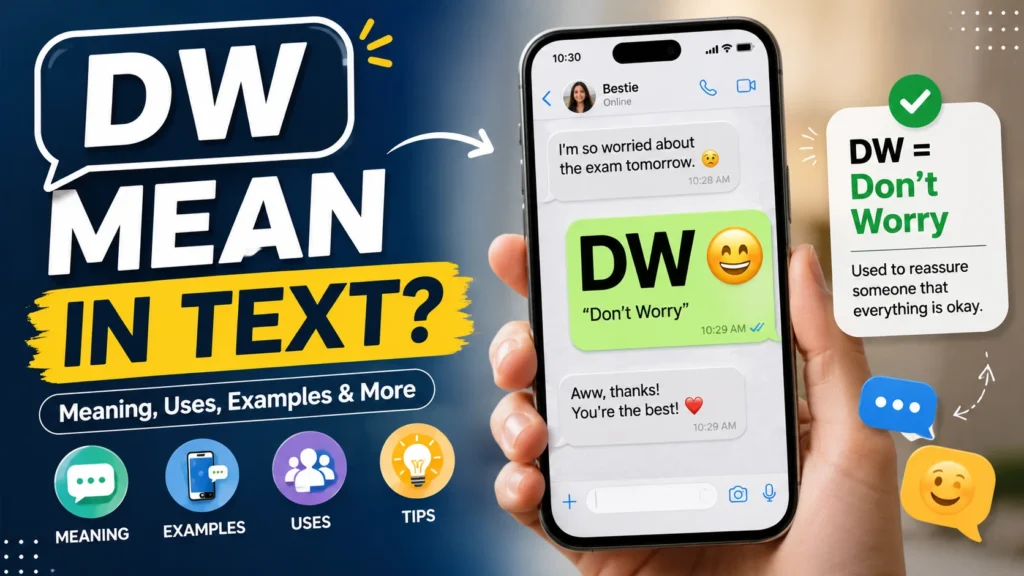
In most casual conversations, DW means “don’t worry.” It is a popular texting abbreviation people use to reassure someone, accept an apology, reduce concern, or let another person know that something is not a big problem.
For example, if your friend texts, “Sorry I’m late,” you might reply, “DW, take your time.” In this context, DW simply means “don’t worry.”
The abbreviation is short, convenient, and easy to use. It fits naturally into fast-moving digital conversations where people often prefer quick responses instead of complete sentences.
You may see DW mean in text searches because abbreviations can be confusing when they appear without context. The same two letters can occasionally have different meanings in specialized conversations, which makes context important.
For ordinary texting, however, DW most commonly stands for “don’t worry.”
This guide explains what DW means, where it is used, how it sounds emotionally, what it means on social media, when you should avoid it, and how to respond when someone sends it.
DW Mean in Text: Quick Meaning
DW in text usually means “don’t worry.”
It is an informal abbreviation used mainly in casual digital communication.
DW Meaning at a Glance
DW = Don’t Worry
People use it to communicate ideas such as:
- Don’t worry about it.
- Everything is okay.
- It’s not a problem.
- You’re fine.
- There is no need to stress.
- I’m not upset.
- You don’t need to apologize.
For example:
“Sorry I forgot to call.”
“DW, it’s okay.”
Another example:
“I might be 10 minutes late.”
“DW, take your time.”
The basic meaning remains the same, but the emotional tone changes depending on the conversation.
Is DW a Word or Abbreviation?
DW is best understood as a texting abbreviation or initialism for “don’t worry.”
People sometimes call DW slang because it belongs to informal internet language. Strictly speaking, it is more accurate to call it an abbreviation.
The distinction is not particularly important in everyday conversation. What matters is knowing how people actually use it.
What Does DW Stand For in Texting?
DW stands for “don’t worry.”
It is normally written in uppercase letters, although lowercase “dw” is also extremely common.
You might see:
“DW!”
“dw about it”
“DW, you’re good.”
“dw 😊”
All of these generally communicate the same basic idea.
DW vs. “Don’t Worry”
The difference is mainly one of style.
“Don’t worry” is the complete phrase.
“DW” is the shortened texting version.
Compare these messages:
“Don’t worry, I can take care of it.”
and:
“DW, I got it.”
The first sounds more complete. The second feels quicker and more conversational.
Neither is inherently better. The appropriate choice depends on the relationship and situation.
Why Do People Use DW in Text Messages?
Digital conversations are often fast.
People respond while commuting, studying, working, shopping, watching videos, or talking to several people at once. Short abbreviations make communication more efficient.
DW is particularly useful because “don’t worry” is a phrase people say frequently.
Instead of typing:
“Don’t worry about it. Everything is fine.”
someone can simply type:
“DW, everything’s fine.”
The abbreviation also helps create an informal atmosphere.
Texting is different from writing a business letter. Friends usually do not need perfectly structured sentences to understand each other.
DW Saves Time
The practical advantage is simple: two letters are faster than two words.
That may seem insignificant, but frequent texters naturally develop shortcuts for common expressions.
This is why abbreviations such as DW, BTW, IDK, TBH, IMO, FYI, and NP remain recognizable in online communication.
DW Makes Conversations Feel Casual
The abbreviation can make a message feel less formal.
For example:
“Please do not be concerned.”
sounds formal.
“Don’t worry.”
sounds normal and conversational.
“DW.”
sounds especially casual.
The choice communicates something about the relationship between the people involved.
Origin and Background of DW
DW developed as part of the broader evolution of digital communication.
Shortened expressions became increasingly common with SMS texting, instant messaging, chat rooms, online forums, and later social media platforms.
Early mobile messaging encouraged brevity because typing on physical or limited mobile keyboards was less convenient than typing on modern smartphones.
As texting culture developed, users created and adopted abbreviations for frequently used expressions.
“Don’t worry” naturally became DW.
From SMS to Social Media
The abbreviation did not remain limited to traditional text messages.
As communication moved toward platforms such as Instagram, Snapchat, Facebook Messenger, TikTok, Discord, and other messaging services, texting language traveled with it.
Today, someone may use DW in a private message, public comment, group chat, or casual conversation without thinking of it as unusual.
How the Meaning Evolved
The basic meaning has remained stable.
What has changed is the emotional range.
DW can now communicate:
- reassurance
- forgiveness
- emotional support
- patience
- casual acceptance
- encouragement
- dismissal, depending on tone
That last possibility is important.
A short abbreviation does not automatically communicate warmth. The surrounding words and relationship determine how it is received.
DW in Real-Life Conversations
Understanding DW meaning in text becomes much easier when you see realistic examples.
WhatsApp Example
Person A:
“Sorry, I completely forgot to send the file.”
Person B:
“DW, just send it when you get home.”
Here, DW reassures Person A that the mistake is not serious.
Instagram DM Example
Person A:
“OMG I accidentally sent that message to the wrong person 😭”
Person B:
“DW 😂 it happens.”
The abbreviation makes the embarrassing situation feel less serious.
TikTok Comment Example
Person A:
“I don’t understand this trend at all.”
Person B:
“DW, I had to watch it three times 😂”
Here, DW creates a sense of shared experience.
Text Message Example
Person A:
“I’m sorry I couldn’t come today.”
Person B:
“DW. We can meet another day.”
This communicates acceptance without making the conversation unnecessarily emotional.
Emotional and Psychological Meaning of DW
The phrase “don’t worry” has an emotional function that goes beyond its dictionary meaning.
People often worry because they believe they have made a mistake, disappointed someone, caused inconvenience, or created a problem.
A reassuring message can reduce that emotional pressure.
When someone writes “DW,” they may effectively be saying:
“You’re okay.”
“I’m not angry.”
“It’s not a big deal.”
“You don’t need to feel guilty.”
Why Reassurance Matters in Texting
Text communication lacks many nonverbal signals.
In person, a smile or calm voice can make reassurance obvious.
In a text, the reader has to interpret the words without seeing the sender’s expression.
That is why punctuation, emojis, additional words, and context can dramatically change the emotional meaning.
Compare:
“DW 😊”
with:
“DW.”
The first often feels warmer.
The second may be perfectly friendly between close friends, but it could also feel abrupt in a sensitive conversation.
A Personal-Style Example
Imagine a friend messages you after making a small mistake:
“I think I messed everything up. Sorry.”
If you respond:
“DW, you didn’t mess anything up.”
you are doing more than sharing information.
You are helping that person feel safe enough to stop overthinking the situation.
That is one reason short reassurance phrases remain powerful in everyday communication.
DW Usage in Different Contexts
DW on Social Media
DW is common in informal social media communication.
You may encounter it in:
- Instagram DMs
- Snapchat messages
- TikTok comments
- Facebook Messenger
- Discord chats
- Group chats
- Online communities
It works especially well when people are already using casual language.
DW Between Friends
Friends often use DW after someone apologizes.
For example:
“Sorry I forgot!”
“DW!”
The response is short because the relationship already provides context.
DW in Romantic Conversations
Partners may use DW to comfort each other.
For example:
“Sorry I made you wait.”
“DW ❤️ I know you were busy.”
In romantic conversations, however, additional wording can make reassurance feel more sincere.
DW With Family
Family members may also use DW, particularly in informal texting.
For example:
“Sorry Mom, I’ll be home late.”
“DW, just let me know when you arrive.”
The abbreviation keeps the conversation relaxed.
DW at Work
Workplace use requires more judgment.
In a casual team chat, DW may be acceptable:
“DW, I’ll handle the update.”
In a formal email, it is better to write:
“No problem. I’ll handle the update.”
Professional communication should prioritize clarity and appropriate tone over texting shortcuts.
DW in a Serious Conversation
A serious situation deserves more context.
If someone says:
“I’m really worried about what is happening.”
replying only:
“DW.”
could sound dismissive.
A better response might be:
“I understand why you’re worried. Let’s talk about it.”
The difference is not the abbreviation itself. It is the amount of emotional attention the situation requires.
When Not to Use DW
Knowing when not to use an abbreviation is just as important as knowing what it means.
Avoid DW in Formal Business Writing
Do not normally use DW in:
- formal emails
- official letters
- academic writing
- job applications
- customer-service communication
- legal communication
- formal reports
Use the complete phrase or a professional alternative.
Instead of:
“DW about the delay.”
write:
“Please don’t worry about the delay.”
Avoid DW When Someone Is Distressed
If a person is experiencing serious emotional distress, “DW” may feel too brief.
They may need acknowledgment rather than immediate reassurance.
A better response could be:
“I understand why this is worrying you. I’m here to listen.”
Avoid It With People Who May Not Know Texting Abbreviations
Not everyone uses internet shorthand.
If you are communicating with an older relative, unfamiliar client, new colleague, or someone who speaks English as an additional language, the complete phrase may be clearer.
Common Misunderstandings About DW
“DW” Does Not Always Mean “Everything Is Fine”
The abbreviation communicates reassurance, but it does not necessarily solve the underlying problem.
Someone may say:
“DW, we’ll figure it out.”
The problem still exists. They are simply saying that there is no need to panic.
DW Can Sound Dismissive
This is one of the most important points about DW meaning in text.
A person may intend to sound reassuring, but the reader may interpret the message as:
“Stop talking about it.”
This is especially possible when DW appears alone.
Adding context helps.
Instead of:
“DW.”
try:
“DW, I understand what happened.”
DW Is Not the Same as “IDK”
These abbreviations have completely different meanings.
DW = Don’t worry
IDK = I don’t know
Understanding the context prevents confusion.
DW Is Not the Same as “BTW”
DW means “don’t worry.”
BTW means “by the way.”
Both are common texting abbreviations, but they serve different purposes.
DW Compared With Similar Texting Expressions
| Expression | Meaning | Tone | Common Use |
|---|---|---|---|
| DW | Don’t worry | Casual | Reassurance |
| No worries | It’s okay | Friendly | Apologies/problems |
| NP | No problem | Casual | Accepting requests/apologies |
| All good | Everything is fine | Casual | Reassurance |
| You’re good | You did nothing wrong | Very casual | Reassurance |
| It’s okay | No problem | Neutral | Comfort |
| Relax | Stop worrying | Casual | Can sound dismissive |
| I got you | I’ll handle/help | Friendly | Support |
| No need to worry | Don’t be concerned | Neutral/formal | Reassurance |
| Don’t stress | Don’t worry | Casual | Emotional reassurance |
Key Insight
DW is one of the shortest ways to reassure someone, but it is not always the warmest. When emotions are serious, a complete sentence can communicate empathy more effectively.
Variations and Types of DW
1. DW
The simplest form means “don’t worry.”
“DW!”
It is common among people who already have a casual relationship.
2. DW About It
This means “don’t worry about the situation.”
“DW about it.”
It is often used after someone apologizes.
3. DW, You’re Good
This means “you haven’t done anything wrong.”
“DW, you’re good.”
It is especially common in casual conversations.
4. DW LOL
Adding “LOL” makes the message playful.
“DW LOL, everyone makes mistakes.”
5. DW 😊
The emoji can make the abbreviation feel softer.
“DW 😊”
This is useful when reassurance is intended to sound warm.
6. DW ❤️
The heart can communicate affection or emotional closeness.
“DW ❤️ everything will be okay.”
7. DW, I Got You
This adds an element of support.
“DW, I got you.”
The meaning becomes closer to “Don’t worry; I’ll help.”
8. DW, Take Your Time
This communicates patience.
“DW, take your time.”
It is useful when someone feels guilty about being late.
9. DW, It Happens
This normalizes a mistake.
“DW, it happens.”
The speaker is saying that the situation is understandable.
10. DW About Me
This means “don’t worry about me.”
“DW about me. I’ll be fine.”
It can be used when someone is concerned about the sender.
How to Respond When Someone Says DW
Your response depends on the situation.
Casual Responses
You can simply say:
- “Thanks!”
- “Okay!”
- “Got it.”
- “Appreciate it.”
- “Thanks 😊”
Funny Responses
With close friends:
- “I already worried 😂”
- “I’ll try!”
- “Too late 😂”
- “Okay, boss!”
- “Fine, I’m calm now 😂”
Mature Responses
For a more meaningful conversation:
- “Thanks for reassuring me.”
- “I really appreciate that.”
- “That makes me feel better.”
- “Thanks for understanding.”
Respectful Responses
For professional or unfamiliar relationships:
- “Thank you, I appreciate your understanding.”
- “Thanks for letting me know.”
- “I appreciate the reassurance.”
Regional and Cultural Usage of DW
The basic definition of DW is generally consistent across global English-language internet communities.
The style of use can vary.
Western Culture
In the United States, Canada, the United Kingdom, Australia, and similar English-speaking online communities, DW is widely recognizable as “don’t worry.”
It is particularly natural among friends and younger digital users.
Asian Culture
English texting abbreviations are common among many internet users across Asia.
Younger bilingual or English-speaking users may understand DW immediately.
In more formal settings, spelling out the phrase is often clearer.
Middle Eastern Culture
Many multilingual internet users in the Middle East combine English abbreviations with Arabic expressions and transliterated language.
DW may therefore appear naturally in mixed-language conversations.
The intended meaning is generally still “don’t worry.”
Global Internet Usage
Social media has created a shared digital vocabulary.
A person can use an abbreviation in one country and be understood by someone thousands of miles away.
Still, internet language is not completely universal.
Context remains the safest guide.
Gen Z vs. Millennials
Both Gen Z and Millennials commonly understand many texting abbreviations.
The difference often comes down to communication habits rather than age.
Someone who spends a lot of time texting and using social media is more likely to recognize DW immediately.
Is DW Safe for Kids?
Yes. In its ordinary texting use, DW meaning “don’t worry” is harmless.
It is simply a shortened way of offering reassurance.
Parents and educators should still remember that abbreviations can occasionally have alternate meanings in specific communities.
When an unfamiliar abbreviation appears in a child’s conversation, the surrounding messages provide important context.
SEO-Friendly FAQ: DW Meaning in Text
What does DW mean in text?
DW usually means “don’t worry” in text messages. It is an informal abbreviation used to reassure someone or tell them that something is not a problem.
What does DW mean in texting from a girl?
If a girl texts “DW,” it generally means “don’t worry.” Depending on the conversation, she may be reassuring you, accepting an apology, or telling you not to stress.
What does DW mean in texting from a guy?
When a guy sends “DW,” it normally means “don’t worry.” The exact tone depends on the surrounding conversation and relationship.
What does DW mean on Instagram?
On Instagram, DW generally means “don’t worry.” It can appear in DMs, comments, replies, or casual conversations.
What does DW mean on Snapchat?
On Snapchat, DW typically means “don’t worry.” It is commonly used when someone wants to reassure another person.
Is DW rude in texting?
DW is not automatically rude. However, using only “DW” during a serious conversation may feel dismissive. Adding context can make the response sound more caring.
What should I reply when someone says DW?
You can reply with “Thanks,” “I appreciate it,” “Got it,” “Thanks for understanding,” or a more playful response if the conversation is casual.
DW vs. Don’t Worry: Which Should You Use?
Choosing between DW and “don’t worry” depends on your audience.
Use DW when:
- You are texting friends.
- The conversation is informal.
- The other person understands texting abbreviations.
- You want to keep the response short.
- The situation is not especially serious.
Use “don’t worry” when:
- The conversation is emotionally important.
- You are speaking with someone unfamiliar with texting slang.
- You want to sound warmer.
- The context requires clarity.
- You are communicating professionally.
There is no universal rule that says abbreviations are better or worse.
Effective communication comes from matching your language to the person and situation.
How DW Fits Into Modern Digital Language
Texting has created a communication style that sits somewhere between spoken conversation and traditional writing.
People rarely type exactly as they would write an essay.
They use contractions, abbreviations, emojis, lowercase letters, repeated punctuation, memes, GIFs, and shortened expressions.
DW fits naturally into this environment.
It is quick enough for rapid conversations but clear enough that most frequent internet users recognize it immediately.
Why Short Expressions Still Matter
Short expressions can carry emotional meaning.
“DW” may communicate reassurance.
“LOL” can soften a statement.
“TBH” can signal honesty.
“IDK” can communicate uncertainty.
These abbreviations are not simply about saving characters. They also help people shape the personality and rhythm of digital conversations.
Tips for Using DW Naturally
If you want your texting to sound natural, consider the context before using DW.
Match the Other Person’s Style
If someone writes complete sentences and uses formal language, replying with multiple abbreviations may feel unnatural.
If someone regularly uses casual shorthand, DW will probably fit comfortably.
Add Words When Emotions Are Strong
Instead of:
“DW.”
try:
“DW, I understand. You didn’t do anything wrong.”
The second version provides emotional reassurance as well as information.
Use Emojis Carefully
A simple emoji can clarify tone.
“DW 😊”
feels different from:
“DW 😐”
Digital communication often depends on these small signals.
Do Not Overuse Abbreviations
Using too many abbreviations can make messages harder to read.
A natural conversation usually mixes short forms with ordinary language.
Final Conclusion: What Does DW Mean in Text?
So, what does DW mean in text?
In most everyday digital conversations, DW means “don’t worry.”
It is a common texting abbreviation used to reassure someone, accept an apology, reduce anxiety, or communicate that a situation is not a major problem.
You may see DW in text messages, WhatsApp chats, Instagram DMs, Snapchat, TikTok comments, Discord, and other informal online conversations.
The abbreviation is simple, but its tone can vary.
“DW 😊” may feel warm and comforting. A single “DW” may feel neutral or, in some situations, slightly dismissive.
That is why context matters.
For friends and casual conversations, DW is perfectly natural. For professional communication or emotionally serious discussions, spelling out “don’t worry” or adding a more thoughtful sentence is usually a better choice.
The most important thing is not simply knowing what DW stands for. It is understanding when, where, and how the abbreviation sounds natural.
Once you understand that difference, you can recognize DW confidently and use it without confusion.