DND Meaning in WhatsApp: What Does DND Mean?

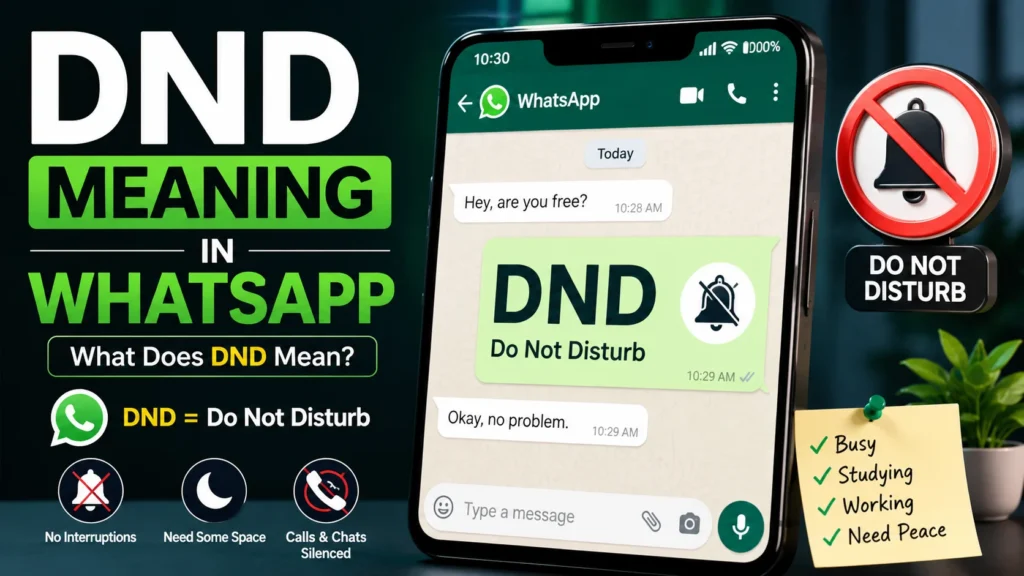
If you have seen **“DND” in a WhatsApp conversation, status, or message and wondered what it means, you are not alone. Short forms have become a natural part of online communication, especially when people want to express something quickly without writing a full sentence.
In WhatsApp conversations, DND usually means “Do Not Disturb.” It is commonly used when someone does not want to be interrupted, called, messaged repeatedly, or distracted for a certain period.
For example, someone might text, “DND, I’m studying” to tell friends that they should avoid disturbing them. Another person may simply write “DND for a while” when they need some uninterrupted time.
The meaning can depend slightly on the situation. Sometimes DND refers to a person’s availability, while in other situations it can refer specifically to the Do Not Disturb feature on a phone.
Understanding the context helps you know whether someone is simply busy, asking for privacy, or talking about a device setting.
DND Meaning in WhatsApp – Quick Meaning
What Does DND Mean in WhatsApp?
DND in WhatsApp usually means “Do Not Disturb.”
It communicates that a person does not want to be interrupted at the moment.
Common interpretations include:
- DND = Do Not Disturb
- I am busy right now.
- Please do not interrupt me.
- I need some quiet time.
- I may not reply immediately.
- Please avoid calling or messaging repeatedly.
For example:
“DND, I have an exam tomorrow.”
This means the person wants others to leave them undisturbed while studying.
Another example is:
“Going DND for two hours.”
This means the person plans to stay unavailable or avoid interruptions for two hours.
Is DND a WhatsApp-Specific Acronym?
No. DND is not exclusive to WhatsApp.
It is a widely recognized abbreviation used in texting, social media, smartphones, workplaces, and everyday digital communication.
On WhatsApp, however, people frequently use it informally to explain why they may not respond quickly.
Origin and Background of DND
Where Did “Do Not Disturb” Come From?
The phrase “Do Not Disturb” has existed long before smartphones and messaging apps.
Historically, people used “Do Not Disturb” signs to communicate that they did not want to be interrupted. Hotels, offices, hospitals, and private rooms have used similar notices to indicate that someone wanted privacy.
Digital communication shortened the phrase to DND, making it easier to type and understand.
DND in Modern Technology
The abbreviation became even more familiar with the growth of mobile phones.
Many smartphones now have a Do Not Disturb mode that can silence notifications, calls, alerts, or other interruptions according to the user’s settings.
Because people regularly see “DND” in their device settings, the abbreviation has naturally moved into casual conversations.
How Social Media Influenced DND
Messaging platforms have made abbreviations like DND part of everyday language.
Instead of saying:
“Please don’t contact me for the next few hours because I need to concentrate.”
A person can simply say:
“DND for a few hours.”
The shorter version communicates the same basic idea with much less effort.
DND Meaning in Real-Life WhatsApp Conversations
The best way to understand DND meaning in WhatsApp is to see how people actually use it.
WhatsApp Conversation 1: Studying
Aisha: Are you coming online tonight?
Maya: Probably not. DND, I have an exam tomorrow.
Aisha: Got it. Good luck!
Here, DND politely tells Aisha that Maya wants uninterrupted study time.
WhatsApp Conversation 2: Work
Ali: Can I call you?
Hamza: Not right now. DND until 4 PM.
Ali: Sure, I’ll call later.
In this situation, DND communicates temporary unavailability.
WhatsApp Conversation 3: Needing Personal Space
Sara: You disappeared. Everything okay?
Nadia: Yeah, I’m fine. Just going DND for a little while.
Sara: No worries. Take your time.
Here, DND suggests that Nadia wants some quiet or personal space rather than necessarily being busy with work.
WhatsApp Conversation 4: Avoiding Repeated Calls
Bilal: Why aren’t you answering?
Usman: I’m DND right now. I’ll message you when I’m free.
Bilal: Okay, no problem.
This use makes the person’s boundary clear without sounding unnecessarily harsh.
Emotional and Psychological Meaning of DND
DND Can Communicate a Boundary
One important reason people use DND is to establish a small communication boundary.
Constant notifications can make people feel mentally overloaded. Work messages, family conversations, social media updates, and personal chats can all compete for attention.
Saying “DND” gives someone a simple way to communicate:
“I need a break from communication right now.”
DND Does Not Always Mean Anger
A common mistake is assuming that someone using DND is angry.
That is not necessarily true.
A person may use DND because they are:
- Studying
- Working
- Sleeping
- Driving
- Exercising
- Attending a meeting
- Spending time with family
- Feeling mentally tired
- Taking a break from their phone
The surrounding conversation is important before interpreting the emotion.
A Realistic Everyday Scenario
Imagine someone is preparing for an important presentation. Their WhatsApp notifications keep appearing while they are trying to concentrate.
They might tell friends:
“DND until I finish this presentation.”
That message is less about rejecting people and more about protecting their concentration.
This is one reason short expressions such as DND have become useful in modern communication.
DND Usage in Different Contexts
DND on WhatsApp
On WhatsApp, DND can be used to tell contacts that someone is temporarily unavailable.
For example:
“DND right now. Text me later.”
The person may still receive messages depending on their phone settings, but they are communicating that they do not want to engage immediately.
DND on Social Media
People may also use DND in Instagram captions, stories, comments, or direct messages.
For example:
“DND today. I need a social media break.”
This use often has a casual or personal tone.
DND Between Friends
Friends may use DND when they are busy or want some uninterrupted time.
“DND, I’m gaming.”
The message does not necessarily sound serious. It can simply mean:
“Don’t disturb me for now.”
DND in Relationships
In relationships, DND can be more sensitive.
If someone says:
“I need some time. DND for tonight.”
It could mean they are emotionally overwhelmed and need space.
The phrase itself does not explain the reason. The relationship and previous conversation provide the necessary context.
DND at Work
DND can be useful in professional conversations, but complete sentences are generally clearer.
Instead of simply saying:
“DND.”
A professional message could be:
“I’m unavailable until 3 PM. Please message me afterward.”
This reduces the possibility of confusion.
When Not to Use DND
Avoid It When the Situation Requires Clarity
If someone urgently needs to know when you will become available, simply writing “DND” may not be enough.
For example, if a manager is waiting for an important update, a clearer message is better:
“I’m in a meeting until 2 PM. I’ll respond afterward.”
Avoid DND in Formal Communication
DND is an abbreviation, so it may sound too casual for formal emails, official notices, or important professional communication.
In those situations, write “Do Not Disturb” or explain your availability directly.
Be Careful in Emotional Conversations
If someone is discussing a serious personal issue, suddenly replying “DND” can feel dismissive.
A more considerate response could be:
“I need some time to process this. Can we talk later tonight?”
The message remains clear while acknowledging the other person’s feelings.
Cultural Sensitivity Matters
Communication styles differ across cultures and generations.
Some people immediately understand DND. Others may interpret it as rude, cold, or overly direct.
When speaking with someone unfamiliar with internet abbreviations, a complete sentence is often safer.
Common Misunderstandings About DND
DND Always Means Someone Is Angry
False.
DND generally means that someone does not want to be disturbed. Anger is only one possible interpretation, and often not the correct one.
DND Means Someone Is Ignoring You
Not necessarily.
Someone can genuinely be busy, asleep, studying, or taking a break.
A DND message may actually be a polite way of preventing you from wondering why they have not replied.
DND Means They Will Never Reply
No.
DND usually communicates temporary unavailability, not permanent rejection.
If someone says:
“DND until 6 PM.”
They are specifically indicating that they expect to be available afterward.
DND Always Refers to WhatsApp Settings
Not necessarily.
In a conversation, DND can simply mean “Do Not Disturb” as a social request.
The exact interpretation depends on the sentence.
DND Compared With Similar Expressions
| Expression | Meaning | Typical Tone | Common Use |
|---|---|---|---|
| DND | Do Not Disturb | Casual | Texting and messaging |
| BRB | Be Right Back | Casual | Temporary absence |
| AFK | Away From Keyboard | Casual | Gaming and online chats |
| Busy | Currently unavailable | Neutral | General communication |
| Offline | Not currently online | Neutral | Social media and messaging |
| GTG | Got to Go | Casual | Ending a conversation |
| TTYL | Talk to You Later | Friendly | Delaying a conversation |
| Leave me alone | Do not contact me | Direct/strong | Requesting space |
| Unavailable | Not available | Professional | Work and formal settings |
Key Insight
DND is mainly about avoiding interruptions, while expressions such as BRB and TTYL focus more on when someone will return or communicate again. The right expression depends on what you want the other person to understand.
Variations and Types of DND Usage
1. DND Right Now
Means the person does not want to be disturbed at the current moment.
“DND right now.”
2. DND for a While
Indicates temporary unavailability without specifying an exact duration.
“I’m going DND for a while.”
3. DND Until Later
Provides a general indication that the person will become available later.
“DND until tonight.”
4. DND While Studying
Used when someone needs concentration for school, college, or exams.
“DND, studying for finals.”
5. DND While Working
Means the person is focusing on work.
“DND during work hours.”
6. DND While Sleeping
Used when someone wants uninterrupted rest.
“DND, I’m sleeping.”
7. DND for Mental Space
Can communicate a need for personal or emotional space.
“Taking some time for myself. DND.”
8. DND During a Meeting
Indicates that someone cannot respond because they are attending a meeting.
“DND until my meeting ends.”
9. DND Mode
This can refer either to someone’s personal communication status or a phone’s Do Not Disturb setting.
“My phone is on DND mode.”
10. DND Today
A broader expression suggesting that someone wants to stay away from communication for the day.
“DND today. Catch you tomorrow.”
How to Respond When Someone Says DND
Your response should depend on your relationship with the person and the situation.
Casual Replies
- “Sure, no worries.”
- “Got it!”
- “Okay, text me later.”
- “All good.”
Funny Replies
- “Entering silent mode, huh?”
- “Okay, I’ll stop disturbing the peace 😂”
- “DND accepted!”
- “I’ll return when the DND spell wears off.”
Mature Replies
- “Sure. Take the time you need.”
- “Understood. I’ll reach out later.”
- “No problem. Focus on what you need to do.”
Respectful Replies
- “Of course. I’ll give you some space.”
- “No worries. Message me whenever you’re available.”
- “Understood. Take care.”
A good response does not pressure someone who has clearly asked for uninterrupted time.
Regional and Cultural Usage of DND
Western Culture
In the United States, Canada, the United Kingdom, and other English-speaking communities, DND is widely understandable in digital communication.
People may use it casually among friends, colleagues, and online communities.
Asian Culture
In Asian online communities, English abbreviations are frequently mixed with local languages.
DND can appear in English-language WhatsApp messages even when the rest of the conversation is written in another language.
The tone may range from playful to serious depending on the relationship.
Middle Eastern Culture
English abbreviations are also common among many digitally connected users in Middle Eastern communities.
DND may be used among friends and younger users, particularly in informal messaging.
The level of directness can vary considerably depending on the person and relationship.
Global Internet Usage
DND has become recognizable beyond native English-speaking communities because smartphone settings and social platforms have helped spread digital abbreviations worldwide.
Its core meaning remains consistent:
Do Not Disturb.
Gen Z vs. Millennials
Gen Z users often combine DND with other internet expressions, emojis, memes, and short status updates.
Millennials may also use DND, particularly because the abbreviation has been present in digital technology for years.
The difference is often less about meaning and more about style.
Is DND Safe for Kids?
Yes, DND itself is generally harmless because it simply stands for “Do Not Disturb.”
Children and teenagers may use it to tell friends they are studying, sleeping, playing games, or taking a break.
Parents should still consider the context in which a child is using unfamiliar slang or abbreviations.
If a child repeatedly uses DND to avoid communication with family members, teachers, or trusted adults, the situation may deserve a calm conversation. The abbreviation itself is not the concern; the behavior and context are what matter.
FAQs About DND Meaning in WhatsApp
What does DND mean in WhatsApp?
DND usually means “Do Not Disturb” in WhatsApp. It tells someone that the person does not want to be interrupted or may not respond immediately.
What does DND mean in a WhatsApp chat?
In a WhatsApp chat, DND generally means “Do Not Disturb.” Someone may use it when studying, working, sleeping, resting, or simply wanting some personal space.
Does DND mean someone is ignoring you?
Not necessarily. DND usually indicates temporary unavailability rather than intentional ignoring. The person may reply when they become free.
Is DND rude on WhatsApp?
DND is not automatically rude. However, sending only “DND” during a sensitive or serious conversation may sound abrupt. A more considerate explanation can make the message friendlier.
What is the difference between DND and AFK?
DND means “Do Not Disturb,” while AFK means “Away From Keyboard.” DND focuses on avoiding interruptions, whereas AFK generally indicates that someone is temporarily away from their device or activity.
Can DND mean something else?
Yes. DND can have other meanings in different subjects or communities. In everyday WhatsApp messaging, however, “Do Not Disturb” is one of the most common interpretations.
How should I respond to DND?
A simple response such as “Sure, no worries” is usually appropriate. If the person has asked for space, respecting that request is better than repeatedly messaging them.
Conclusion
So, what does DND mean in WhatsApp? In most casual conversations, DND means “Do Not Disturb.”
It is a short and practical way to tell someone that you are busy, resting, studying, working, or simply looking for some uninterrupted time.
The important thing is not to assume that DND means anger or rejection. Context matters. A friend saying “DND, studying” is communicating something very different from someone saying “DND” during a difficult emotional conversation.
Used thoughtfully, DND can make digital communication easier. It gives people a quick way to set boundaries without writing a long explanation.
If you understand the situation around the abbreviation, you can also respond appropriately—whether that means giving someone space, waiting until later, or simply saying, “No worries.”