TTYL Full Form in Chat: Meaning, Uses & Examples

If someone sends you “TTYL” in a text message, WhatsApp conversation, Instagram DM, or social media chat, you may wonder what these four letters actually mean.
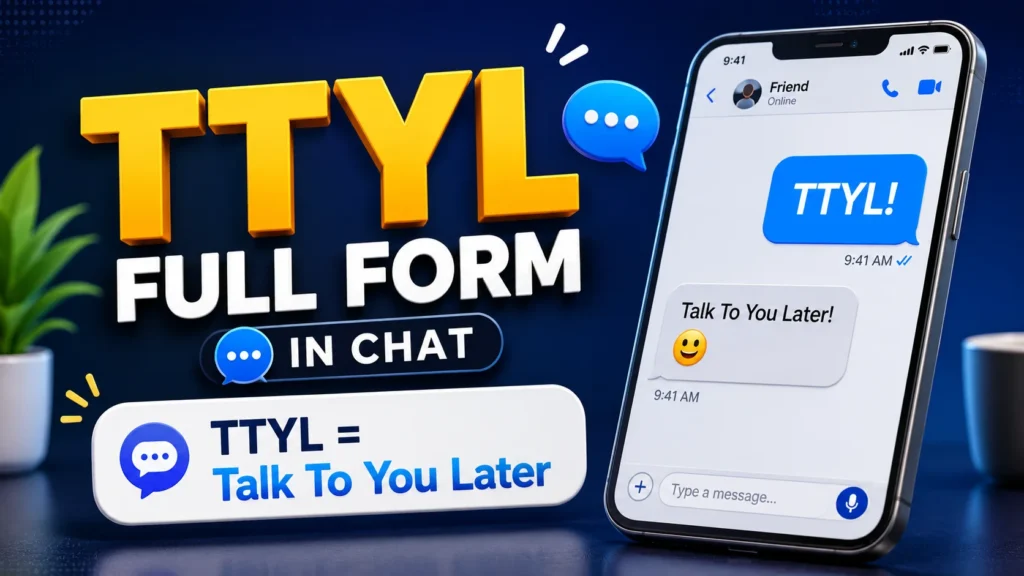
The TTYL full form in chat is “Talk to You Later.” It is a popular informal abbreviation used when someone wants to end a conversation for the moment while indicating that they expect to communicate again later.
TTYL is common in everyday digital communication because it is short, convenient, and easy to understand. Instead of typing “I have to go now, but I’ll talk to you later,” someone can simply write, “TTYL.”
The expression is usually friendly rather than negative. Still, its tone can change depending on the conversation, punctuation, emojis, and relationship between the people involved.
Understanding TTYL meaning in chat helps you recognize whether someone is simply leaving temporarily, being casual, or using the expression in a more playful way.
TTYL Full Form in Chat
The full form of TTYL in chat is “Talk to You Later.”
Each letter represents a word:
- T = Talk
- T = To
- Y = You
- L = Later
It is primarily used in informal texting and online conversations.
For example:
“I have to finish my assignment. TTYL!”
This means:
“I have to finish my assignment. Talk to you later!”
Another example is:
“I’m going to dinner now, TTYL 😊”
The sender is simply letting you know that they are leaving the conversation for now.
What Does TTYL Mean in Texting?
TTYL means “Talk to You Later.” It tells the other person that the current conversation is ending temporarily.
It can communicate several ideas at once:
- I have to leave now.
- I cannot continue chatting at the moment.
- I expect to talk to you again.
- The conversation is not necessarily finished permanently.
- I am ending the chat in a casual way.
The exact meaning is normally easy to understand from the surrounding conversation.
Is TTYL a Friendly Expression?
Yes. TTYL is generally considered casual and friendly.
Compare these messages:
“Bye.”
and
“Okay, TTYL 😊”
The first can sound more final or neutral. The second suggests that the person intends to reconnect later and may feel warmer because of the emoji.
Tone always depends on context.
Why Do People Use TTYL in Chat?
Online communication is fast. People often prefer short expressions that communicate an entire idea without requiring a complete sentence.
Typing TTYL is quicker than writing “Talk to you later.”
The abbreviation also fits naturally into the informal style of messaging.
People may use TTYL when they are:
- Going to class
- Starting work
- Having dinner
- Going to sleep
- Meeting someone
- Driving or traveling
- Busy with family
- Leaving social media
- Ending a long conversation
- Temporarily unavailable
For example:
“My class is starting. TTYL!”
The sender does not need to provide a lengthy explanation.
Origin and Background of TTYL
TTYL developed as part of the broader culture of internet slang and text-message abbreviations.
As SMS texting, instant messaging, and online chat became popular, people began shortening frequently used phrases. Common expressions such as “Talk to You Later” were naturally transformed into TTYL.
The abbreviation became particularly recognizable through early online messaging and texting culture.
It later continued into social media platforms and modern messaging applications.
From Text Messages to Social Media
The meaning of TTYL has remained remarkably consistent even as communication platforms have changed.
People have used it across:
- SMS
- Instant messaging
- Online chatrooms
- Email-style informal messages
- Snapchat
- Facebook Messenger
- TikTok
- Gaming chats
Its continued use shows how some internet abbreviations can become established parts of everyday language.
Has the Meaning of TTYL Changed?
The basic meaning has not changed.
TTYL still means “Talk to You Later.”
What has changed is the way people express emotion around it.
A person might write:
“TTYL.”
Another might write:
“TTYL 😂”
Someone else may write:
“Okayyy TTYL ❤️”
The abbreviation remains the same, but punctuation, spelling, and emojis can make the message sound more serious, playful, affectionate, or casual.
TTYL in Real-Life Conversations
Looking at realistic examples makes the meaning much easier to understand.
WhatsApp Conversation
Person A:
Are you still coming to the movie tonight?
Person B:
Yes, definitely. I just need to finish some work first.
Person A:
Okay, let me know when you’re leaving.
Person B:
Sure. I have to get back to work now. TTYL!
Here, TTYL means that Person B needs to stop chatting temporarily.
Instagram DM
Person A:
Did you see the new café everyone is posting about?
Person B:
Yes! It looks really good.
Person A:
We should go there this weekend.
Person B:
I’m in! I have to attend a meeting now. TTYL 😊
The expression is friendly and suggests that the conversation can continue later.
Text Message Between Friends
Person A:
Are you free to talk?
Person B:
Not right now. I’m helping my brother with something.
Person A:
No worries.
Person B:
I’ll text you later. TTYL.
The sender is not rejecting the conversation. They simply cannot talk at that moment.
Casual Relationship Conversation
Person A:
I’m exhausted. I think I’m going to sleep.
Person B:
Already? 😂
Person A:
Yes, today was crazy.
Person B:
Okay, TTYL ❤️
In this context, the expression can feel warm and affectionate.
TikTok or Social Media Conversation
Person A:
That video you sent me was hilarious 😂
Person B:
Wait until you see the next one.
Person A:
Send it!
Person B:
I have to go for dinner. TTYL.
The phrase works naturally in quick online conversations.
Emotional and Psychological Meaning of TTYL
Although TTYL is technically an abbreviation, it can perform an important social function.
When someone says “TTYL,” they are often doing more than announcing that they are leaving.
They are also managing the ending of a conversation.
A person who suddenly disappears from a chat may leave the other person wondering whether they are busy, upset, uninterested, or simply distracted.
TTYL can reduce that uncertainty.
TTYL Can Signal Temporary Separation
The phrase often communicates:
“I’m leaving this conversation now, but I’m not necessarily ending our communication.”
That distinction is important in digital relationships.
For example:
“I need to study for my exam. TTYL!”
This sounds very different from simply disappearing without replying.
TTYL Can Show Consideration
A short sign-off can be a polite way of acknowledging the other person before leaving.
It lets them know that the sender has intentionally ended the conversation rather than simply abandoning the chat.
Tone Depends on Context
The emotional meaning should never be judged from TTYL alone.
Consider:
“TTYL 😊”
This is likely warm.
Now consider:
“Fine. TTYL.”
That could sound irritated or dismissive depending on what came before it.
The words are identical, but the context changes the emotional interpretation.
TTYL Usage in Different Contexts
TTYL on Social Media
TTYL is perfectly natural in informal social media conversations.
You may see it in:
- Instagram DMs
- Snapchat messages
- TikTok chats
- Facebook Messenger
- Online communities
Example:
“I’ll check your new post later. TTYL!”
TTYL Between Friends
Friends frequently use TTYL because their conversations are generally relaxed.
Example:
“I’ve got practice now. TTYL!”
There is usually no need for formal language.
TTYL in Romantic Relationships
Partners can use TTYL when they need to leave a conversation temporarily.
Example:
“I’m going to bed. TTYL ❤️”
The surrounding words or emojis can make it sound affectionate.
TTYL in Family Conversations
It can also appear between siblings, cousins, or younger family members.
Example:
“Dad needs help with something. TTYL!”
TTYL at Work
This is where context matters most.
TTYL may be acceptable in a very casual workplace chat where colleagues regularly use abbreviations.
For formal communication, however, it is safer to use:
- “I’ll speak with you later.”
- “Let’s continue this conversation later.”
- “I’ll get back to you later.”
- “Speak with you soon.”
Professional communication benefits from clarity.
When Should You Not Use TTYL?
TTYL is useful, but it is not appropriate for every situation.
Formal Emails
Avoid abbreviations such as TTYL in formal emails to clients, managers, professors, or professional contacts.
Instead of:
“Thanks for your help. TTYL.”
Write:
“Thank you for your help. I’ll speak with you later.”
Serious Conversations
Imagine someone is telling you about a serious personal problem.
Responding with only:
“TTYL”
could appear insensitive.
If you genuinely need to leave, explain briefly:
“I’m sorry, I have to go right now. Can we talk about this later?”
That response provides context and shows consideration.
Important Professional Discussions
If the conversation involves a deadline, contract, complaint, business decision, or sensitive workplace matter, informal abbreviations can create the wrong impression.
Clear language is usually better.
Common Misunderstandings About TTYL
Does TTYL Mean Goodbye Forever?
No.
TTYL normally means “Talk to You Later.”
It generally suggests that the person expects another conversation.
Does TTYL Mean Someone Is Ignoring You?
Not necessarily.
Someone might write TTYL because they are genuinely busy.
The rest of the conversation should be considered before assuming negative intentions.
Can TTYL Be Sarcastic?
Yes.
Like almost any casual expression, TTYL can be used sarcastically.
For example:
“Sure, because that worked so well last time. TTYL 🙄”
Here, the surrounding language and emoji create a different tone.
Does TTYL Always Mean They Will Talk Later?
Not necessarily.
The literal meaning suggests an intention to talk later, but everyday language is not always a guarantee.
Someone might say TTYL casually and then become busy or forget to message again.
TTYL vs. Similar Texting Abbreviations
| Abbreviation | Full Form | Meaning in Conversation | Tone |
|---|---|---|---|
| TTYL | Talk to You Later | I’ll talk with you later | Casual |
| TTYS | Talk to You Soon | I expect to talk soon | Friendly |
| BRB | Be Right Back | I’ll return shortly | Casual |
| GTG | Got to Go | I need to leave | Direct |
| G2G | Got to Go | I need to leave | Casual |
| CU | See You | See you later | Casual |
| BBL | Be Back Later | I’ll return later | Informal |
| TTFN | Ta-Ta for Now | Goodbye for now | Playful/old-fashioned |
Key Insight
TTYL is particularly useful when someone wants to close a conversation without making the ending feel permanent. BRB usually suggests a shorter break, while GTG focuses on the need to leave.
Variations and Related Forms of TTYL
1. TTYL
Meaning: Talk to You Later
This is the standard abbreviation.
2. TTYL!
The exclamation mark can make it feel more energetic and friendly.
3. TTYL 😊
An emoji adds warmth and can make the message feel more personal.
4. TTYL ❤️
The heart emoji can communicate affection between close friends or romantic partners.
5. TTYL LOL
Adding “LOL” can make the sign-off playful.
Example:
“I seriously need to sleep now lol. TTYL!”
6. Talk Later
This is a simple alternative that uses complete words without sounding formal.
7. TTYS
TTYS means “Talk to You Soon.”
It is closely related to TTYL but may imply that the next conversation will happen relatively soon.
8. BRB
BRB means “Be Right Back.”
Unlike TTYL, it generally suggests that the person intends to return to the current conversation shortly.
9. GTG
GTG means “Got to Go.”
It emphasizes the person’s need to leave rather than specifically promising another conversation.
10. BBL
BBL means “Be Back Later.”
It can be used when someone expects to return after being away for some time.
How to Respond When Someone Uses TTYL
The best response depends on the relationship and the tone of the conversation.
Casual Replies
- “Sure, TTYL!”
- “Okay, talk later!”
- “Sounds good!”
- “Catch you later!”
- “See you later!”
Funny Replies
- “Okay, but don’t disappear 😂”
- “Fine, I’ll be waiting 😂”
- “TTYL, stranger!”
- “Don’t forget to come back!”
Mature Replies
- “Sure, take care.”
- “No problem. Talk later.”
- “Of course. We can continue later.”
- “Sounds good. Have a great day.”
Respectful Replies
- “Sure, take care.”
- “No problem. Speak with you later.”
- “Absolutely. Talk to you soon.”
- “Okay, have a good one.”
Regional and Cultural Usage of TTYL
TTYL is primarily an English-language abbreviation, but social media has helped spread it far beyond traditional English-speaking communities.
Western Culture
In the United States, Canada, the United Kingdom, and Australia, TTYL is widely recognizable in casual digital communication.
It is particularly common among people who regularly use text messaging and social media.
Asian Culture
In many Asian countries, English abbreviations are frequently mixed with local languages in online conversations.
Young people may use TTYL naturally even when English is not their first language.
Middle Eastern Culture
Bilingual and multilingual internet users may also use TTYL in English-language digital conversations.
The expression often appears alongside local-language phrases, emojis, and other internet slang.
Global Internet Usage
Digital communication has created a shared vocabulary that crosses national borders.
Someone in one country may understand TTYL immediately because they have encountered it through social media, entertainment, gaming, or messaging platforms.
Gen Z vs. Millennials
Both Gen Z and Millennials can recognize TTYL, although their preferred texting styles may differ.
Gen Z communication often combines abbreviations with emojis, lowercase writing, memes, and newer slang.
Millennials may be especially familiar with TTYL because it was widely used during the growth of SMS and instant messaging.
Older people who are less familiar with internet slang may prefer the complete phrase.
Is TTYL Safe for Kids?
Yes. TTYL itself is generally safe for children.
The abbreviation simply means “Talk to You Later.” It does not inherently contain offensive or inappropriate language.
Parents and educators should focus more on the context surrounding the abbreviation than on TTYL itself.
For example, a child may encounter TTYL in a normal conversation with a classmate. In another situation, the same abbreviation could appear in a conversation with an unknown online contact.
The abbreviation is harmless, but responsible online communication still requires awareness of who is communicating, what is being discussed, and where the conversation is taking place.
FAQs About TTYL Full Form in Chat
What is the full form of TTYL in chat?
The full form of TTYL is “Talk to You Later.” It is an informal abbreviation commonly used in texting, messaging apps, and social media conversations.
What does TTYL mean in texting?
TTYL means “Talk to You Later.” A person typically uses it when they are ending a conversation temporarily and expect to communicate again later.
Is TTYL a positive or negative word?
TTYL is generally neutral to positive and casual. It is normally not intended to express anger or rejection. Context can change its tone.
What does TTYL mean from a girl?
If a girl sends “TTYL,” it normally means “Talk to You Later.” The abbreviation itself does not have a special meaning based on gender.
What does TTYL mean from a guy?
If a guy sends “TTYL,” it generally means “Talk to You Later.” Any romantic or emotional interpretation depends on the overall conversation rather than the abbreviation itself.
What is the difference between TTYL and TTYS?
TTYL means “Talk to You Later,” while TTYS means “Talk to You Soon.” Both suggest future communication, but TTYS can imply that the next conversation may happen sooner.
Is TTYL appropriate for professional communication?
TTYL is usually best for informal communication. In professional emails or formal conversations, writing “Talk to you later” or “I’ll speak with you later” is clearer and more appropriate.
Conclusion
The TTYL full form in chat is “Talk to You Later.”
It is a simple, informal abbreviation that people use when they need to leave a conversation but want to communicate again later.
You can find TTYL in text messages, WhatsApp chats, Instagram DMs, Snapchat, TikTok conversations, gaming chats, and other informal digital spaces.
Its meaning is straightforward, but its tone depends on context. “TTYL 😊” can sound warm and friendly, while “TTYL.” in the middle of an argument might feel more distant.
The safest approach is to consider the complete conversation rather than interpreting four letters in isolation.
For casual conversations, TTYL is perfectly natural. For formal or sensitive communication, spelling out the phrase can make your message clearer and more respectful.
Once you know what it means, you will quickly recognize TTYL whenever it appears in modern online conversations.