OP Meaning in Gaming Chat: What Does OP Mean?

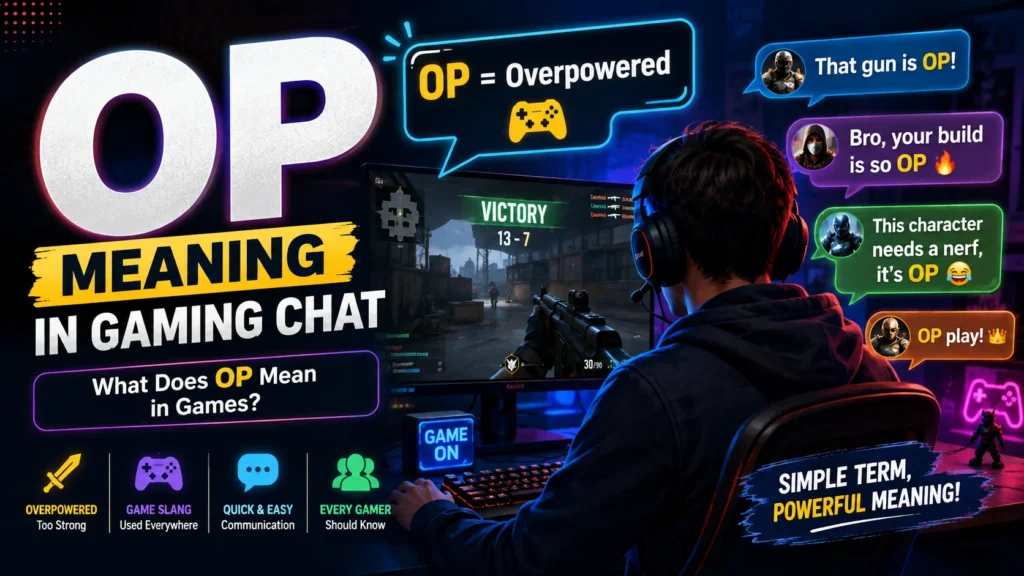
If you have ever played an online game or read gaming conversations on Discord, Twitch, Reddit, YouTube, or in-game chat, you have probably seen “OP” used repeatedly.
A player might type, “That weapon is OP,” “Bro, your build is so OP,” or “They need to nerf this character.” If you are new to gaming slang, the OP meaning may not be obvious.
So, what does OP mean in gaming chat?
In most gaming conversations, OP means “overpowered.” Gamers use it when a character, weapon, ability, strategy, item, or game mechanic seems much stronger than it should be compared with other options.
For example:
“That gun is OP.”
This means the gun is considered overpowered or unusually strong.
OP can also have other meanings depending on the platform and conversation. In forums and social communities, it can mean “original poster,” referring to the person who created a post.
Understanding the context is important because the same two letters can mean different things.
OP Meaning in Gaming Chat – Quick Meaning
The most common OP meaning in gaming chat is “overpowered.”
When gamers call something OP, they usually believe it has an advantage that makes it exceptionally effective, difficult to counter, or stronger than comparable choices.
The OP meaning can describe:
- A powerful weapon
- A strong character
- An effective ability
- A powerful spell
- An unusually strong strategy
- A high-damage build
- A powerful item
- An advantageous game mechanic
Simple Examples of OP Meaning in Gaming
“That character is OP.”
The character is extremely powerful compared with others.
“This shotgun is OP.”
The shotgun is considered too strong or too effective.
“Your build is completely OP.”
The person’s setup is unusually powerful.
“That boss is OP for this level.”
The boss seems excessively difficult or powerful for the player’s current stage.
The expression is often informal and can be positive, negative, or humorous depending on how it is used.
What Does OP Meaning Stand For in Gaming?
In gaming, the OP meaning usually stands for “overpowered.”
“Overpowered” does not necessarily mean that something is officially stronger according to the game’s developers. It is often a player’s opinion about balance.
For example, a player may defeat several opponents easily using a particular character and say:
“This character is OP.”
They are expressing the idea that the character has an unusually strong advantage.
The term is especially common in competitive games where balance matters.
In games involving different characters, weapons, classes, abilities, or builds, players frequently compare their effectiveness. When something seems noticeably stronger than the alternatives, understanding the OP meaning becomes a convenient way to describe it.
Why Do Gamers Say OP?
Gaming conversations can move quickly, especially during competitive matches.
Typing “overpowered” takes more time than typing “OP.” Short expressions help players communicate quickly without interrupting gameplay.
The OP meaning also carries more weight than simply saying “strong.”
When someone says:
“That sword is strong.”
They are describing its power.
When they say:
“That sword is OP.”
They may be suggesting that its strength is unbalanced, excessive, or difficult to counter.
That difference is important.
A powerful item can still be balanced. An OP item is usually perceived as being too powerful relative to the rest of the game.
OP Meaning vs. Strong: What’s the Difference?
Not everything powerful is automatically OP.
Imagine a character that has high damage but low health and poor mobility. The character may hit hard but still have clear weaknesses.
Players may call the character strong.
Now imagine another character that has extremely high damage, excellent defense, fast movement, and abilities that are difficult to counter.
Gamers may call that character OP.
The word usually suggests that the power level feels excessive.
This is why OP is closely connected with conversations about game balance, fairness, patches, nerfs, buffs, and competitive play.
Origin & Historical Background of the OP Meaning
The abbreviation OP developed as part of internet and gaming culture, where short forms became increasingly useful for fast communication.
As multiplayer gaming grew, players needed quick ways to discuss characters, weapons, strategies, and game mechanics.
“Overpowered” naturally became shortened to OP.
The term became especially common in online communities where players discussed game balance, competitive strategies, and updates.
OP and Online Gaming Culture
Modern gaming communities use OP across many platforms.
You may see it in:
- Discord servers
- Twitch chats
- YouTube comments
- Reddit gaming communities
- Gaming forums
- In-game chat
- Facebook gaming groups
- TikTok gaming comments
- Multiplayer voice chats
Its meaning remains relatively consistent when the discussion concerns game strength.
How Social Media Changed OP
Social media made gaming slang even more visible.
A gamer might upload a short clip showing an unusually powerful weapon and caption it:
“This build is OP!”
Other users may respond with comments such as:
“Definitely OP.”
or
“They need to nerf this.”
This kind of interaction has helped OP become familiar even among people who do not play the particular game being discussed.
Real-Life Gaming Conversations
The easiest way to understand OP is to see how gamers actually use it.
Discord Chat
Player A: That new character is insane.
Player B: I know. The damage is ridiculous.
Player A: Definitely OP.
Player B: Give it a week. The developers will probably nerf it.
Here, OP means overpowered.
In-Game Text Chat
Player A: How did you get that much damage?
Player B: New weapon plus the critical build.
Player A: Bro, that’s OP 😂
The player is saying the combination is extremely powerful.
TikTok Gaming Comments
User A: This build literally destroyed the whole lobby.
User B: That’s not a build. That’s an OP setup 😭
User C: The devs are going to nerf it.
Here, OP describes a setup that appears unusually powerful.
Text Message Between Gamers
Friend A: Have you tried the new update?
Friend B: Yeah. The shotgun is crazy now.
Friend A: Is it actually good?
Friend B: Way too good. It’s OP.
Again, OP means overpowered.
Emotional & Psychological Meaning of OP
OP is not always a neutral description.
It can communicate surprise, frustration, admiration, excitement, or humor.
A player who gets eliminated by an extremely powerful weapon might type:
“That gun is OP.”
The same phrase can come from admiration after a friend performs incredibly well.
For example:
“Your aim is OP today.”
In this case, the speaker is probably complimenting the player’s performance rather than criticizing game balance.
Why Players Use OP Emotionally
Gaming can be intense.
Players become attached to their characters, strategies, rankings, and victories. When something suddenly changes the outcome of a match, a short expression like OP allows them to communicate a strong reaction immediately.
I have seen this kind of language become part of the social side of gaming: players may complain about an unfair weapon one moment and jokingly call their friend’s ridiculous strategy OP the next.
The surrounding conversation tells you which emotion is intended.
Applying the OP Meaning in Different Gaming Contexts
OP in Competitive Games
In competitive games, OP usually refers to something that appears stronger than competing options.
Players may discuss OP characters, weapons, maps, abilities, or strategies.
Balance is particularly important because small differences can affect rankings and competitive results.
OP in Casual Games
In casual gaming, OP can be more playful.
Someone might discover a powerful combination and say:
“This combo is OP!”
They may not seriously believe the game is broken. They might simply be excited about how effective it is.
OP in Multiplayer Games
Multiplayer communities use OP frequently when discussing:
- Weapons
- Characters
- Classes
- Loadouts
- Builds
- Perks
- Skills
- Team combinations
OP in Single-Player Games
The term can also appear in single-player gaming.
A player might find an extremely powerful weapon and describe it as OP because it makes enemies much easier to defeat.
The term does not require a competitive environment.
When to Avoid the OP Meaning
Although OP is common in gaming communities, it is informal slang.
Avoid using it when formal language is expected.
For example, a professional game review might use more precise language such as:
- Overpowered
- Poorly balanced
- Excessively strong
- Difficult to counter
- Unbalanced
- Too effective compared with alternatives
Using “OP” in a formal report may make the writing feel too casual.
Cultural and Contextual Sensitivity
OP is generally harmless gaming slang, but its meaning depends on context.
If you see OP in a Reddit post, forum, or social media thread rather than a game discussion, it may mean “original poster.”
Always consider what the conversation is about before interpreting it.
Common Misunderstandings About OP Meaning
OP Always Means Overpowered
Not necessarily.
In gaming discussions, overpowered is the most likely meaning.
In online forums, however, OP can mean original poster.
OP Always Means Something Is Bad
No.
Calling something OP can be criticism, but it can also be praise.
A player may say:
“That combo is OP!”
with excitement.
Another player might say:
“This weapon is so OP. The game isn’t fun anymore.”
The first sounds impressed. The second sounds frustrated.
OP Means the Developers Intentionally Made Something Too Strong
Not necessarily.
Players use OP to describe their perception of balance.
Developers may disagree with that assessment.
OP and Hack Are the Same
They are not.
An OP weapon or character can be completely legitimate and available to every player.
A hack usually refers to unauthorized software, cheating, or manipulation.
Something can be OP without involving cheating.
OP Meaning vs. Similar Gaming Slang
| Gaming Term | Meaning | How It Differs From OP |
|---|---|---|
| OP | Overpowered | Too strong or unusually effective |
| Broken | Extremely unbalanced | Often suggests something is seriously unfair or malfunctioning |
| Buffed | Made stronger | Usually describes an official game change |
| Nerfed | Made weaker | Describes reducing power |
| Meta | Most effective current strategies or choices | Refers to the current competitive environment |
| Weak | Not very powerful | Opposite general idea of OP |
| Balanced | Fairly designed | Opposite of the unbalanced sense of OP |
| God-tier | Exceptionally powerful or high quality | Often stronger praise than ordinary “good” |
| Noob-friendly | Easy for beginners to use | Does not necessarily mean powerful |
| Cheese | An easy, gimmicky, or frustrating strategy | Describes the method rather than simply its power |
Key Insight
The OP meaning focuses on excessive strength, while terms like meta, broken, buffed, and nerfed describe different aspects of game balance. Knowing the distinction makes gaming conversations much easier to understand.
Variations and Types of OP Usage
1. OP Weapon
A weapon that appears unusually powerful.
“That rifle is OP after the update.”
2. OP Character
A character with exceptional abilities or advantages.
“Everyone is playing that character because it’s OP.”
3. OP Build
A combination of equipment, skills, or stats that creates unusually high performance.
“Try this OP build for ranked.”
4. OP Ability
A skill or special ability that seems too strong.
“That ultimate is seriously OP.”
5. OP Combo
A sequence of attacks or abilities that produces overwhelming results.
“Once you learn that combo, it’s OP.”
6. OP Loadout
A powerful combination of weapons, equipment, and perks.
“This loadout is OP for close-range fights.”
7. OP Strategy
A tactic that gives players a significant advantage.
“That strategy is OP if your team knows how to use it.”
8. OP Meta
A particularly dominant choice within the current competitive environment.
“The OP meta is getting boring.”
9. OP Setup
A broad term for a powerful gaming configuration.
“Your whole setup is OP.”
10. OP Player
Sometimes OP describes a player’s performance rather than the game itself.
“You’re OP today!”
This can mean the player is performing exceptionally well.
The True OP Meaning in Conversational Contexts
Your response depends on the situation.
Casual Replies
- “For real!”
- “Yeah, it’s crazy strong.”
- “I know, right?”
- “That thing is broken.”
- “Absolutely!”
Funny Replies
- “OP until the next patch 😂”
- “Don’t tell the developers!”
- “Let me enjoy it before they nerf it.”
- “Skill issue 😭”
- “OP? I call it strategy.”
Mature Replies
- “It definitely feels stronger than the other options.”
- “I think it needs a little balancing.”
- “It is powerful, but there are counters.”
- “The latest update changed its effectiveness.”
Respectful Replies
If you disagree, you can say:
“I don’t think it’s OP. It just takes practice.”
This keeps the conversation friendly rather than turning a disagreement about game balance into an argument.
Regional & Cultural Usage Of the OP Meaning
Gaming slang has become highly global.
A player in North America may say:
“That weapon is OP.”
A gamer in Asia may use the same phrase in a competitive discussion.
A player in the Middle East may use OP naturally while chatting with an international gaming community.
The basic OP meaning generally remains overpowered.
Western Gaming Communities
The term of the OP meaning is widely recognized in English-speaking gaming communities, especially around competitive games and online multiplayer titles.
Players commonly connect it with nerfs, buffs, patches, and balance discussions.
Asian Gaming Communities
The abbreviation is also common in international gaming spaces across Asia.
English gaming slang frequently crosses language boundaries through games, esports, streaming, and social media.
Middle Eastern Gaming Communities
Multilingual gaming communities often mix local languages with English gaming terminology.
Terms such as OP, GG, AFK, NPC, buff, and nerf can appear naturally within conversations.
Global Internet Usage
Gaming slang spreads quickly through Twitch streams, YouTube videos, Discord communities, esports, and short-form video platforms.
That is why OP can be understood far beyond traditional English-speaking gaming communities.
Gen Z vs. Millennials
Younger gamers may use OP casually, ironically, or as part of meme culture.
Older gamers may use it more literally to discuss game balance.
The meaning remains similar, but the tone can change.
Is OP Meaning Safe for Kids?
Yes. OP itself is generally harmless gaming slang.
When it means “overpowered,” it simply describes something as excessively strong in a game.
Parents should still consider the broader gaming environment rather than focusing on one abbreviation.
A gaming chat may contain other slang, insults, mature jokes, or inappropriate language depending on the community.
Understanding OP helps parents and younger players recognize what other gamers are discussing without assuming that every abbreviation has the same meaning.
FAQs About OP Meaning in Gaming Chat
What does OP mean in gaming chat?
OP usually means “overpowered” in gaming chat. It describes a character, weapon, ability, strategy, build, or player that seems unusually strong or difficult to counter.
Is OP a good or bad thing in gaming?
It can be either. Players may use OP as praise when something is impressively powerful, or as criticism when they believe it creates unfair game balance.
What does OP mean in a game?
In a game, OP generally means overpowered. It suggests that something has more strength or effectiveness than players consider reasonable compared with other options.
Does OP mean overpowered or original poster?
It depends on context. In gaming discussions, OP usually means overpowered. In forums and social media discussions, OP can also mean original poster, the person who created a post.
What does “this gun is OP” mean?
“This gun is OP” means the speaker believes the gun is overpowered, usually because it deals excessive damage, has strong advantages, or is difficult to counter.
Is OP the same as broken?
Not exactly. Both can describe balance problems, but “broken” often suggests something is extremely unbalanced, unfair, or functioning in an unintended way.
What is the opposite of OP in gaming?
Depending on context, possible opposites include weak, underpowered, ineffective, or balanced. “Underpowered” is particularly useful when something is noticeably weaker than comparable choices.
Conclusion
So, what is the actual OP meaning in gaming chat?
In most gaming conversations, OP means “overpowered.” Gamers use it to describe something that seems unusually strong, highly effective, difficult to counter, or poorly balanced compared with other options.
You may see this OP meaning applied to weapons, characters, abilities, builds, combos, loadouts, strategies, and even exceptionally skilled players.
The tone can change depending on the situation. One gamer might use the OP meaning as a complaint about unfair balance, while another might use it as a compliment after seeing an impressive play.
Context is the key.
It is also worth remembering that the OP meaning does not always point to “overpowered.” In forums and social communities, it can mean “original poster.” Looking at the surrounding conversation will usually make the intended meaning clear.
Once you understand this small piece of gaming slang, phrases such as “OP build,” “OP weapon,” “OP character,” and “that player is OP” become much easier to understand.
The next time you see someone type “That weapon is OP,” you will know exactly what they mean: they think it is seriously powerful.