Internet Abbreviations List: 100+ Common Meanings

The internet has changed the way people communicate. Messages that once took several words can now be expressed with just a few letters. From LOL and OMG to newer expressions such as FR, NGL, and SYBAU, internet abbreviations have become a natural part of everyday digital communication.
People often search for an internet abbreviations list because online conversations can feel confusing, especially when someone uses an unfamiliar acronym in a text, comment, DM, or gaming chat.
Understanding these short forms makes digital communication easier. It also helps you recognize the difference between a casual abbreviation, internet slang, professional shorthand, and an expression that may have a completely different meaning depending on context.
This guide explains more than 100 common internet abbreviations, their meanings, examples, appropriate uses, and the cultural differences that can affect how they are understood.
Internet Abbreviations List – Quick Meaning
Internet abbreviations are shortened forms of words or phrases commonly used in online communication. They save typing time and can make conversations feel faster, more casual, and more expressive.
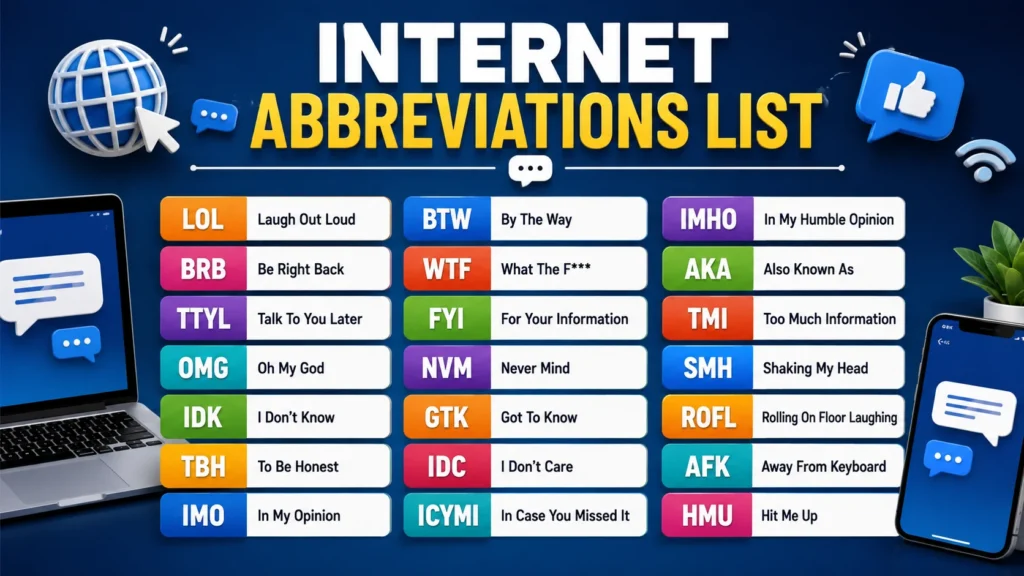
Here are some of the most common internet abbreviations:
| Abbreviation | Meaning |
|---|---|
| LOL | Laughing Out Loud |
| LMAO | Laughing My Ass Off |
| ROFL | Rolling On the Floor Laughing |
| OMG | Oh My God |
| BTW | By The Way |
| IDK | I Don’t Know |
| IDC | I Don’t Care |
| IMO | In My Opinion |
| IMHO | In My Humble Opinion |
| TBH | To Be Honest |
| NGL | Not Gonna Lie |
| FR | For Real |
| RN | Right Now |
| ASAP | As Soon As Possible |
| FYI | For Your Information |
| BRB | Be Right Back |
| TTYL | Talk To You Later |
| GTG | Got To Go |
| AFK | Away From Keyboard |
| WYD | What You Doing? |
| WYA | Where You At? |
| HBU | How About You? |
| HMU | Hit Me Up |
| BFF | Best Friends Forever |
| IRL | In Real Life |
| DM | Direct Message |
| PM | Private Message |
| FYP | For You Page |
| POV | Point Of View |
| OMW | On My Way |
| NVM | Never Mind |
| JK | Just Kidding |
| IKR | I Know, Right? |
| SMH | Shaking My Head |
| TMI | Too Much Information |
| BAE | Before Anyone Else / Term of Affection |
| GOAT | Greatest Of All Time |
| OG | Original Gangster / Original |
| W | Win / Winning |
| L | Loss / Losing |
| GG | Good Game |
| GLHF | Good Luck, Have Fun |
A single abbreviation can have different meanings in different communities. Context is always important.
Origin & Background of Internet Abbreviations
Internet abbreviations did not begin with TikTok or Instagram. Their history goes back to early online communities, chat rooms, forums, text messaging, and instant-messaging platforms.
Early internet users often dealt with slower connections and limited typing environments. Short forms made conversations quicker and easier.
Text messaging created another major reason for abbreviation use. Before smartphones became common, people sometimes had strict character limits and inconvenient phone keyboards. Expressions such as LOL, BRB, and TTYL became widely recognized.
Online gaming introduced its own vocabulary. Terms such as GG, AFK, GLHF, and LFG became common among players communicating during matches.
Social media later accelerated the trend. Twitter, Instagram, Snapchat, TikTok, Discord, and other platforms helped abbreviations move rapidly between communities.
Modern internet language is particularly flexible. Gen Z users may create, remix, shorten, or redefine expressions within months. An abbreviation that feels unfamiliar today can become mainstream surprisingly quickly.
Real-Life Conversations
WhatsApp Conversation
Aisha: Are you coming tonight?
Maya: OMW! Give me 10 mins.
Aisha: LOL, you said that 20 mins ago.
Maya: NGL, traffic is terrible 😂
Here, OMW means “On My Way,” while LOL and NGL add a casual emotional tone.
Instagram DM
Sam: Did you see her new post?
Alex: OMG yes!
Sam: IKR? The outfit is amazing.
Alex: FR. She absolutely nailed it.
In this conversation, OMG expresses surprise, IKR shows agreement, and FR emphasizes sincerity.
TikTok Comments
User 1: This is literally me every Monday.
User 2: FR 😭
User 3: NGL, same.
User 4: POV: you have no motivation left.
The abbreviations make the comments short while still communicating strong emotional agreement.
Text Messages
Noah: WYD?
Liam: Nothing. Just gaming.
Noah: Wanna join?
Liam: Bet. Send the invite.
Gaming and texting communities often combine abbreviations with slang. Their meaning becomes clear from the surrounding conversation.
Emotional & Psychological Meaning
Internet abbreviations are not simply shortcuts. They can also communicate personality, emotion, familiarity, and social connection.
Someone who writes LOL may not literally be laughing out loud. The expression can soften a statement, show amusement, or prevent a message from sounding too serious.
TBH can signal honesty. NGL often introduces a personal opinion. FR can emphasize agreement or sincerity.
The choice of abbreviation can also reveal the relationship between two people. Friends may use highly casual expressions that would feel inappropriate in a workplace email.
Digital communication removes many facial expressions and vocal cues. Abbreviations sometimes fill that emotional gap.
I have seen conversations where a simple “okay” sounded cold, while “okay lol” felt noticeably friendlier. A tiny addition can change how a message is emotionally received.
Usage in Different Contexts
Social Media
Internet abbreviations are extremely common on Instagram, TikTok, Snapchat, X, Reddit, and Facebook.
Users often choose short expressions because social media conversations move quickly. Comments also benefit from concise language.
Common examples include FR, NGL, POV, FYP, OMG, LOL, and TBH.
Friends and Relationships
Casual abbreviations work naturally between friends.
You might receive a message such as:
“WYD?”
“HMU when you’re free.”
“IDK what to wear.”
These expressions make conversations feel relaxed and familiar.
Work and Professional Settings
Some abbreviations are perfectly acceptable at work. FYI, ASAP, and ETA are common in professional communication.
Highly informal slang should be used more carefully.
Writing “LOL this report is wild” to a close coworker may be acceptable in an informal workplace. Sending the same message to a client could appear unprofessional.
Casual vs. Serious Tone
Abbreviations usually create a conversational tone.
Compare:
“I do not know what happened.”
with:
“IDK what happened.”
The first sounds more formal. The second feels like everyday texting.
That distinction matters when choosing the right expression.
When NOT to Use Internet Abbreviations
Internet abbreviations are not appropriate for every situation.
Avoid casual slang in formal academic assignments unless the instructor specifically permits it. Professional applications, legal documents, official complaints, and formal business correspondence generally require standard language.
Cultural sensitivity also matters. Some abbreviations contain profanity or references that can offend people.
Expressions such as WTF, STFU, and similar forms should not be used casually with strangers, employers, teachers, or professional contacts.
Context can completely change the impression of a message.
A friend might understand “OMG 😂” immediately. A customer may interpret the same expression as careless or overly informal.
Common Misunderstandings
Taking Abbreviations Literally
LOL does not necessarily mean someone is physically laughing. It often communicates amusement or lightness.
Assuming Every Meaning Is Universal
An abbreviation can have multiple meanings.
FT might mean “FaceTime,” “featuring,” or “full-time,” depending on context.
DM usually means “Direct Message” online, but the abbreviation can have other meanings outside social media.
Confusing Slang With Standard English
Internet abbreviations are useful in casual communication, but they are not always suitable for formal writing.
Misreading Tone
A short message such as “K” may be interpreted as annoyed or dismissive even when the sender did not intend it that way.
Adding context, punctuation, or an emoji can sometimes make the intended tone clearer.
Comparison Table
| Internet Abbreviation | Meaning | Similar Expression | Typical Tone |
|---|---|---|---|
| LOL | Laughing Out Loud | Haha | Casual |
| TBH | To Be Honest | Honestly | Casual |
| NGL | Not Gonna Lie | Honestly | Casual |
| IDK | I Don’t Know | Not sure | Casual |
| IMO | In My Opinion | I think | Neutral |
| FR | For Real | Seriously | Casual |
| BTW | By The Way | Incidentally | Casual |
| BRB | Be Right Back | Back soon | Casual |
| TTYL | Talk To You Later | See you later | Casual |
| ASAP | As Soon As Possible | Quickly | Professional/Casual |
| FYI | For Your Information | Just so you know | Professional |
| GG | Good Game | Well played | Gaming |
| AFK | Away From Keyboard | Not available | Gaming |
| HMU | Hit Me Up | Contact me | Casual |
| WYD | What You Doing? | What are you doing? | Casual |
Key Insight
The best abbreviation is not always the shortest one. The right choice depends on your audience, relationship, platform, and the tone you want to create.
Variations and Types of Internet Abbreviations
1. Reaction Abbreviations
Examples include LOL, LMAO, OMG, and SMH.
They communicate immediate emotional reactions.
2. Conversation Abbreviations
WYD, WYA, HBU, and HMU are commonly used to keep casual conversations moving.
3. Agreement Abbreviations
FR, IKR, and NGL can express agreement, sincerity, or shared feelings.
4. Time-Related Abbreviations
RN, ASAP, BRB, and TTYL relate to timing or availability.
5. Friendship Abbreviations
BFF, BFFR, and ILY can appear in conversations about friendship and affection.
6. Gaming Abbreviations
GG, AFK, GLHF, LFG, and WP are common in gaming communities.
7. Social Media Abbreviations
DM, FYP, POV, IRL, and PM are strongly associated with online platforms.
8. Opinion Abbreviations
IMO, IMHO, TBH, and NGL often introduce opinions or personal observations.
9. Relationship Slang
BF, GF, Bae, and ILY may appear in romantic or affectionate conversations.
10. Warning or Information Abbreviations
FYI, PSA, and ICYMI are often used to share information or draw attention to something.
How to Respond When Someone Uses an Internet Abbreviation
Casual Replies
If a friend says:
“WYD?”
You can reply:
“Nothing much, you?”
For “LOL,” a natural response could be:
“😂 I knew you’d find that funny.”
Funny Replies
If someone says:
“IDK.”
You could respond:
“Great answer. Very informative 😂”
Humor works best when you already have a comfortable relationship.
Mature Replies
If someone uses an abbreviation you do not understand, simply ask:
“What does that mean?”
There is no need to pretend you understand unfamiliar slang.
Respectful Replies
In a professional conversation, respond in standard language when appropriate.
If someone writes “FYI,” you can simply say:
“Thanks for letting me know.”
Clear communication is more important than matching every abbreviation.
Regional & Cultural Usage
Western Culture
Internet abbreviations are deeply integrated into everyday digital communication in the United States, Canada, the United Kingdom, Australia, and other English-speaking communities.
Expressions such as LOL, OMG, BTW, and IDK are widely recognized.
Asian Culture
English internet abbreviations are also common across many Asian online communities. Users may combine English abbreviations with local languages.
The meaning can remain familiar even when English is not the speaker’s first language.
Middle Eastern Culture
English abbreviations appear frequently in social media, gaming, and international conversations. Younger users may move naturally between English internet slang and their native language.
The level of acceptable informality depends heavily on the relationship and setting.
Global Internet Usage
Social media has made internet language increasingly international.
A person in Pakistan can easily understand an abbreviation used by someone in the United States, while a gaming community may use the same expressions across several countries.
Generational Differences
Gen Z tends to adopt newer internet slang quickly and may use abbreviations creatively.
Millennials are generally familiar with older expressions such as LOL, BRB, and TTYL.
Neither group uses exactly the same vocabulary all the time. Online language changes continuously.
Is It Safe for Kids?
Most common internet abbreviations are harmless when understood in context.
Parents and educators should still recognize that not every abbreviation is appropriate for children. Some slang contains profanity, sexual references, insults, or harmful meanings.
Teaching children to understand context is more useful than simply banning every abbreviation.
A child should know that language appropriate for a private conversation with friends may not be suitable for school, teachers, or adults.
FAQs
What are internet abbreviations?
Internet abbreviations are shortened words or phrases commonly used in online communication, texting, social media, gaming, and digital communities.
What is the most common internet abbreviation?
LOL, meaning “Laughing Out Loud,” is one of the best-known internet abbreviations. Other extremely common forms include OMG, IDK, BTW, and BRB.
Why do people use internet abbreviations?
People use them to save time, reduce typing, express emotions, and make digital conversations feel casual and natural.
Are internet abbreviations proper English?
Most internet abbreviations are informal rather than standard formal English. They are appropriate for many casual conversations but may not belong in academic or professional writing.
What does FR mean in texting?
FR usually means “For Real.” It is commonly used to show agreement, sincerity, or emphasis.
What does NGL mean online?
NGL means “Not Gonna Lie.” People commonly use it before giving an honest opinion or personal reaction.
Can internet abbreviations have multiple meanings?
Yes. Some abbreviations have different meanings depending on the platform, community, or conversation. Context is essential for interpreting them correctly.
Conclusion
Internet abbreviations have become one of the defining features of modern digital communication. They make conversations faster, more expressive, and often more personal.
From classic terms such as LOL, BRB, and OMG to newer expressions such as FR, NGL, and POV, online language continues to evolve with technology and culture.
The key is not to memorize every abbreviation at once. Pay attention to context, understand who you are talking to, and choose language that fits the situation.
Once you become familiar with the most common expressions, texts, comments, DMs, and online conversations become much easier to understand. A few letters can carry a surprising amount of meaning, but the relationship and context behind those letters often matter even more.