LMR Meaning in Dating: What Does LMR Mean?

If you have seen LMR meaning in dating searches online, you may have noticed that the term can be confusing. Unlike everyday abbreviations such as “IDK” or “BRB,” LMR is strongly connected to dating conversations, intimacy, hesitation, and personal boundaries.
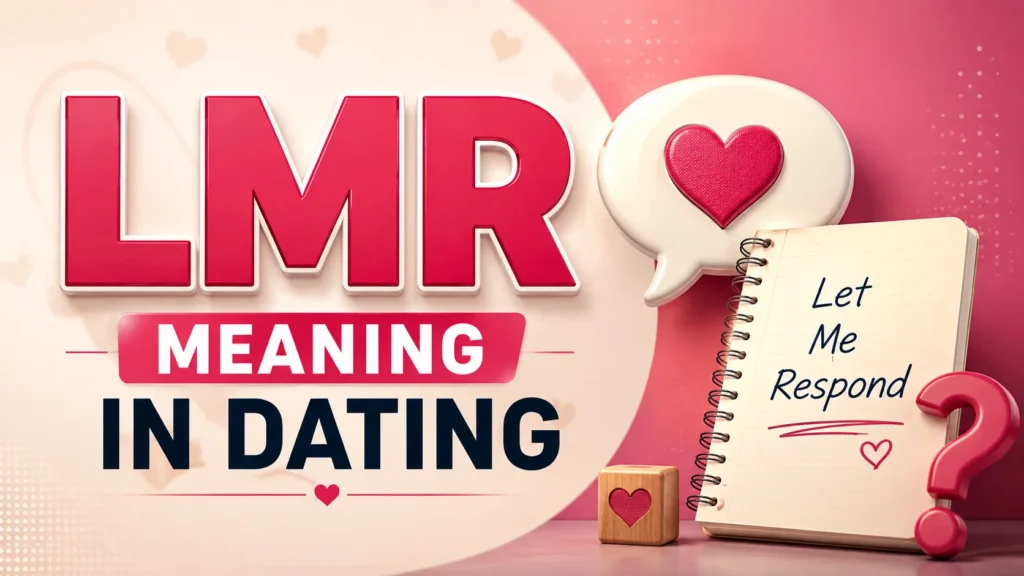
In dating slang, LMR usually stands for “Last Minute Resistance.” It is used in some online dating communities to describe a situation where someone hesitates, changes their mind, or becomes uncomfortable just before a romantic or intimate situation moves forward.
However, there is an important point to understand: hesitation is not something that should be “overcome.” If someone says no, pulls away, becomes uncomfortable, or changes their mind, that decision should be respected immediately.
The phrase can therefore be useful for understanding what someone means online, but it should be handled carefully. In healthy dating communication, clearer words such as “hesitation,” “not ready,” “changed my mind,” or “I need to slow down” are usually better.
LMR Meaning in Dating – Quick Meaning
LMR meaning in dating = “Last Minute Resistance.”
In online dating discussions, the phrase describes hesitation or reluctance that appears at the last moment, particularly when a romantic or intimate interaction is about to progress. Some sources trace the expression to online dating and pickup communities.
In simple English, it can describe a moment when someone who previously seemed comfortable suddenly says they are not ready or no longer want to continue.
For example:
“We were getting close, but she suddenly said she wanted to slow down.”
“He seemed comfortable earlier, but then he changed his mind.”
“She wasn’t ready to take things further, so we stopped.”
The last example is especially important because changing your mind is always allowed.
What Does LMR Stand For?
LMR stands for Last Minute Resistance in dating-related discussions.
It is an informal internet expression rather than a professional relationship or psychological term. Its meaning can also vary outside dating contexts. For example, LMR is widely used on social media to mean “Like My Recent,” usually as a request for someone to like a recent post.
That means the surrounding conversation matters.
Origin & Background
LMR became associated with online dating discussions, especially communities that focused on dating strategies and romantic escalation. Older references describe the phrase specifically in relation to a person withdrawing consent or expressing reluctance before sexual activity.
The terminology has since appeared in broader dating conversations, forums, social media discussions, and slang explanations.
The phrase can sound clinical or strategic when used to describe a deeply personal moment. That is one reason it is important to distinguish understanding slang from accepting the attitude behind the slang.
Cultural Influence
Modern dating happens through a mixture of texts, dating apps, social media, and face-to-face meetings. People often want short labels for complicated social situations.
LMR fits that environment because three letters can summarize a situation that would otherwise require a longer explanation.
Still, relationships are rarely as simple as an acronym.
Someone may hesitate because they feel nervous, uncomfortable, emotionally uncertain, physically unsafe, overwhelmed, or simply because they have changed their mind.
Social Media Impact
Online discussions have helped spread LMR beyond its original niche. Dating advice pages, forums, short-form videos, and slang websites can introduce the term to people who have never encountered it before.
The result is sometimes confusion because LMR has more than one meaning online.
If you see LMR in an Instagram Story, “Like My Recent” is often the intended meaning. In a conversation specifically about dating or intimacy, “Last Minute Resistance” may be intended instead.
Real-Life Conversations
The following examples show how LMR may appear in dating-related discussions. They also demonstrate a healthier way to respond to hesitation.
Text Message Example
Person A:
“Last night was going really well, but she showed some LMR when things got more serious.”
Person B:
“Then I’d take that as a sign to slow down and ask what she’s comfortable with.”
Person A:
“Yeah, I didn’t want to pressure her.”
Person B:
“That’s the right approach. She can change her mind at any point.”
Dating App Conversation
Person A:
“We had great chemistry, but he suddenly said he wasn’t ready to take things further.”
Person B:
“Did you give him space?”
Person A:
“Of course. I told him there was no pressure.”
Person B:
“Good. Being interested in someone doesn’t mean they have to move at your pace.”
WhatsApp Conversation
Person A:
“She seemed excited about meeting again, then changed her mind tonight.”
Person B:
“Maybe she realized she needs more time.”
Person A:
“I was disappointed, honestly.”
Person B:
“That’s understandable. Just respect what she said.”
Relationship Discussion
Person A:
“What does LMR mean in dating?”
Person B:
“It usually means last-minute hesitation or resistance.”
Person A:
“So does it mean the person secretly wants to continue?”
Person B:
“Not necessarily. If they say no or pull back, take that seriously.”
That final distinction is crucial. Hesitation should never be interpreted as hidden consent.
Emotional & Psychological Meaning
The emotional meaning behind an LMR situation can vary considerably.
A person may be attracted to someone but still feel uncomfortable moving forward. Attraction and readiness are not identical feelings.
Someone can genuinely enjoy a date and still decide that physical intimacy is too much at that moment.
What Emotion Can LMR Express?
Depending on the situation, hesitation may reflect:
- Nervousness
- Uncertainty
- Fear
- Emotional overwhelm
- Lack of readiness
- A need for more trust
- A personal boundary
- A simple change of mind
There is no reliable way to determine someone’s reason without listening to them.
Why People May Hesitate
Dating often involves complicated emotional decisions.
A person might have enjoyed the evening but suddenly realize that the pace feels too fast. Someone else may become uncomfortable because circumstances changed.
Sometimes there is no dramatic reason at all.
A person simply does not want to continue.
That is enough.
A Personal-Style Scenario
Imagine you have spent several hours talking with someone and everything feels natural. Toward the end of the evening, the person becomes quiet and says, “I think I want to take things slower.”
A respectful response is not to persuade them.
It is to say, “Absolutely. We can slow down.”
That small response can build far more trust than trying to convince someone to continue.
Usage in Different Contexts
Social Media
LMR is not particularly common as a dating abbreviation on mainstream social media. When it appears in a dating discussion, its meaning depends heavily on the surrounding conversation.
On Instagram and similar platforms, LMR may instead mean “Like My Recent.”
Friends & Relationships
Friends may use LMR while describing a dating experience.
For example:
“He said everything was fine, but then there was LMR.”
In ordinary conversation, clearer language such as “he hesitated” or “she changed her mind” is usually easier to understand.
Work & Professional Settings
Avoid LMR in professional communication.
It is informal, context-dependent, and potentially confusing. If you need to describe hesitation in a workplace setting, use precise language such as “hesitation,” “reluctance,” “uncertainty,” or “changed their decision.”
Casual vs. Serious Tone
LMR belongs to casual internet language.
Because it can involve sensitive dating situations, however, it is not always the best choice even in casual conversation. Clear and respectful wording is often more appropriate when discussing boundaries or consent.
When NOT to Use It
Don’t Use LMR to Dismiss a “No”
The most important rule is simple: do not treat someone’s refusal as a challenge.
A person who says no does not need to justify the decision.
They can change their mind after previously agreeing to something. Consent must be voluntary and can be withdrawn.
Avoid Using It as a Strategy
LMR should not be treated as a dating “obstacle” that someone needs to overcome.
That framing can encourage unhealthy assumptions about another person’s boundaries.
Instead, view hesitation as communication.
Avoid It in Sensitive Conversations
If you are talking directly to a partner about intimacy, saying:
“Are you experiencing LMR?”
may sound strange or overly clinical.
A much healthier question would be:
“Are you comfortable?”
or:
“Would you like to slow down?”
Those questions create space for an honest answer.
Common Misunderstandings
Misunderstanding 1: LMR Means Someone Secretly Wants It
This is one of the most dangerous interpretations.
Hesitation does not automatically mean hidden interest.
If someone says no, the answer is no.
Misunderstanding 2: LMR Is a Psychological Diagnosis
It is not a formal psychological diagnosis.
LMR is informal slang associated with certain online dating discussions. It should not be treated as a scientific explanation of someone’s behavior.
Misunderstanding 3: LMR Always Refers to Physical Intimacy
The term is especially associated with intimate situations, but people sometimes use it more loosely for last-minute hesitation in dating.
Context determines what the speaker means.
Misunderstanding 4: LMR Is the Same as “Mixed Signals”
Not exactly.
Mixed signals describe communication that seems contradictory.
LMR is generally used for hesitation or reluctance appearing at a late stage of an interaction.
Comparison Table
| Expression | Meaning | Typical Context | Better Interpretation |
|---|---|---|---|
| LMR | Last Minute Resistance | Dating discussions | Last-minute hesitation |
| Hesitation | Uncertainty or reluctance | Dating and everyday life | Give the person time |
| Changed my mind | A decision has changed | Relationships | Respect the new decision |
| Not ready | Someone does not feel prepared | Dating | Slow down |
| Mixed signals | Conflicting behavior or messages | Relationships | Communicate clearly |
| Need space | A request for distance or time | Relationships | Give appropriate space |
| Slow down | Reduce the pace | Dating | Respect the requested pace |
| No | Refusal or lack of agreement | Any context | Stop and respect it |
Key Insight
LMR meaning in dating is best understood as last-minute hesitation, not as a problem that needs to be solved. If someone’s comfort level changes, respectful communication should come before assumptions.
Variations / Types
LMR itself does not have a standardized set of official “types.” However, when people discuss the concept informally, hesitation can appear in several different forms.
1. Emotional Hesitation
Someone likes the person but is unsure about becoming emotionally closer.
2. Physical Hesitation
A person becomes uncomfortable with physical affection or intimacy and wants to stop or slow down.
3. Commitment Hesitation
Someone becomes uncertain when a relationship starts becoming more serious.
4. First-Date Hesitation
A person may enjoy the date but decide they are not comfortable progressing beyond that meeting.
5. Trust-Related Hesitation
Someone may need more time to build trust before becoming closer.
6. Pace-Related Hesitation
The relationship may simply be moving faster than the person wants.
7. Nervous Hesitation
An individual can feel anxious even when they genuinely like the other person.
8. Boundary-Based Hesitation
Someone may reach a personal boundary and decide not to continue.
9. Change-of-Mind Hesitation
A person can initially agree and later decide differently. That change must be respected.
10. Uncertainty About the Relationship
Someone may question whether they want the relationship to become more serious.
How to Respond When Someone Uses It
If someone uses LMR while describing a dating situation, avoid immediately assuming what the other person was thinking.
Casual Replies
- “Sounds like they wanted to slow things down.”
- “Maybe they just weren’t ready.”
- “I’d give them some space.”
Funny Replies
Use humor only when the situation is genuinely lighthearted:
- “Dating really does come with plot twists.”
- “Three letters, but apparently a whole conversation behind them.”
Mature Replies
- “Their hesitation is worth taking seriously.”
- “If they changed their mind, respect the decision.”
- “It sounds like clearer communication would help.”
Respectful Replies
- “Ask what they’re comfortable with.”
- “Don’t assume what they mean—let them explain.”
- “If they say no, stop and respect it.”
Regional & Cultural Usage
Western Culture
In Western online dating discussions, LMR may appear in niche dating communities and discussions about intimacy. The expression is informal and is not something most people use in everyday relationship conversations.
Asian Culture
In many Asian dating environments, people may be more likely to communicate discomfort indirectly, depending on cultural expectations, family values, and social norms.
That makes context especially important.
A quiet response or a change in behavior should not automatically be interpreted as agreement. Asking respectfully is safer than guessing.
Middle Eastern Culture
Dating expectations can vary significantly across Middle Eastern communities, families, and individuals.
Privacy, religious values, family expectations, and cultural boundaries may influence how romantic relationships are discussed.
The safest approach is to avoid applying a slang label to someone else’s feelings without understanding their perspective.
Global Internet Usage
The internet has made slang cross cultural and geographic boundaries.
Someone may encounter LMR through an American dating forum even if the expression is not commonly used in their local community.
Gen Z vs. Millennials
Younger internet users are generally more accustomed to rapidly changing acronyms and platform-specific slang.
Millennials may recognize LMR from older online dating discussions, but neither generation should assume that everyone understands the term in the same way.
The meaning still depends on context.
Is It Safe for Kids?
LMR is not a particularly useful term for children because its dating-related meaning can involve romantic boundaries and intimate situations.
Parents, teachers, and caregivers should focus less on memorizing slang and more on the underlying communication lesson.
Children and teenagers should understand that everyone has the right to say no, change their mind, set boundaries, and ask someone else to stop.
If a child encounters LMR online, an age-appropriate conversation about consent, personal boundaries, respectful relationships, and online safety is more valuable than simply memorizing the acronym.
FAQs
What does LMR mean in dating?
LMR usually means “Last Minute Resistance” in dating discussions. It refers to hesitation or reluctance that appears near the point when a romantic or intimate situation is about to progress.
Is LMR a common dating term?
LMR is a niche dating expression rather than a universally understood abbreviation. It appears more often in online dating discussions and certain internet communities than in ordinary face-to-face conversation.
Does LMR mean someone secretly wants to continue?
No. LMR does not mean someone secretly wants to continue. Hesitation, refusal, or a change of mind should be taken seriously rather than interpreted as hidden consent.
What should I do if someone hesitates while dating?
Stop or slow down and give them room to communicate. You can ask, “Are you comfortable?” or “Would you like to slow down?” Never pressure someone to continue.
Can LMR mean something different?
Yes. On social media, LMR commonly means “Like My Recent,” referring to a request to like someone’s latest post. Context is essential.
Is LMR a psychological term?
No. LMR is informal slang associated with online dating discussions. It should not be treated as a formal psychological diagnosis or scientific category.
Is LMR appropriate to use with a dating partner?
Usually, clearer language is better. Instead of labeling someone’s hesitation as LMR, ask directly whether they are comfortable and what pace feels right to them.
Conclusion
Understanding LMR meaning in dating is less about memorizing another internet abbreviation and more about recognizing what can happen when someone’s comfort level changes.
LMR generally stands for “Last Minute Resistance” in dating-related discussions. It can describe hesitation or reluctance that appears at a late stage of a romantic or intimate interaction.
The most important part is not the acronym.
It is the response.
Someone can be attracted to you and still say no. They can agree initially and later change their mind. They can enjoy a date but decide they want to move more slowly.
Healthy dating leaves room for all of those choices.
So, if you encounter LMR online, understand the slang—but don’t let the slang replace clear communication. Respect boundaries, listen carefully, and treat a change of mind as a valid decision. That approach will always communicate more maturity than any dating acronym.