
SYM Meaning in Text: What Does SYM Mean?

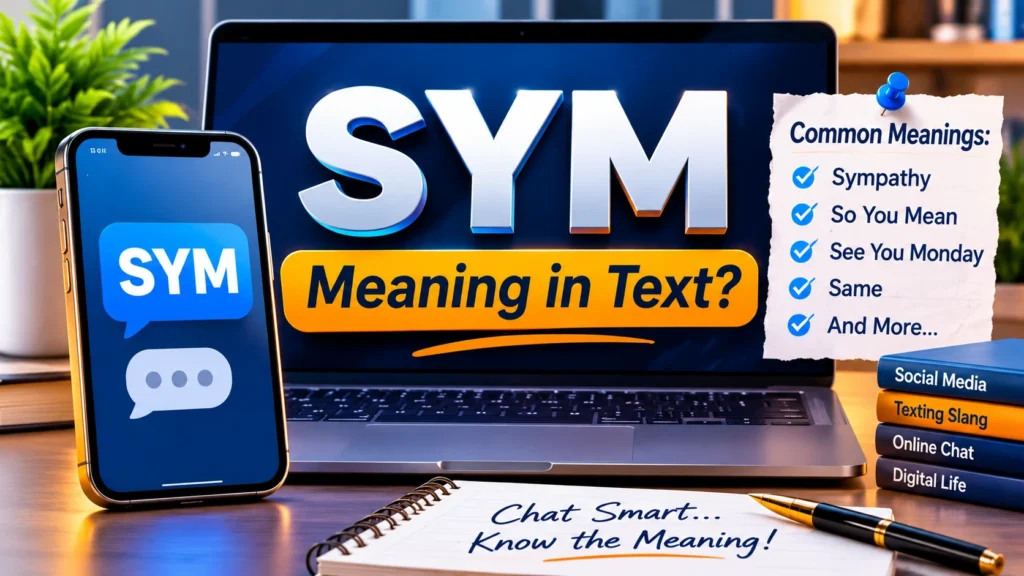
SYM meaning in text usually stands for “Shut Your Mouth.” It is an informal texting abbreviation used to tell someone to stop talking, express surprise, or react to something unbelievable. Depending on the conversation, SYM can sound playful between friends or rude during an argument.
When someone texts you SYM, they may be jokingly saying “Stop talking!” or seriously telling you to be quiet. It can also have other interpretations, including a vulgar insult, so understanding the surrounding conversation is important.
What Does SYM Mean in Text Messages?
The most commonly reported meaning of SYM is Shut Your Mouth. It is an abbreviation formed from the first letters of the three words:
- S = Shut
- Y = Your
- M = Mouth
People use it in informal conversations when they want someone to stop talking or when they are reacting dramatically to surprising information.
For example:
Friend: I told your crush that you like them.
You: SYM 😂
Here, SYM is a playful reaction expressing embarrassment and surprise rather than genuine anger.
Other Possible Meanings of SYM
Although Shut Your Mouth is the primary slang interpretation, SYM can have other meanings depending on the conversation.
| Meaning | Explanation | Usage |
|---|---|---|
| Shut Your Mouth | Telling someone to stop talking | Common slang interpretation |
| Suck Your Mom | A vulgar insult | Offensive conversations |
| Sympathy | A shortened reference to sympathy | Uncommon, context-dependent |
| So You Mad? | Asking whether someone is angry | Reported informal usage |
| Save Your Money | Advising someone not to spend | Financial conversations |
Not every listed expansion is an established texting definition. In particular, meanings such as sympathy and save your money should only be assumed when the conversation supports them.
How Is SYM Used in Texting and Social Media?
SYM is an informal abbreviation that may appear in private messages and online conversations. Its interpretation depends more on the conversation than the messaging platform.
SMS, iMessage, and WhatsApp
In ordinary text messages, SYM can be used between friends when someone shares surprising information or keeps teasing another person.
Example:
A: I heard you were talking about me.
B: SYM, who told you that?
Instagram and Snapchat DMs
In private social media messages, SYM can work as a quick response to teasing, gossip, or an unexpected statement.
Example:
A: Your old crush just asked about you.
B: SYM 😭
Discord and Group Chats
In casual group conversations, SYM may be used as a blunt or joking response when someone says something unexpected.
Its meaning is not standardized across these platforms, and some groups may use their own interpretations.
Capitalization: Both SYM and sym can carry the same meaning. Uppercase SYM may look more forceful, while lowercase sym can feel more casual. Capitalization does not create a different official definition.
SYM Meaning Based on Tone and Context
The same abbreviation can communicate different attitudes depending on the relationship and situation.
1. Funny Meaning
Friends may use SYM when someone reveals an embarrassing or unbelievable story.
A: I accidentally called my teacher Mom today.
B: SYM 😂
A: Everyone heard it.
B: I would never recover from that.
2. Sarcastic Meaning
SYM can be sarcastic when someone is tired of hearing another person’s repeated comments.
A: I told you five times that I was right.
B: SYM.
A: You really don’t want to hear it?
B: Not for the sixth time.
3. Playful Meaning
Between close friends, it can be a lighthearted reaction to teasing.
A: Your secret is safe with me.
B: SYM, you told three people already.
A: Okay, maybe four.
B: You’re impossible 😂
4. Serious Meaning
During an argument, SYM can become a direct and disrespectful command.
A: I think you handled that situation badly.
B: SYM.
A: I’m only trying to explain.
B: I don’t want to discuss it anymore.
10 Realistic SYM Text Conversation Examples
Here are different situations showing how people might interpret or respond to SYM in everyday messages.
Example 1: Between friends
A: Guess who I saw at the mall?
B: Who?
A: Your favorite singer!
B: SYM, seriously?
Example 2: With a partner
A: I still have your old pictures.
B: SYM 😂
A: Why? They’re cute.
B: You’re embarrassing me.
Example 3: Between siblings
A: Mom found your hidden chocolate.
B: SYM!
A: She ate half of it.
B: That’s actually terrible.
Example 4: With a coworker
A: The manager said our meeting is canceled.
B: SYM, I already prepared everything.
A: Sorry, just got the update.
B: No worries. I’ll use the time for something else.
Example 5: Group chat
A: I finished the entire assignment in one hour.
B: SYM 😂
A: I’m not even joking.
B: Teach me your methods.
Example 6: With a close friend
A: I know who you have a crush on.
B: SYM, don’t start.
A: Should I tell everyone?
B: Absolutely not!
Example 7: During an argument
A: You never listen to my side.
B: SYM.
A: That’s not helping us solve anything.
B: I need some space.
Example 8: With a parent
A: I heard you stayed up until 3 a.m.
B: SYM 😭
A: Don’t think I didn’t notice.
B: Okay, I’ll sleep earlier tonight.
Example 9: With someone new
A: You look familiar. Have we met?
B: Maybe at the college event?
A: SYM, I remember you now!
B: Haha, small world.
Example 10: Talking about gossip
A: Someone told me your biggest secret.
B: SYM, who?
A: I’m not telling you yet.
B: You’re making me nervous.
Grammar and Language Role of SYM
SYM is an abbreviation rather than a standard English word. It represents a three-word expression and is mainly used as informal internet slang.
- Part of speech: Informal abbreviation.
- Sentence position: Usually appears at the beginning or as a standalone response.
- Standalone use: Yes, it can work as a complete short reply.
- Mid-sentence use: Possible, although less natural.
- Capitalization: SYM and sym generally have the same interpretation.
- Register: Informal and unsuitable for most professional communication.
Unlike ordinary words, SYM does not have a fixed grammatical role in every message. Its function depends on how the sender uses it.
How to Reply to SYM in a Text
Your response should match the sender’s tone and the situation.
| Reply Style | Example Text Response |
|---|---|
| Funny | “Make me! 😂” |
| Serious | “I’m trying to explain something important.” |
| Flirty | “Only if you give me a reason 😉” |
| Neutral | “Okay, I’ll stop.” |
| Confused | “What do you mean by SYM?” |
If someone uses SYM aggressively, you do not need to respond with another insult. A calm answer can prevent the conversation from becoming an argument.
SYM vs Similar Texting Abbreviations
Some abbreviations look similar or communicate related reactions, but their definitions are different.
| Term | Meaning | Usage Context | Tone | Popularity | Confusion Risk |
|---|---|---|---|---|---|
| SYM | Shut Your Mouth | Telling someone to stop talking | Playful or rude | Niche | Medium |
| STFU | Shut The F*** Up | Strong command to be quiet | Harsh | Recognized | High |
| SMH | Shaking My Head | Disappointment or disbelief | Disapproving | Common | Medium |
| SRY | Sorry | Apologizing | Polite | Common | Low |
| LOL | Laughing Out Loud | Reacting to something funny | Friendly | Common | Low |
| TTYL | Talk To You Later | Ending a conversation | Neutral | Common | Low |
The biggest difference is that SYM directly refers to telling someone to stop talking, while SMH expresses disappointment or disbelief without necessarily asking anyone to be quiet.
Who Uses SYM?
SYM is an informal expression that may appear in different age groups and online communities. However, reliable demographic research establishing its exact age distribution is limited.
Gen Z vs Millennials
- Gen Z: May encounter SYM in casual online conversations, teasing, and group chats.
- Millennials: May recognize it through internet slang and informal messaging, although individual familiarity varies.
These are general possibilities, not verified differences in usage frequency.
Regional Usage
SYM does not have a reliably established regional meaning unique to the United States, United Kingdom, or other countries.
Some alternative insulting interpretations appear in user-generated slang discussions, but they should not be treated as universal regional definitions.
Platform Differences
The main interpretation, Shut Your Mouth, can be understood in private messages and online discussions. There is no reliable evidence establishing one platform as its exclusive home.
Origin and Internet Culture of SYM
There is no well-documented historical record identifying the exact person, platform, or date when SYM first became used as an abbreviation for Shut Your Mouth.
The expression is a straightforward initialism formed from the first letters of its words. Its structure resembles other internet and texting shortcuts that make longer expressions quicker to type.
Some user-generated slang records also document alternative interpretations, including Suck Your Mom and So You Mad. These entries demonstrate that the abbreviation can have community-specific meanings rather than one universally accepted definition.
Its exact origin should therefore be treated as uncertain rather than attributed to TikTok, Snapchat, or a particular generation.
Is SYM Rude or Offensive?
SYM can be rude, depending on the situation.
When close friends use it jokingly, it may simply express surprise or playful annoyance. However, when someone sends it during a disagreement, it can sound disrespectful.
The alternative expansion Suck Your Mom is explicitly vulgar and insulting.
Is SYM Appropriate at School or Work?
It is generally better to avoid SYM when communicating with teachers, managers, clients, or people you do not know well.
Instead of sending SYM, use clearer expressions such as:
- “Please let me finish.”
- “I disagree with that.”
- “Could we discuss this calmly?”
- “I understand your point.”
These alternatives communicate your intentions without creating unnecessary misunderstandings.
Real-World Observation: Why SYM Can Be Confusing
One interesting feature of SYM is that its three letters can produce very different reactions. Someone receiving it after sharing surprising gossip might understand it as a playful way of saying “Stop it!” However, the same message during a disagreement can feel like a genuine command to remain silent. Unlike LOL, which has a relatively recognizable meaning across casual conversations, SYM depends heavily on the relationship between the people texting. That makes the surrounding messages especially important when interpreting it.
Read More: TTM Meaning in Text – What Does TTM Stand For?
Frequently Asked Questions About SYM Meaning in Text
1. What does SYM mean in text messages?
SYM most commonly stands for Shut Your Mouth in informal texting slang. People use it to tell someone to stop talking or react to surprising information. Between friends, it can be playful rather than aggressive. However, during an argument, it may sound disrespectful.
2. Does SYM mean Shut Your Mouth?
Yes, Shut Your Mouth is the most commonly reported slang expansion of SYM. It can express surprise, annoyance, or a request for someone to stop talking. The sender’s tone and relationship with you help determine the intended meaning. It is not always meant as a serious insult.
3. Is SYM rude to reply with in a text?
SYM can sound rude, particularly when sent to someone you do not know well. Close friends may use it jokingly during casual conversations. Without a friendly tone or clear context, the recipient might interpret it as disrespectful. Consider using a clearer response when discussing something serious.
4. What does SYM mean from a girl or a boy?
SYM does not have a different standard meaning depending on whether a girl or boy sends it. It generally refers to Shut Your Mouth in informal slang. The conversation, relationship, and surrounding messages are more important than the sender’s gender. Avoid assuming that it has a romantic meaning.
5. What is the difference between SYM and STFU?
SYM generally stands for Shut Your Mouth, while STFU means Shut The F*** Up. Both expressions can tell someone to stop talking. However, STFU contains explicit profanity and is generally more aggressive. SYM can also be rude, but it may be used playfully among friends.
6. Does SYM mean the same thing in a group chat and a private text?
Not necessarily. In a group chat, SYM might be used as a playful reaction to someone’s surprising comment. In a private conversation, it may sound more personal or direct. The surrounding discussion helps determine its intended meaning. Neither setting guarantees a particular interpretation.
7. Can SYM have a different meaning?
Yes, SYM has several reported alternative interpretations, including Suck Your Mom and So You Mad. Some sources also list sympathy as a possible shortened form. However, these meanings are not equally established or interchangeable. Always consider the topic and wording before interpreting the abbreviation.
8. Should I use SYM in professional messages?
No, it is generally not recommended in professional communication. The abbreviation can sound disrespectful, and some people may not understand it. When communicating with a manager, teacher, or customer, use complete sentences instead. Clear language helps prevent unnecessary confusion.
Conclusion
Understanding SYM meaning in text helps you recognize what someone is trying to communicate in casual online conversations. Its most commonly reported slang meaning is Shut Your Mouth, although alternative interpretations can appear in particular communities.
Before using or responding to SYM, remember these tips:
Usage Tips:
- Use SYM only when the conversation is informal.
- Consider the relationship before sending it.
- Check the surrounding messages to understand the intended meaning.
- Avoid using it when a serious or respectful response is needed.
Common Mistakes:
- Assuming SYM always has one meaning.
- Confusing SYM with SMH or STFU.
- Treating every use as an expression of anger.
- Using SYM in professional conversations.
Ultimately, SYM is best understood through context. When you are unsure what someone means, simply ask them to clarify.

[…] Read More: SYM Meaning in Text: What Does SYM Mean? […]