
SMS Mean in Text: Meaning, Examples & Usage

Have you ever received a message asking you to send an SMS and wondered what it means? Understanding SMS mean in text is simple once you know what the abbreviation stands for. Unlike popular texting slang such as LOL, BRB, or IDK, SMS is a technical abbreviation commonly used when talking about mobile messaging.
People use this term in everyday conversations, phone settings, social media discussions, and online account verification. However, its meaning can depend slightly on how it appears in a sentence.
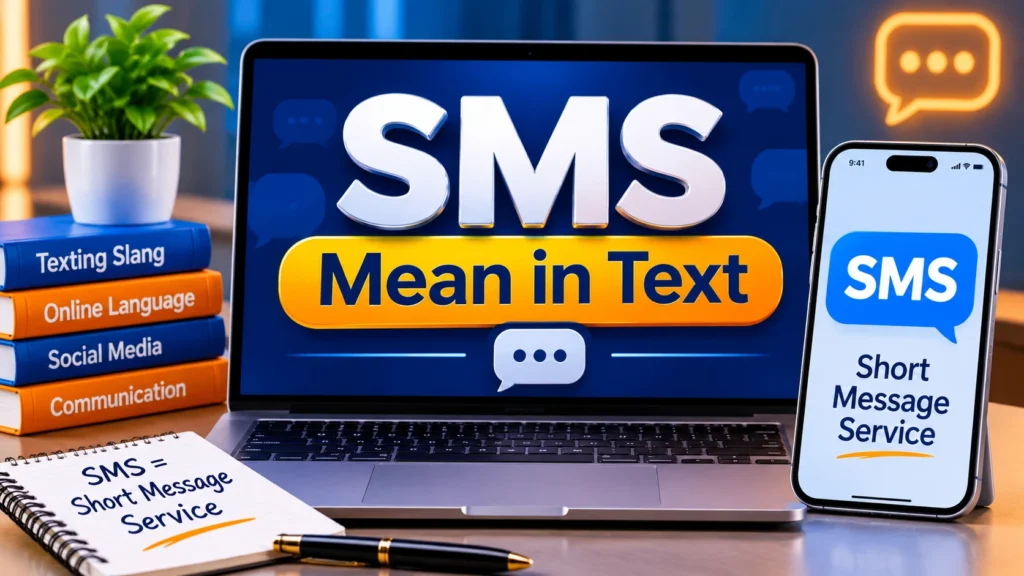
Quick Answer: SMS stands for Short Message Service. In texting, it refers to a regular text message sent from one mobile phone to another through a cellular network. For example, “SMS me when you arrive” means “Send me a text message when you arrive.”
What Does SMS Mean in Text?
SMS stands for Short Message Service, the standard technology used to send text messages between mobile phones.
In simple words, SMS means a traditional phone text message. It is different from internet-based messaging services such as WhatsApp, Instagram DMs, and Facebook Messenger.
For example, when someone says, “I sent you an SMS,” they mean they sent a regular text message to your phone number.
Unlike abbreviations that express emotions or reactions, SMS describes a messaging service. It is generally neutral, straightforward, and suitable for casual as well as professional communication.
SMS Full Form and Simple Definition
| Term | Meaning |
|---|---|
| SMS | Short Message Service |
| Full form | Short Message Service |
| Simple meaning | Regular mobile text message |
| Category | Technical abbreviation |
| Tone | Neutral and informative |
| Pronunciation | S-M-S |
How Is SMS Used in Everyday Texting?
People use SMS when they want to distinguish traditional mobile text messages from messages sent through internet-based applications.
For instance, someone might ask you to send an SMS instead of contacting them through a social media platform. Similarly, businesses use SMS to deliver appointment reminders, delivery updates, and security notifications.
Here are some common ways the abbreviation appears:
- Send me an SMS: Send me a regular text message.
- Check your SMS: Look at your phone’s text message inbox.
- I received your SMS: I received your text message.
- SMS verification: A verification code delivered through a text message.
In casual conversations, people may also use SMS as a verb. For example, “SMS me later” means “Text me later.”
This usage is informal but easy to understand.
What Does SMS Mean on Snapchat, Instagram, and TikTok?
If you see SMS mentioned on social media, its basic meaning usually stays the same: Short Message Service.
However, the situation in which it appears can explain why someone is talking about it.
- Snapchat: SMS may refer to a phone verification code or a regular text sent outside Snapchat.
- Instagram: It can refer to security codes, account notifications, or traditional phone messaging.
- TikTok: SMS may appear when discussing phone-number verification or login security.
- Facebook: It commonly refers to text-message notifications and account verification.
For example, if someone says, “I didn’t receive my SMS code,” they are talking about a verification message sent to their mobile number.
Remember that SMS is not a special Snapchat or TikTok slang expression. Its standard meaning remains the same across these platforms.
SMS vs. MMS vs. WhatsApp: What’s the Difference?
SMS, MMS, and WhatsApp are all connected to messaging, but they do not work in exactly the same way.
Understanding their differences helps you recognize which communication method someone is referring to.
| Messaging Type | Full Form | Main Purpose |
|---|---|---|
| SMS | Short Message Service | Traditional text messages |
| MMS | Multimedia Messaging Service | Sending pictures and other media through carrier messaging |
| Internet-based messaging and media sharing | ||
| DM | Direct Message | Private messaging on social platforms |
The biggest difference is how these services operate. Traditional SMS uses a mobile carrier’s network, while WhatsApp relies on an internet connection.
MMS is designed to support multimedia content, such as pictures and videos, through carrier messaging.
For example, if someone asks you to send an SMS, they generally want a regular phone text rather than a WhatsApp message.
Real-Life Examples of SMS in Text Conversations
Here are three realistic examples showing how people use SMS in everyday communication.
Example 1: Talking to a Friend
- Alex: I’m leaving now. I’ll be there in 20 minutes.
- Sam: Okay, send me an SMS when you arrive.
- Alex: Sure!
Meaning: Sam wants Alex to send a regular text message after arriving.
Example 2: Phone Verification
- Mia: I can’t log into my account.
- Jake: Did you check your SMS?
- Mia: Yes, I just received the verification code.
Meaning: Jake is asking Mia to check her phone’s text messages for a security code.
Example 3: Choosing Between Messaging Apps
- Emma: Can I send you the details on Instagram?
- Ryan: My notifications are off. Just SMS me instead.
- Emma: No problem!
Meaning: Ryan prefers receiving a traditional phone text instead of an Instagram message.
Does SMS Require an Internet Connection?
No. Traditional SMS does not require Wi-Fi or mobile data because it uses your mobile carrier’s network to deliver messages.
However, you generally need an active mobile service and cellular network coverage. This is one reason SMS is useful when someone cannot access internet-based messaging applications.
For example, if your mobile data stops working but your cellular service is available, you may still be able to send and receive regular SMS messages.
This is also why banks, websites, and other services often use SMS to deliver one-time passwords (OTPs), security codes, and important notifications.
Common Misunderstandings About SMS
Although SMS is a familiar abbreviation, people sometimes confuse it with other messaging terms.
Here are a few important differences:
- SMS is not internet slang: It is a technical abbreviation for Short Message Service, not an expression like LOL or OMG.
- SMS and MMS are different: SMS is designed for standard text messaging, whereas MMS supports multimedia content.
- SMS is not the same as a DM: A direct message is sent through a social or online platform, while traditional SMS is sent through a mobile carrier.
- Capitalization does not change its meaning: SMS, sms, and Sms generally refer to the same service in messaging contexts.
Context is still important. The same three letters can have different meanings in specialized industries, but Short Message Service is the relevant interpretation when discussing mobile texting.
When Should You Avoid Using SMS?
SMS is a perfectly acceptable term, but it may not always be the most natural choice.
In casual conversations with friends, saying “text me later” often sounds more conversational than “SMS me later.”
Similarly, when communicating with someone who is unfamiliar with technical abbreviations, using “text message” instead of SMS can make your meaning clearer.
In professional writing, SMS is appropriate when discussing mobile messaging systems, customer notifications, or verification services. However, spelling out Short Message Service the first time can help readers understand the abbreviation.
The important thing is to choose wording that suits your audience and the situation.
Read More: BYT Mean in Text: Meaning, Examples & Uses
SMS Meaning in Chat and Full Form
Readers also search SMS full form, SMS vs MMS and SMS meaning in chat. The SMS full form is “Short Message Service.”
- SMS vs MMS: SMS is plain text; MMS includes photos or videos.
- SMS vs iMessage: iMessage uses the internet; SMS uses your mobile network.
- SMS in chat: “I’ll SMS you” simply means “I’ll text you.”
Frequently Asked Questions About SMS
1. What does SMS mean in text messages?
SMS stands for Short Message Service. It refers to traditional text messages sent between mobile phones through a cellular network.
2. What does SMS me mean?
“SMS me” means “send me a text message.” Someone is asking you to contact them through regular mobile texting.
3. Is SMS considered texting slang?
No. SMS is a technical abbreviation rather than traditional internet slang. However, people commonly use it in everyday conversations about text messaging.
4. What does SMS mean from a girl or guy?
It has the same meaning regardless of who sends it. SMS refers to Short Message Service or a regular mobile text message. It does not automatically indicate romantic interest or a particular emotion.
5. What is the difference between SMS and MMS?
SMS stands for Short Message Service and is designed for traditional text messages. MMS stands for Multimedia Messaging Service and supports content such as pictures and videos through carrier messaging.
6. Why do I receive SMS verification codes?
Websites, banks, and applications may send verification codes through SMS to confirm your phone number or help protect your account. Never share an unexpected verification code with someone else.
What is the SMS full form?
The SMS full form is “Short Message Service,” a standard text message.
Final Thoughts
Understanding SMS mean in text is easy because the abbreviation has a straightforward meaning. SMS stands for Short Message Service and generally refers to a traditional text message sent through a mobile network.
Whether someone asks you to send an SMS, check a verification code, or contact them through regular texting, the meaning is usually the same. It is a neutral communication term rather than secret internet slang. Understanding the context helps you recognize when someone is referring to traditional texting instead of an online messaging application.

[…] Read More: SMS Mean in Text: Meaning, Examples & Usage […]